Here's the story behind it
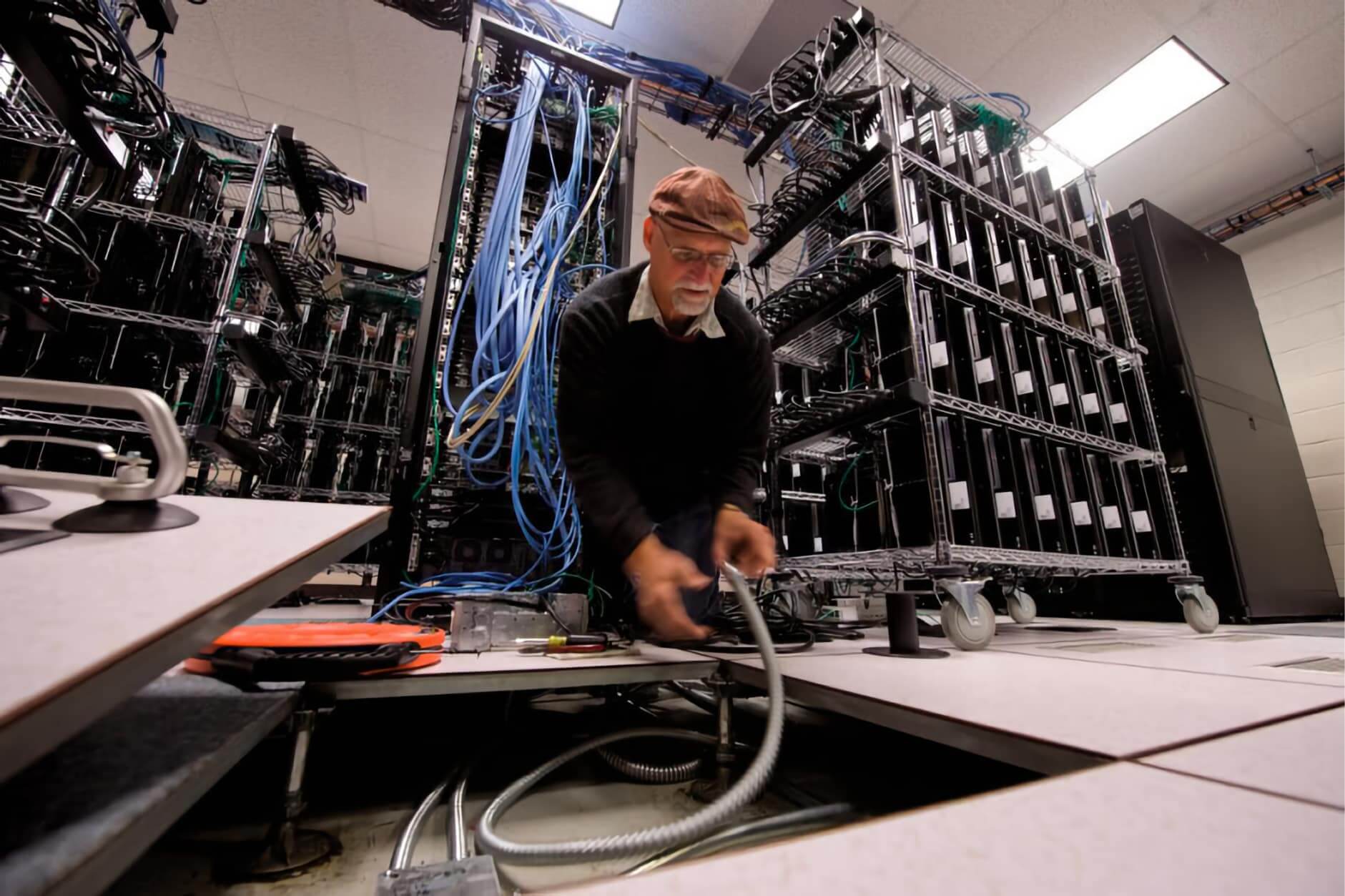
Ranked as the 33rd largest supercomputer in the world at the time, the "Condor Cluster" was built by the US Air Force Research Laboratory (AFRL) using 1,760 PlayStation 3 consoles. Situated in Rome, New York, the system was constructed for radar enhancement, processing satellite imagery, and researching AI.
The total cost of the cluster was estimated to be only about $2 million, just 5-10% of the cost of comparable supercomputers at the time, according to AFRL Director of High Power Computing Mark Barnell.
While the PlayStation 3 was priced at around $400 at the time, it's reported that the AFRL was otherwise looking at an expense of $10,000 per unit for comparable technology built with conventional computer parts.
The PlayStation 3 console was chosen for its efficiency in handling high-res graphics as well as its general affordability. The "Condor Cluster" would include 168 separate GPUs and 84 coordinating servers in a parallel array, capable of performing 500 trillion floating-point operations per second (500 TFLOPS).
While the PlayStation 3 was priced at around $400 at the time, it's reported that the AFRL was otherwise looking at an expense of $10,000 per unit for comparable technology built with conventional computer parts. The PS3 was also ideal for its ability to run Linux, although this feature was later removed due to security concerns, halting potential future projects of PS3-based clusters.
The success of the Condor Cluster highlighted the potential of gaming technology in scientific and military applications. The project demonstrated how consumer electronics, typically used for entertainment, could be repurposed for serious computational work – it would take another decade before GPUs would start becoming mainstream processors for building large language models, machine/AI training, and so forth. That gap looks even more striking today: a handful of modern high-end GPUs can now match the Condor Cluster's entire output, a reminder of just how fast compute has scaled since 2010.
Prior to the AFRL's project, Gaurav Khanna at the University of Massachusetts Dartmouth physics department built a similar machine using almost 200 PlayStation 3 consoles. His project focused on astrophysical simulations, showcasing the broader academic interest in leveraging gaming consoles for complex computational tasks.
The Condor Cluster didn't last much beyond its debut. By around 2015, the program was decommissioned: Sony's slimmer PS3 revisions dropped the ability to run Linux, and the incoming PS4 wasn't networkable the same way, leaving the Air Force with no way to replace failed consoles or expand the cluster further. Many of the retired PS3s were sold off or donated to smaller research clusters, with some reportedly finding their way to Khanna's own project. A handful even resurfaced on screen, as set dressing in the season 5 premiere of Person of Interest.