
Today we're looking back at AMD's last decade of processors, focusing on the flagship models while also touching on what each Ryzen series brought to the table.
We'll revisit the history behind each generation, then test how these CPUs perform today across a range of modern games to see where AMD made meaningful gains, and where progress came more slowly. It has been a remarkable journey from survival bet to market leader, and it's one well worth revisiting. Let's get into it.
Bulldozer: A Financial "Near-Death" Experience
AMD released its first Zen-based Ryzen processors in March 2017, but before that came AMD's Bulldozer architecture, which almost piledrivered, steamrolled, and excavated the entire company out of existence. Those were the core code names, by the way, a little pun for the early birds.
Anyway, the point is that by 2015, AMD was effectively on life support. The company's stock price had fallen to around $1.60 per share, and it was carrying roughly $2 billion in debt with very little cash on hand.

In the years leading up to Ryzen, Intel held over 90% of the enthusiast and server CPU market. AMD was essentially invisible in the high-performance space, surviving primarily on budget chips and semi-custom deals.
As we alluded to a moment ago, its previous architecture, Bulldozer, which the FX series was based on, was a massive failure. It was wildly inefficient, ran hot, and was soundly beaten by Intel's "Sandy Bridge" and "Haswell" chips. That left AMD with no truly competitive product for nearly six years.

People laughed at the power usage of Intel's Core i9-14900K, and rightfully so, but some went too far by calling it another Bulldozer. The comparison does not hold up. The 14900K, while it uses enough power to make an AI data center blush, is also incredibly fast. Bulldozer came with the power bill and none of the performance accolades.
The situation was so bad that many gamers today may not realize how close AMD came to collapse just a decade ago. In fact, if it were not for the deal to provide chips for the PlayStation 4 and Xbox One, it is highly likely AMD would not have survived long enough to release Ryzen. Those console royalties provided the steady cash flow needed to keep the lights on while Lisa Su and Mike Clark developed the "Zen" architecture.
If the first Ryzen CPUs in 2017 had performed like the FX series before them, AMD likely would not exist in its current form today. The company may have been forced into bankruptcy protection to restructure or liquidate.

That would have been a disastrous outcome for several reasons. AMD's right to produce x86 processors was tied to a cross-licensing agreement with Intel. In a bankruptcy or acquisition scenario, that license may have been terminated or legally challenged, making it nearly impossible for a buyer to continue producing CPUs.
Without Ryzen, Intel would have had little reason to innovate, and we know that at the time Intel was highly resistant to change. For example, before Ryzen launched, Intel's "flagship" consumer CPUs were stuck at 4 cores and 8 threads for nearly a decade. This might trigger some people, but we'll say it anyway: had AMD not released Ryzen the way it did, we might still be paying $350+ for 4-core processors today, as there would have been little competitive pressure to increase core counts or lower prices.
It really is hard to overstate how thin the margin for error was. AMD bet the entire company on the "Zen" architecture, and luckily for us, it worked.
The Original Zen: Ryzen 7 1800X

That brings us to 2017, with everything on the line. The Ryzen 1000 series launched with three models based on the original Zen architecture: the Ryzen 7 1700, 1700X, and 1800X. These Ryzen 7 CPUs offered 8 cores and 16 threads for as little as $330 at a time when Intel's 8-core option sat on its high-end desktop platform in the form of the Core i7-6900K for more than $1,000. That single launch effectively cut the price of high-performance computing by two-thirds overnight.
Of course, price was only part of the equation. While these new Ryzen parts were very affordable, they were also quite competitive in terms of performance. Gaming results were not amazing, and in many ways were underwhelming, as a lot of work still needed to be done to improve core and memory latency. Even so, the results were good enough, especially when paired with strong productivity performance.
These Ryzen CPUs offered 8 cores and 16 threads starting at $330 at a time when Intel's 8-core option was on its high-end desktop platform for more than $1,000.
AMD surpassed its internal goal of a 40% IPC improvement over the previous "Excavator" architecture, achieving roughly a 50% increase. That massive uplift is what got the company back on track. Helping matters was the introduction of AMD's SMT technology, similar to Intel's Hyper-Threading, which significantly boosted efficiency in multi-threaded tasks such as video rendering and 3D modeling.

Looking back at our 2017 gaming data, we see that the 7700K, Intel's flagship mainstream desktop part at the time, was 18% faster than the 1800X. So although the 1800X was 43% faster than the FX-8370 and far more power efficient, it still struggled to match Intel's Core i5 range, which at the time was limited to just 4 cores and 4 threads.
Today, games are more CPU demanding and make better use of a part like the 1800X, but even so, the 7700K was still up to 13% faster in our testing using the medium preset. That said, the Ultra data is generally more CPU demanding, as settings such as crowd density increase, and that reduced the margin to just 8%.

Overall, the initial wave of Ryzen 1000 series processors did enough for AMD to jam its foot in the door, letting Intel know it was not going away just yet.
Zen+: Ryzen 7 2700X - The Refinement That Made Ryzen Real

A year after releasing the disruptor that was Ryzen 1000, AMD was ready to unleash the refinement: the "Zen+" generation, which addressed many of the original platform's teething issues.
First, there was the price drop. The Ryzen 7 2700X, the new flagship model, launched at $330, significantly cheaper than the 1800X's $500 launch price. It was positioned directly against Intel's Core i7-8700K, essentially a 7700K with two more cores and 50% more L3 cache, and the result was very good.
Ryzen 7 2700X vs. Intel Core i7-8700K
| AMD Ryzen 7 | Intel Core i7 | |
|---|---|---|
| Processor | Ryzen 7 2700X = $320 | Core i7-8700K = $350 |
| Motherboard | ASRock Fatal1ty X470 Gaming K4 = $150 | ASRock Z370 Killer SLI/ac = $140 |
| Memory | G.Skill Sniper X DDR4-3400 16GB = $230 | G.Skill Sniper X DDR4-3400 16GB = $230 |
| Cooling | Corsair Hydro Series H115i Pro = $130 | Corsair Hydro Series H115i Pro = $130 |
| Platform Total | $830 | $850 |
| Graphics Card | GeForce GTX 1080 Ti = $750 | GeForce GTX 1080 Ti = $750 |
| Case | Corsair Crystal 570X RGB = $170 | Corsair Crystal 570X RGB = $170 |
| Power Supply | Corsair RM850x = $130 | Corsair RM850x = $130 |
| Storage | Corsair MP300 480GB = $150 | Corsair MP300 480GB = $150 |
| Extras Total | $1200 | $1200 |
| Total System Cost | $2030 | $2050 |
AMD also included its top-tier Wraith Prism RGB cooler, a major value add, as the 1800X had not included a cooler at all. Then there were the performance gains, driven by higher core clock speeds and improvements to memory and cache latency. In the case of the 2700X, the maximum boost clock was raised from 4 GHz to 4.3 GHz, an 8% increase, achieved by moving Zen+ from GlobalFoundries' 14nm process to the newer 12nm LP process.

A significant boost to gaming came from reduced L1, L2, and L3 cache latencies, all improved by roughly 8% to 16%. AMD also improved memory compatibility with a refined IMC, or Integrated Memory Controller, officially supporting DDR4-2933, up from DDR4-2666. That change made it much easier to reach DDR4-3200.
2nd Gen Ryzen CPUs
| Ryzen 7 2700X | Ryzen 7 2700 | Ryzen 5 2600X | Ryzen 5 2600 | |
| MSRP | $330 | $300 | $230 | $200 |
| Cores / Threads | 8 / 16 | 8 / 16 | 6 / 12 | 6 / 12 |
| Base Frequency | 3.7 GHz | 3.2 GHz | 3.6 GHz | 3.4 GHz |
| Boost Frequency | 4.3 GHz | 4.1 GHz | 4.2 GHz | 3.9 GHz |
| L2 Cache | 4MB | 4MB | 3MB | 3MB |
| L3 Cache | 16MB | 16MB | 16MB | 16MB |
| Memory Config | Dual-Channel | |||
| Max Mem Support | DDR4-2933 | |||
| TDP | 105 W | 65 W | 95 W | 65 W |
| Box cooler | AMD Prism RGB | AMD Spire RGB | AMD Spire | AMD Stealth |
Looking at our updated data, we can see these improvements boosted the 2700X's gaming performance by 11% to 12% over the 1800X on average, which was enough to finally catch the 7700K. The only problem for AMD was that Intel had already replaced the 7700K with the much faster 8700K, boosting performance by a substantial 24% to 27%, easily outpacing the 2700X.

Not to worry, though. The Ryzen 2000 series was another case of doing enough for AMD, and while the company was forced to slash prices to compete, it seemed happy enough just to be in the fight at the time. That led to the flagship 2700X hitting an all-time low price of just $130 in November 2019 at Micro Center.
It is also worth noting that although the Ryzen 2000 series ushered in the new 400 series chipsets, including X470, motherboards featuring those chipsets were not required to support 2000 series processors. Users could instead opt for cheaper 300 series boards. Intel's 8700K, on the other hand, was not an in-socket upgrade option for owners of 6000 or 7000 series processors, who required a brand-new motherboard.
Zen 2: Ryzen 7 3800X & Ryzen 9 3900X - The chiplet revolution begins

This is when things really started to heat up in the battle with Intel. AMD rolled out the Zen 2-based Ryzen 3000 series about a year later, in November 2019. Zen 2 was arguably the most important architectural shift in AMD's history, marking the move from a monolithic design to a chiplet design, and it was a game changer.
The chiplet design allowed AMD to separate the CPU into different pieces of silicon, an approach that helped massively with scaling and manufacturing costs, while enabling the company to bring 16-core/32-thread processors to the mainstream desktop.
As a result, we got the first Ryzen 9 processors in the form of the 12-core/24-thread Ryzen 9 3900X and 16-core/32-thread Ryzen 9 3950X. These CPUs were productivity monsters, easily crushing Intel's 8-core/16-thread Core i9-9900K.

When it came to gaming, though, they did suffer from scheduling issues, meaning gamers were often better served by Ryzen 5 and Ryzen 7 processors. These 6-core and 8-core models were also greatly improved thanks to roughly a 15% increase in IPC, achieved through architectural refinements such as a redesigned branch predictor and better cache handling. This effectively closed the single-core gap with Intel.

AMD also introduced "GameCache," which was really just a doubling of the L3 cache to 32 MB. It was branded as GameCache because it drastically reduced memory latency, which had been the primary bottleneck for gaming performance on previous Ryzen chips. It was becoming increasingly evident that L3 cache capacity was key to boosting gaming performance and often had a greater effect than simply adding more cores.
We wrote a feature back then that clearly demonstrated this, titled "How CPU Cores & Cache Impact Gaming Performance." The answer was cache. Despite using Intel CPUs for that demonstration, we were vindicated once AMD released the 5800X3D, though that did not happen until years later. This was a timely test because Zen 2 sparked a debate online about whether Ryzen 7 or Ryzen 9 processors were the better investment for gamers.

Some believed going from 8 to 16 cores would better "future-proof" their investment, but given how these CPUs were designed, that did not seem likely to us. We recommended gamers save the money and opt for an 8-core or even 6-core processor instead, and thankfully that advice has aged very well.
The 3800X was able to roughly match the performance of the Core i7-8700K, as seen in our updated testing, but Intel managed to stay one step ahead by tacking on two more cores and increasing L3 cache by 33%, from 12 MB to 16 MB, creating the Core i9-9900K. Based on our updated testing, the 9900K is 16% to 18% faster than the 3800X, but at over $500 the Intel CPU cost substantially more and, as we noted, could not hold a candle to AMD's Ryzen 9 parts for core-heavy productivity workloads.

Not only that, but more affordable models such as the Ryzen 5 3600 still received the full 32 MB L3 cache, leading to strong gaming performance that easily rivaled Core i5 models, all while costing just $200 at launch, then dropping as low as $150 just months later, whereas Intel pricing barely moved.
This helped make the Ryzen 3600 one of AMD's most popular CPUs to date, and for the money it was a ripper deal. In true AMD fashion, you could also simply slot it into virtually any AM4 motherboard released as far back as 2017, assuming the appropriate BIOS version was installed.
Ryzen 4000: The Laptop Push and OEM Detour

The Zen 2 generation also spawned the Ryzen 4000 series, one of the more unique entries in AMD's history. Unlike the 1000, 2000, and 3000 series before it, the 4000 series did not have a traditional big DIY desktop launch. Instead, it was primarily targeted at laptops, with mostly OEM-only availability on desktops.
The 4000 series was based on cut-down silicon. There was no 4800X, for example. These were mostly mobile and APU-style products designed for OEM channels. They used small monolithic designs and supported older features such as PCI Express 3.0.
In short, the Ryzen 4000 series was meant to be a proof of concept that AMD could win the laptop war, though we are not sure how well that ultimately went for them.
AMD Takes the Gaming Crown with Zen 3: Ryzen 7 5800X & 5800X3D

Zen 3 was a major ground-up redesign of the core logic, even though it remained on the same 7nm process as Zen 2. It debuted in November 2020, one year after the release of Zen 2. It delivered one of the largest single-generation jumps in x86 history and allowed AMD to finally overtake Intel in single-threaded performance, which had been Intel's last remaining stronghold.
AMD unified all 8 cores into a single complex with direct access to a massive 32 MB L3 cache pool. This unified design was the secret sauce that drastically reduced latency and boosted gaming frame rates. Not only that, but despite the performance gains, Zen 3 maintained incredible power efficiency. The 5800X, for example, delivered significantly more performance per watt than Intel's 10th and 11th Gen competitors.

There were a few drawbacks, particularly when discussing the Ryzen 7 5800X. For one, AMD increased the MSRP to $450, a $50 jump from the 3800X. This was the moment AMD shifted from being the budget alternative to the premium performance leader. By this, we do not necessarily mean the 5800X was faster than the Core i9-10900K, because it was not, but AMD was still able to claim that position as its Ryzen 9 parts were annihilating Intel in almost all productivity benchmarks.

The 5950X, for example, was around 60% faster than the 10900K in Cinebench, and believe us, Intel fans did not love Cinebench back then the way they do today thanks to E-core clusters.

The other downer for the 5800X was the fact that it did not come with a box cooler. Instead, AMD recommended at least a 240 mm AIO or a high-end air cooler, as the 8-core chip was notorious for running hotter than the 6-core 5600X or even the 12-core 5900X.

Now if we look at the updated gaming data, we see just how significant a release Zen 3 was. The 5800X is right there alongside the 10900K, with less than a 5% margin separating them. They were trading blows, and this was setting off alarm bells at Intel. But Zen 3 had one more party trick up its sleeve, and it was a big one. 3D V-Cache tech was first introduced by the Ryzen 7 5800X3D in April 2022.

It is a bit of a warped timeline, though, because by the time the 5800X3D arrived, Intel had already released its 12th Gen series, a very impressive CPU architecture in its own right.
In a way, the 5800X3D was more of a proof of concept, a way for AMD to test its 3D V-Cache technology, but it ended up becoming one of the company's most successful products ever. AMD essentially took one of its Zen 3 CCDs and stacked an additional 64 MB cache layer directly on top. Of course, how it achieved this was far more complex, but in simple terms, that was the end result.

In a recent revisit, we found that the 5800X3D was 1% to 5% faster than the 12900K when configuring Intel's Core i9 processor with high-speed DDR5 memory, or 19% to 25% faster when limiting the 12900K to the same DDR4-3600 memory used by the 5800X3D. By this point, AMD had well and truly put an end to Intel's gaming dominance, offering the same or better performance at considerably more affordable price points.

Putting a feather in AMD's cap was the fact that it achieved all this while remaining on the exact same AM4 socket released five years earlier, while Intel found itself on its fourth socket, and yes, we kid you not.
AM5 Arrives with Zen 4 and X3D Takes Over: Ryzen 7 7700X / 7800X3D

As they say, all good things must come to an end, and although AMD has continued to support and bin "new" models for the AM4 platform, Zen 3 was the last CPU architecture it would ever see. Zen 4 marked the transition to AM5.
The AM5 socket also marked the move from PGA, or Pin Grid Array, where the pins are on the CPU, to Land Grid Array, or LGA, the same socket technology used by Intel. This change allowed for better power delivery and more pins for modern connectivity. Along with the new socket, AMD also mandated DDR5 and PCIe 5.0 support. So unlike Intel's 12th and 13th generation, which supported both DDR4 and DDR5, Zen 4 required DDR5 memory. This initially made the platform expensive, but it did help push the industry toward the newer, faster memory standard.

Coming off the highs of the 5800X3D, the standard Zen 4 parts like the Ryzen 5 7600X and Ryzen 7 7700X were not that exciting, and with no increase to core counts, productivity performance was lacking compared to Intel.


Gaming performance, on the other hand, was strong, with a 13% improvement in IPC along with an 800 MHz+ increase in clock speeds thanks to the move to TSMC's 5nm node for the core dies. L2 cache capacity was also upgraded from 512 KB per core to 1 MB per core, giving a part like the 7700X 8 MB of L2 cache, whereas the 5800X3D had just 4 MB.

These upgrades allowed the standard 7600X and 7700X processors to match and even outpace the 5800X3D. The 7700X was also faster than the DDR5-enabled 12900K, and of course the 7700X also used DDR5 memory, though lower-clocked DDR5-6000 was the sweet spot.

Truth be told, the AM5 socket did not really get rolling until the release of the 3D V-Cache-enabled 7800X3D, which arrived seven months later and comfortably outclassed the Core i9-13900K for gaming, though it was much slower for productivity tasks. That is where the 7950X and 7950X3D took over.

By this point, AMD had also introduced the 65 W non-X parts like the Ryzen 5 7600 and Ryzen 7 7700, so the AM5 rollout was well underway. For new system builds it was a great option, but for those already invested in AM4, there was not enough on offer from AM5 to justify a platform upgrade.

Even looking at our updated testing, the 7700X is still rubbing shoulders with the 5800X3D, a part AMD is rumored to be bringing back soon, something we are sure has many AM4 owners excited. Compared to the DDR5-enabled 12900K, the 7700X is just 5% to 7% faster, so while it is faster for gaming, it is not much faster. In reality, they are comparable.
With almost a dozen retail AM5 models to choose from, there was a wide range of options available, from the affordable 7500F all the way up to the 7950X3D. In the end, it is fair to say Zen 4 was a success for AMD. It was a slow start that turned into a dominant victory. While it struggled at launch, it eventually helped propel AMD to record-breaking market share by late 2025.
Initially, Zen 4 was seen as a tough sell. In early 2023, reports from major retailers showed Zen 4 was being outsold by the previous generation Zen 3 by a ratio of nearly 5 to 1. The Ryzen 7 5800X3D remained so good and so affordable that many gamers chose to stay on the older AM4 platform rather than upgrade to the 7000 series, and this is one reason AMD has been so reluctant to bring it back.
Ryzen 8000: The APU Stopgap Generation

As a side note, the Zen 4 architecture also spanned the Ryzen 8000 series, mostly featuring APU models with Zen 4 cores and RDNA 3 graphics. Key models included the Ryzen 5 8500G, Ryzen 5 8600G, and Ryzen 7 8700G.
AMD Ryzen 8000G Series
| Ryzen 3 8300G | Ryzen 5 8500G | Ryzen 5 8600G | Ryzen 7 8700G | Ryzen 7 7700 | |
|---|---|---|---|---|---|
| Price | (OEM) | $180 | $230 | $330 | $330 |
| Release date | January 2024 (OEM) | January 31, 2024 | Jan 10, 2023 | ||
| Cores / Threads | 4 / 8 | 6 / 12 | 8 / 16 | 8 / 16 | 8 / 16 |
| Base Clock | 3.2 GHz | 3.2 GHz | 4.3 GHz | 4.2 GHz | 3.8 GHz |
| Boost Clock | 4.9 GHz | 5.0 GHz | 5.0 GHz | 5.1 GHz | 5.3 GHz |
| Core Config | 1 + 3 | 2 + 4 | 1 × 6 | 1 × 8 | 1 × 8 |
| L3 Cache | 8 MB | 16 MB | 16 MB | 16 MB | 32 MB |
| GPU | Radeon 740M (4 CUs) | Radeon 740M (4 CUs) | Radeon 760M (8 CUs) | Radeon 780M (12 CUs) | RDNA 2 CUs |
| GPU Clock | 2.6 GHz | 2.8 GHz | 2.8 GHz | 2.9 GHz | 2.2 GHz |
| NPU | No | No | Ryzen AI (up to 16 TOPS) | Ryzen AI (up to 16 TOPS) | No |
| PCIe Lanes | 14 PCIe 4.0 | 14 PCIe 4.0 | 20 PCIe 4.0 | 20 PCIe 4.0 | 28 PCIe 5.0 |
| TDP | 65 W | ||||
We also got binned versions without the iGPU in the 8700F and 8400F. All models featured a cut-down 16 MB L3 cache, so performance was not amazing, and for the most part you were better off skipping them in favor of Ryzen 7000 parts.
Zen 5 Underwhelms, X3D Delivers: Ryzen 9000 Series

AMD's most recent release, the Ryzen 9000 series is based on the Zen 5 architecture, and unfortunately this latest generation has been AMD's weakest offering since the original Zen debut back in 2017.
Whereas previous generations delivered IPC gains in the region of 10% to 20%, Zen 5 delivered less than that. Gains were claimed to be around 15%, but they were highly workload dependent. For gaming, Zen 5 was typically reported to be around 5% faster on average compared to Zen 4, quickly earning it the nickname "Zen 5%."
AMD Ryzen 7 7700X vs. Ryzen 7 9700X Specifications
| Ryzen 7 7700X | Ryzen 7 9700X | |
|---|---|---|
| Release date | Sep 27, 2022 | July, 2024 |
| Fabrication process | TSMC N5 FinFET (N6 I/O die) | TSMC N4 FinFET (N6 I/O die) |
| Cores / Threads | 8 / 16 | |
| Base clock | 4.5 GHz | 3.8 GHz |
| Boost clock | 5.4 GHz | 5.5 GHz |
| Core config | 1 × 8 | |
| Chiplets | 1 × CCD, 1 × I/O die | |
| L3 cache | 32 MB | |
| PCIe lanes | 28 PCIe 5.0 lanes | |
| Memory support | DDR5-5200 | DDR5-5600 |
| TDP | 105 W | 65 W |
The 9700X, for example, clocked just 2% higher than the 7700X, so couple that with weak IPC gains and no other tangible advantage, and you end up with single-digit gains. Those weak gains after a two-year wait were only part of the issue. The 9700X was also much more expensive, coming in at over a 20% premium.
Unfortunately, that was not the full extent of the issues. Unlike its predecessor, the 7700X, which launched with a 105 W TDP, the 9700X launched with a 65 W TDP. This made it incredibly easy to cool and very efficient, though it led some to believe it was significantly more power efficient than it really was, with some claiming it consumed 40% less power for slightly better performance.
In reality, core-heavy productivity workloads saw power usage drop by around 10% for a 2% increase in performance, meaning power efficiency improved by perhaps 15%. Certainly not nothing, but also a disappointing improvement after two years, and nowhere near enough to justify the price premium. Not only that, but gaming power efficiency went virtually unchanged, and in some cases the 9700X was less efficient than the 7700X.


All of this was disappointing, but what came next left us baffled. AMD's handling of disappointed Zen 5 reviewers can best be described as a masterclass in how not to handle a product launch. What should have been a victory lap while Intel was struggling with stability issues turned into a PR nightmare involving recalls, contradictory data, condescending blog posts, and blaming the operating system.
Just days before the July 2024 launch, AMD issued a global recall of all Ryzen 9000 units already sitting in warehouses. It officially cited "quality expectations," but it was later revealed to be a packaging typo. Some Ryzen 7 chips were labeled as Ryzen 9. As a result, the launch was delayed by two weeks. While a typo seems minor, it signaled to reviewers that the launch was rushed and disorganized, and that was just the tip of the iceberg.

When reviews finally went live in August, the consensus was underwhelming. Reviewers found the 9700X was only ~3% faster than the 7700X for gaming, ourselves included. Yet despite the vast majority of reviewers reporting similar findings, AMD pushed back, claiming its own internal testing showed double-digit gains of 10% to 15%. This created a he-said, she-said situation between AMD and reviewers. AMD essentially implied reviewers were testing the chips incorrectly.
AMD published a blog post on its official website explaining that the PC ecosystem is "complex," with thousands of variables, suggesting this was why reviewers got different data than AMD. Except, as we said, almost all reviews saw similar margins despite testing different games and configurations. Not only that, but humorously, in the same blog post AMD eventually had to walk back its own marketing claims, revising the original "6% faster than Intel" claim down to parity, which still is not even true, as the 14900K, even with the latest BIOS versions, is still around 6% faster than the 9700X.
You would think at this point AMD would quit while it was behind, but no, this is AMD we are talking about. As the drama escalated, AMD pivoted, blaming Microsoft Windows for the poor review scores. This led us to investigate AMD's claimed "Administrator Bug." Apparently Zen 5 suffered from a specific issue with Windows branch prediction, and to see the "true" performance, AMD claimed reviewers needed to run Windows in a hidden Administrator account mode.
This claim was met with mockery from the tech community, and many of us were quick to point out that normal users would never use a hidden admin account just to get advertised performance, but we investigated anyway. While there were some performance gains, they applied equally to Zen 4, meaning Zen 5 did not improve relative to Zen 4.

To AMD's credit, it worked with Microsoft to backport a branch prediction fix to Windows 11. The catch, however, was that while the update did improve Zen 5 performance by a further 5% to 10% in some games, it also improved Zen 4 and Zen 3 performance. The irony was that because the update helped older chips too, the gap between the 9700X and the older, cheaper 7700X stayed roughly the same. The 9700X did not look any better relative to the competition, everything just got faster.

In the end, Zen 5 has not been a great release for desktop users. General usage barely improved, and even today, benchmarking the 9700X with the updated 105 W TDP mode, it is just 4% faster than the 7700X in our testing. As we predicted in our day-one review, standard Zen 5 parts would only become worth buying, and therefore grow in popularity, once they reached rough pricing parity with Zen 4, and that happened some time ago.
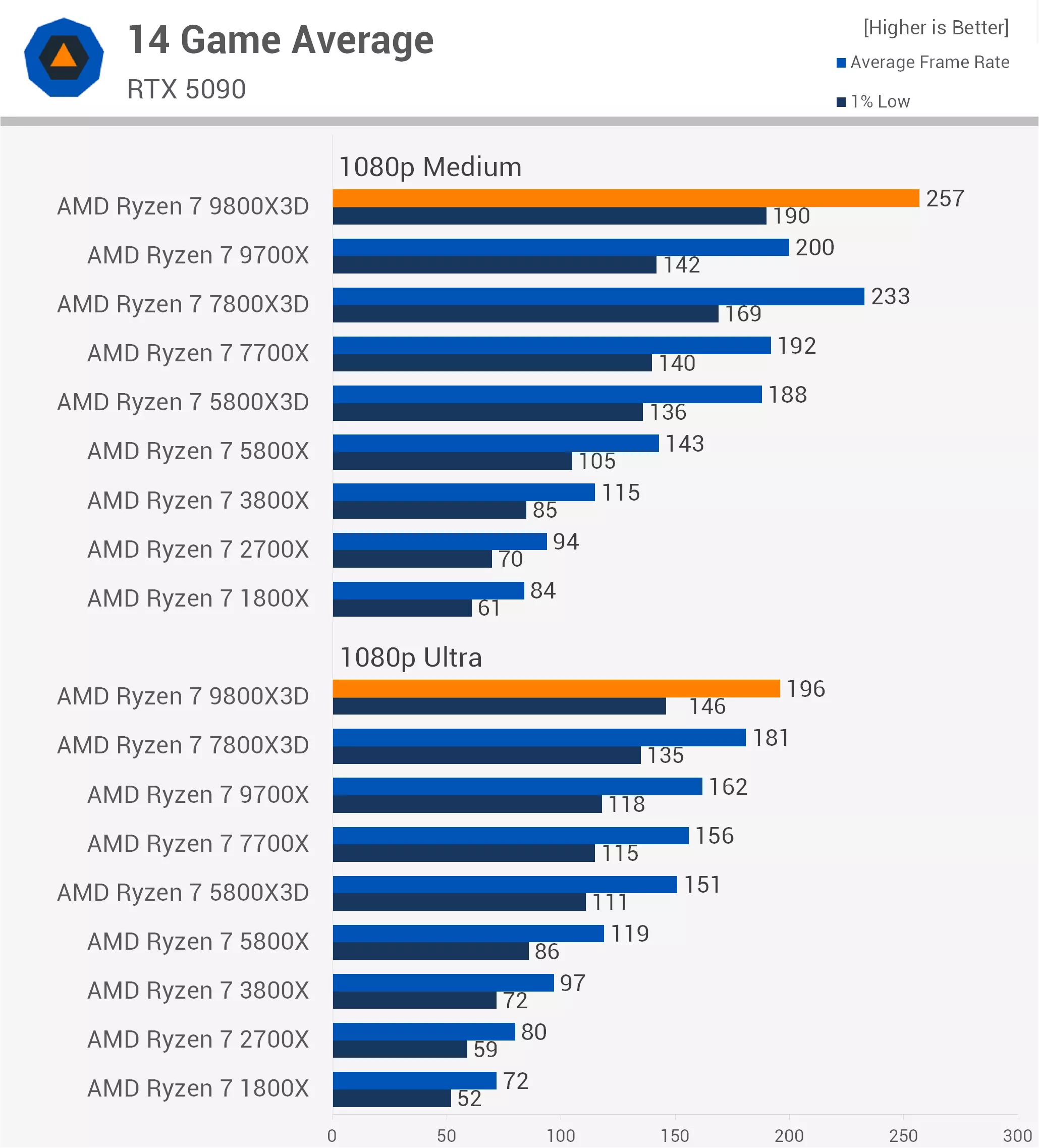
Despite the Zen 5% memes and initially weak sales, the 9800X3D was well received, and this is despite the fact that it is only single digits faster than the 7800X3D and therefore generally worse value. But as the world's fastest gaming CPU, many gamers simply could not get enough of the 9800X3D. We have been told sales of the 9900X3D and 9950X3D have been weak, though.

More recently, we got the 9950X3D2, the dual 3D V-Cache CCD version of the 9950X3D. It is an underwhelming product with a ridiculous price tag, so based on that, it should sell well.
Ryzen 9 9950X3D2 Dual Edition Specs
| Model | 9950X3D2 Dual Edition | 9950X3D | 9950X | 9800X3D |
|---|---|---|---|---|
| Price MSRP [$US] | $900 | $700 | $650 | $480 |
| Release Date | April 22, 2026 | March 12, 2025 | August 15, 2024 | November 7, 2024 |
| Cores / Threads | 16 / 32 | 8 / 16 | ||
| Base Clock | 4.3 GHz | 4.7 GHz | ||
| Boost Clock | 5.6 GHz | 5.7 GHz | 5.2 GHz | |
| L3 Cache [Total] | 192 MB | 128 MB | 64 MB | 96 MB |
| Box Cooler | N/A | |||
| Chiplets | 2 x CCD, 1 x I/OD | 1 x CCD, 1 x I/OD | ||
| Core Config | 2 x 8 | 1 x 8 | ||
| TDP | 200 W | 170 W | 120 W | |
Zen 6: The Next Big Reset
Looking to the future, we are expecting Zen 6 CPUs to land in late 2026 or early 2027. Codenamed "Morpheus," Zen 6 is shaping up to be a more significant architectural shift than the evolutionary Zen 5. While official details are still emerging, recent leaks and roadmap updates provide a fairly clear picture of what to expect.
In good news for upgraders, Zen 6 has been confirmed to continue using the AM5 socket, though it will almost certainly require a BIOS update for existing 600 and 800 series motherboards, which is a non-issue.

Zen 6 is being described as a "ground-up" redesign rather than a refinement. It will utilize TSMC's 2nm node for the CPU cores, or CCDs, and likely a 3nm node for the I/O die, or IOD.
For the first time since Zen 2, AMD is expected to increase both core count and L3 cache per chiplet. Leaks suggest 12 cores per CCD with 48 MB of L3 cache, allowing for a flagship 24-core / 48-thread desktop processor, and given what we have been hearing about Intel's next-generation Nova Lake CPUs, AMD will need to increase core counts.

Early engineering targets suggest Zen 6 parts could reach clock speeds of 6.3 to 6.4 GHz, with some optimistic rumors even pointing to 7 GHz. Combined with a projected 10% to 15% IPC gain, single-threaded performance could see a massive jump.
Native support for faster DDR5-8000 memory is also expected, along with a move toward "Chiplet 2.0," which uses 2.5D and 3D packaging to significantly reduce latency between cores and memory. There is a lot to get excited about based on what we are hearing, and that is true not just of AMD's next-generation CPUs, but also Intel's, so that is at least some good news.
If you enjoyed all the testing we put into this feature, please share it, subscribe to our newsletter to receive news of future articles like this one, and check out our TechSpot Elite subscription option for ad-free browsing and additional perks.