A brief explanation why
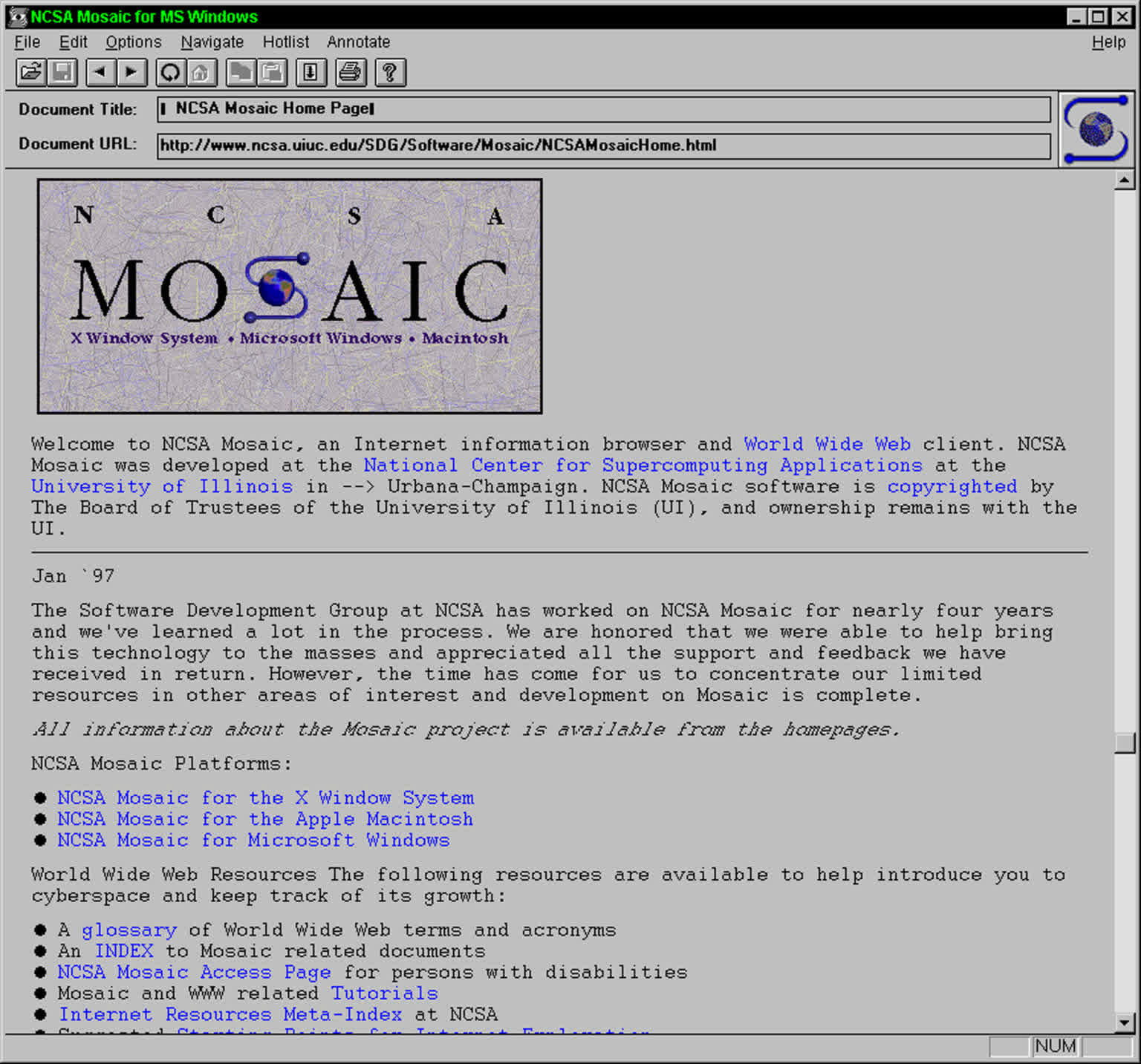
Mosaic was a groundbreaking web browser developed in 1993 at the National Center for Supercomputing Applications (NCSA) at the University of Illinois Urbana-Champaign. While it wasn't the first web browser, or even the first graphical one, Mosaic played a pivotal role in popularizing the World Wide Web and is widely regarded as the first browser to achieve broad mainstream use.
Development was led by Marc Andreessen and Eric Bina, with an early version of Mosaic for Unix appearing in early 1993. What set it apart wasn't simply graphics, but accessibility: Mosaic was relatively easy to install, offered a friendly point-and-click interface, and eventually became available across Unix, Windows, and Macintosh computers. That made exploring the Web far less intimidating for people outside universities and technical circles.
This was a major step forward from the way many people had previously experienced the Web. Earlier browsers included graphical projects such as ViolaWWW and Erwise, along with text-based software that presented links as numbered selections. Mosaic combined ease of use with a polished graphical interface and, crucially, could display images directly alongside text on a web page.
If you're wondering what came before Mosaic, here is TechSpot's trivia about the first web browser ever created.
By September 1993, Mosaic was available for the major computing platforms of the era: Unix, Microsoft Windows, and Macintosh. Its cross-platform availability helped expose a rapidly growing audience to something that was still remarkably new. At the beginning of 1993, the Web consisted of only a tiny collection of servers, but by the end of the year interest in the Web and Mosaic was spreading well beyond research institutions.
One of Mosaic's most important contributions was making the Web visually compelling. Earlier browsers often displayed images separately, while Mosaic helped establish the now-familiar concept of mixing text, links, and images within the same page. More than three decades later, modern browsers are vastly more sophisticated, but that basic idea of navigating richly formatted pages through clickable links remains fundamental to how we use the Web.
Mosaic's success also helped trigger the first great browser race. Andreessen left NCSA and in April 1994 joined Silicon Graphics founder Jim Clark to create Mosaic Communications, later renamed Netscape Communications. The company recruited several members of the Mosaic team and released an early version of Netscape later that year. Netscape quickly overtook Mosaic and became the dominant browser of the mid-1990s, setting the stage for its famous battle with Microsoft's Internet Explorer.
Mosaic had another connection to that browser war. NCSA licensed Mosaic technology to Spyglass, which in turn licensed browser technology to Microsoft for the original Internet Explorer. Mosaic itself was eventually discontinued in 1997, but by then its job was done: it had helped transform the Web from a relatively obscure academic system into a medium ordinary computer users could explore.
Today's browsers bear little technical resemblance to Mosaic, but most of the conventions it helped popularize remain: graphical pages, inline images, clickable hyperlinks, bookmarks, navigation controls, and more. In that sense, Mosaic wasn't the browser that invented the Web. It was the browser that helped the world discover it.