For years, we've been hearing rumors that Intel's big Battlemage gaming GPU, presumably the B770, is just around the corner. Of course, it never arrived. We got the Intel Arc B580 in late 2024, followed by the cut-down B570 in early 2025, but that was it.
Intel never expanded its Arc Battlemage lineup the way many had hoped. That was until recently, although not in a way that will excite most gamers, because, as you probably guessed, Intel has shifted its efforts toward AI.
As a result, we now have the Arc Pro B70: big Battlemage in all its glory, just not for gamers.
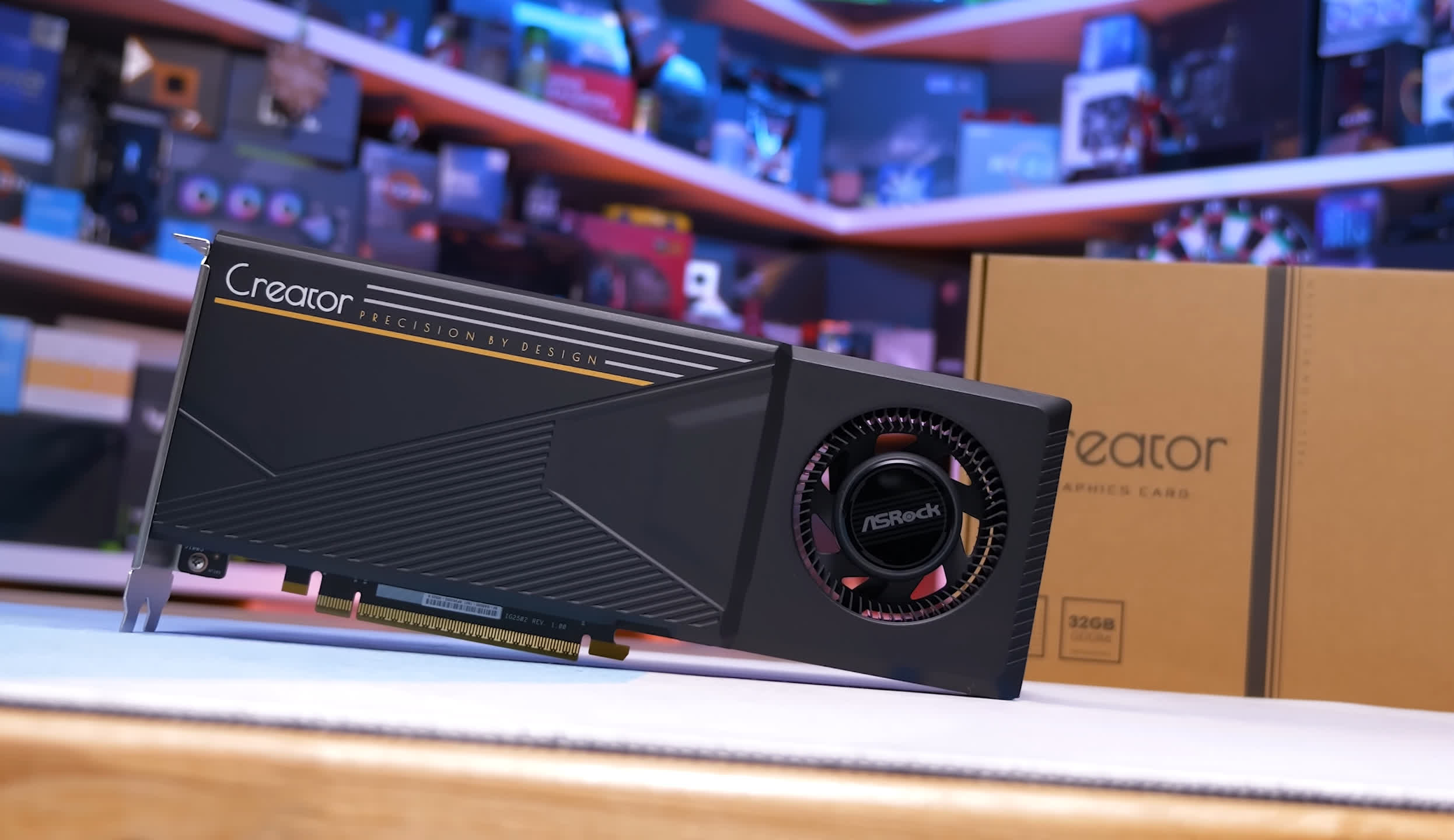
The Arc Pro B70 packs 32GB of GDDR6 memory, and as a result the MSRP has been set at $1,000. So is it a pointless product for gaming? Possibly. Still, while it's not something we'd recommend buying for gaming, we're very interested to see how it performs in games. After all, this is still a Battlemage GPU with full gaming driver support.
It's also a product that likely would have ended up in the hands of gamers if not for the AI boom. And who knows, if that trend cools off, Intel could eventually release a B770 variant with less VRAM.
So what exactly is the Arc Pro B70? In short, it's a larger version of the B580 that we're already familiar with. While the B580 packed 20 Xe2 cores, the B70 increases that count to 32, a 60% increase. Core boost frequency has also been raised by 5% to 2.8 GHz. It's still manufactured by TSMC using the N5 process, just on a larger die.
| Specification | Intel Arc B570 | Intel Arc B580 | Intel Arc Pro B70 |
| Price (US MSRP) | $220 | $250 | $950 |
| Release Date | Jan 16, 2025 | Dec 12, 2024 | Q1 2026 |
| Process | TSMC N5 | ||
| Core Config (Xe2 Cores) |
18 Xe2 | 20 Xe2 | 32 Xe2 |
| GPU Boost Clock | 2500 MHz | 2670 MHz | 2800 MHz |
| Memory Capacity | 10 GB | 12 GB | 32 GB |
| Memory Speed | 19 Gbps | ||
| Memory Type | GDDR6 | ||
| Bus Type | 160-bit | 192-bit | 256-bit |
| Total Board Power | 150 W | 190 W | 230 W |
As a result, the B70 also features 33% more L2 cache, increasing the total to 16MB. Combined with a 256-bit memory bus, memory bandwidth has increased by 33% to 608 GB/s. Another significant upgrade comes in the PCIe configuration. While the B580 was limited to a PCI Express 4.0 x8 interface, the B70 supports PCIe 5.0 with a full x16 connection.
On paper, that should make the B70 noticeably faster than the B580 for gaming. However, the B580 wasn't exactly fast by modern standards. It launched before the current generation of AMD and Nvidia GPUs, and even then Intel was already trailing the competition.
So, had Intel released the Arc B770, it would likely have looked very similar to the B70, perhaps with half the VRAM and potentially higher clock speeds. With that in mind, let's see where a theoretical B770 might land in today's market. To find out, we've tested a dozen games at 1080p and 1440p, so let's get into the benchmarks.
Test System Specs
| CPU | AMD Ryzen 7 9800X3D |
| Motherboard | Gigabyte X670E Master (BIOS F42b), Resizable BAR Enabled |
| Memory | G.Skill Trident Z5 RGB DDR5-6000 CL30 (CL30-38-38-96) |
| ATX Case | MSI Prospect 700R |
| Power Supply | Kolink Regulator Gold ATX 3.0 1200W |
| Storage | TeamGroup T-Force Cardea A440 M.2 PCIe Gen4 NVMe SSD 4TB |
| Operating System | Windows 11 25H2 |
| Display Drivers | Intel Graphics Driver 32.0.101.8517 Nvidia GeForce Game Ready Driver 610.62 WHQL AMD Radeon Adrenalin 26.6.2 WHQL |
Benchmarks
Clocks and Temps
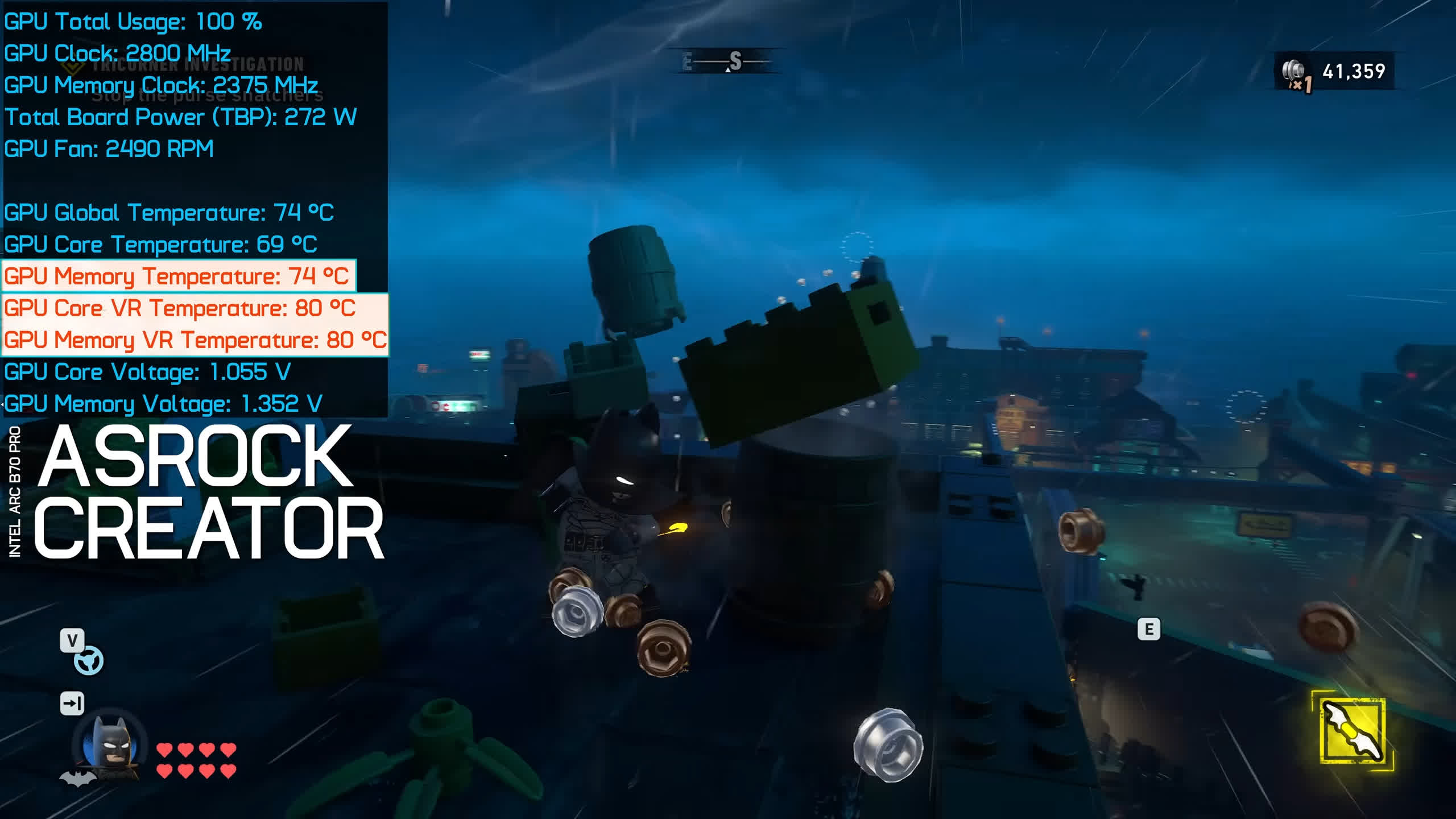
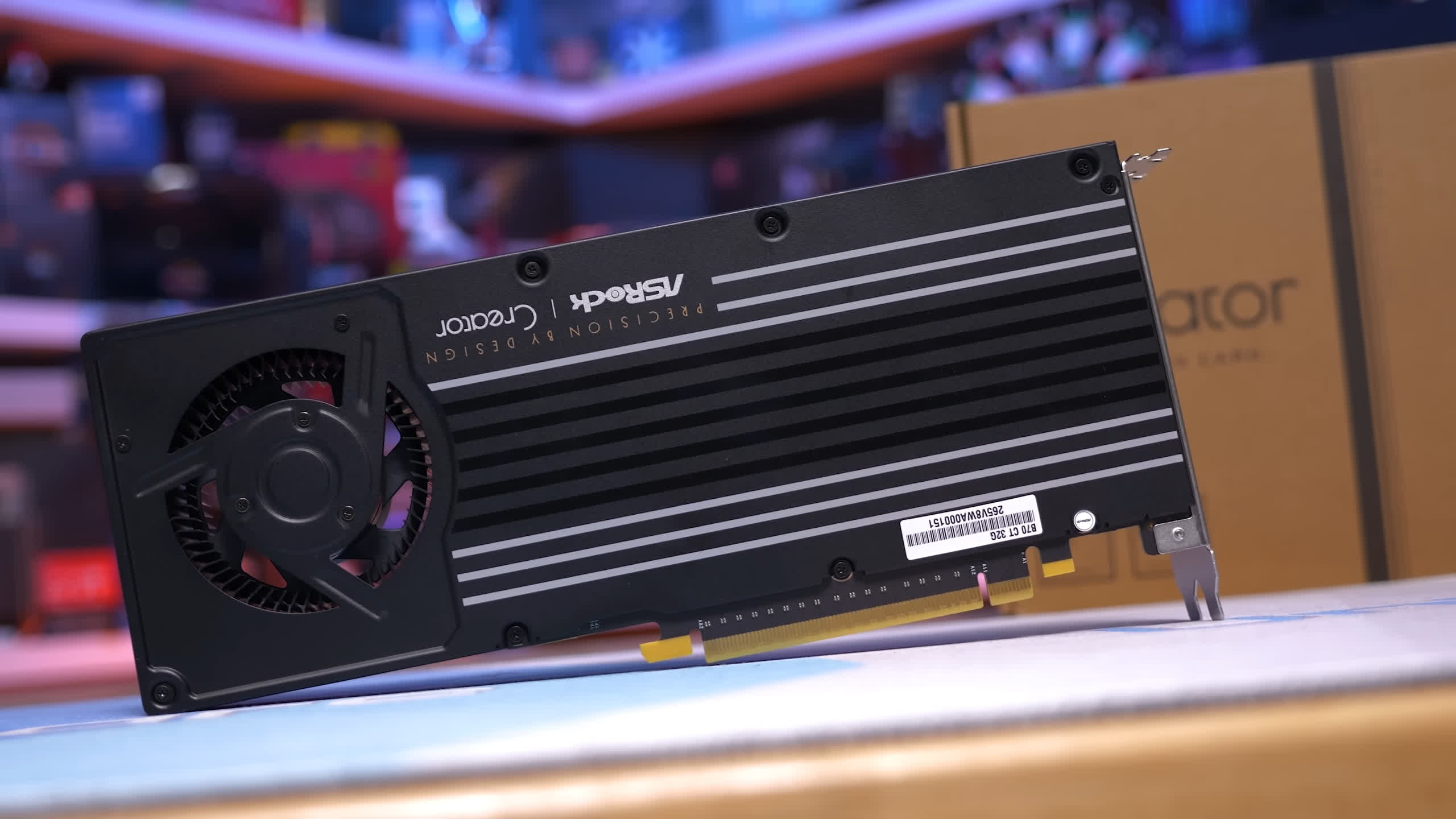
First, here's a quick look at how the ASRock Arc Pro B70 Creator 32GB graphics card performs, noting that to record footage on this GPU we had to use OBS on the same PC running the game. Apparently, Intel no longer offers screen recording support in its Arc software.
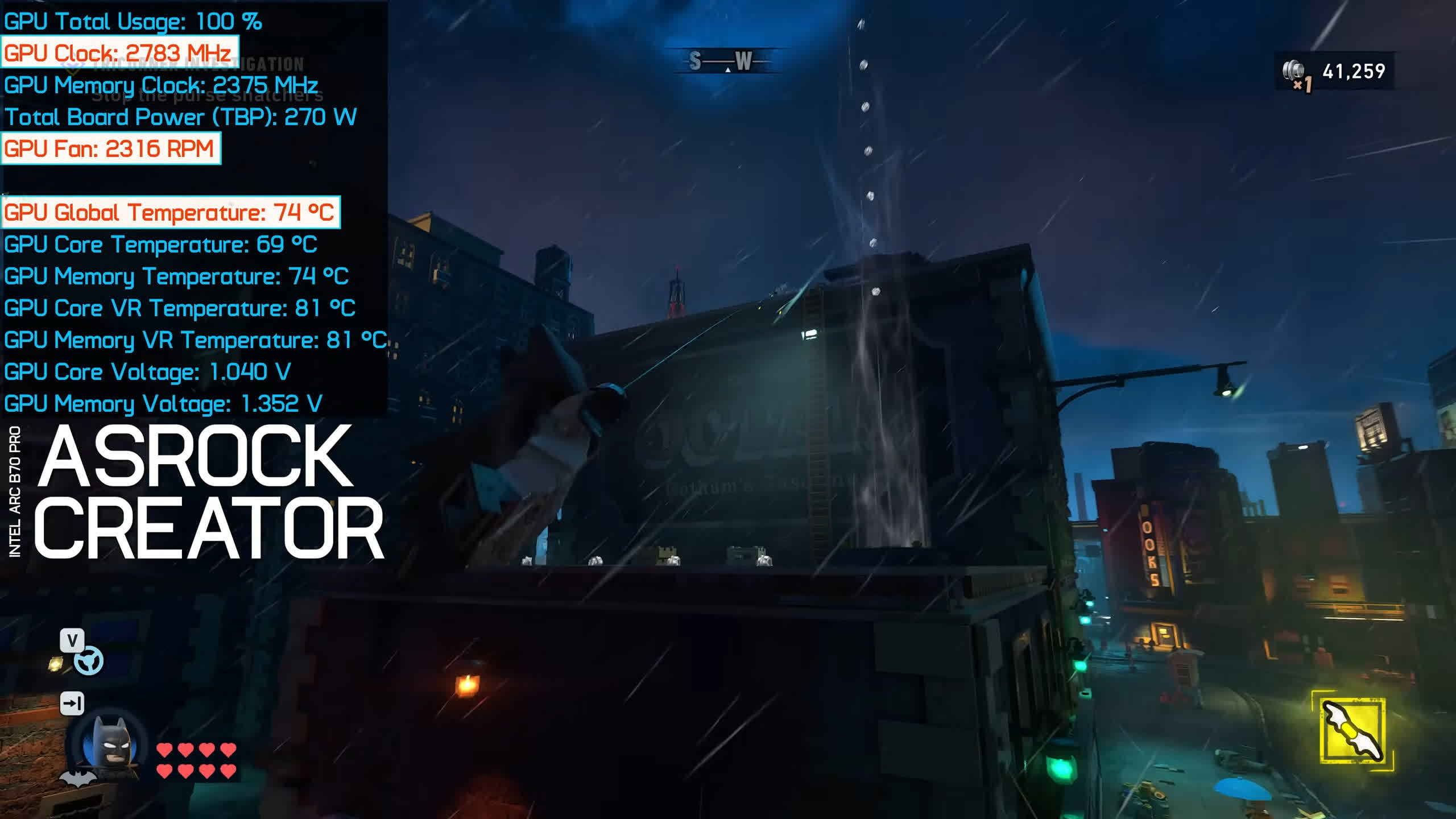
Anyway, the B70 maintained a core clock frequency of 2.8 GHz, with core temperatures peaking at 74°C. Achieving that required a fan speed of around 2,500 RPM. The ASRock Creator uses a single blower-style fan, so it is quite loud under load. Memory temperatures also peaked at 74°C, while the VRM components reached up to 82°C.
With that out of the way, let's get into the blue bar graphs.
Forza Horizon 6
Starting with Forza Horizon 6 using the Extreme quality preset, we see that the B70 is 34% faster than the B580 at 1080p and 39% faster at 1440p, representing a substantial performance uplift.
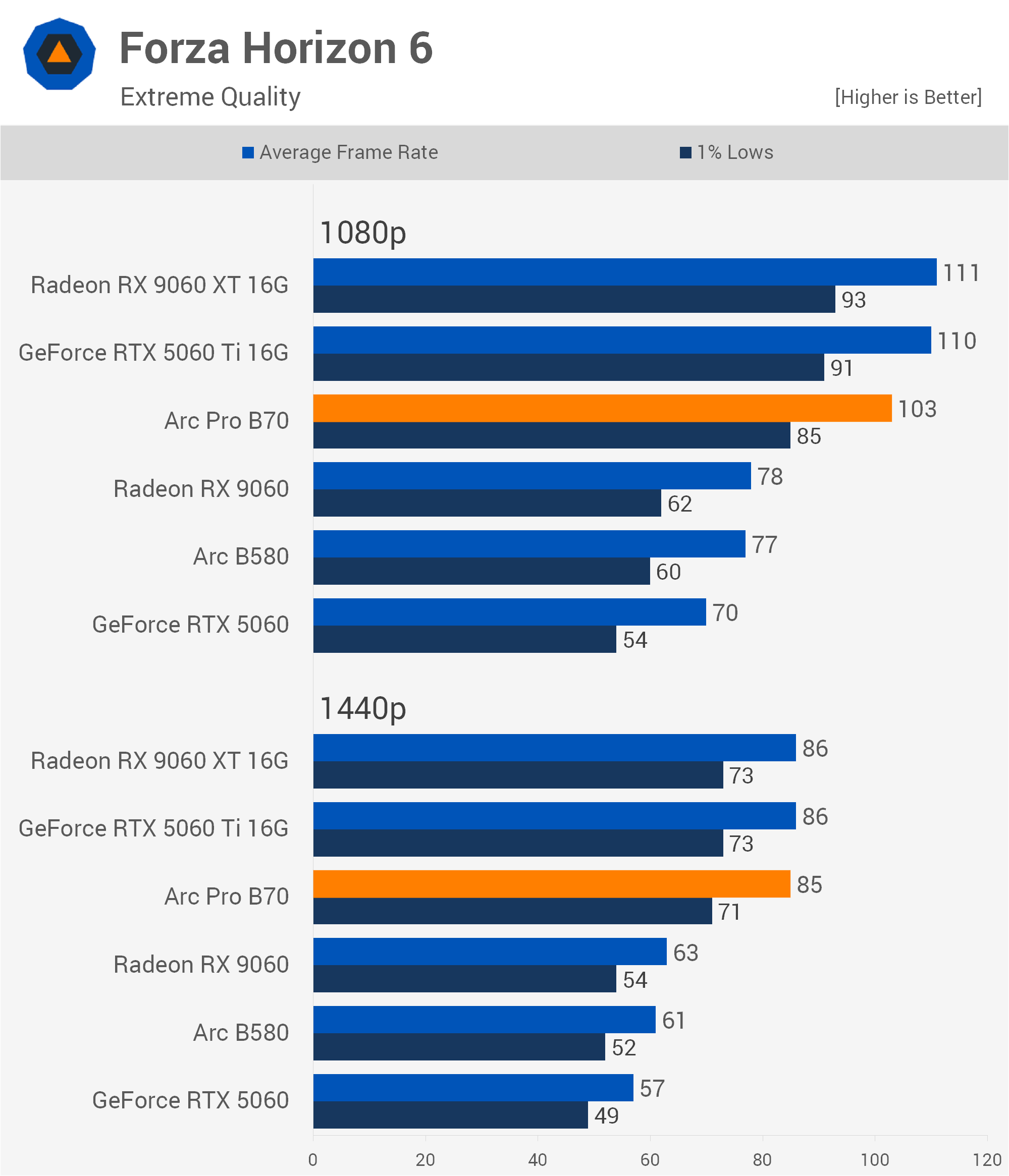
That said, we're only looking at RTX 5060 Ti and RX 9060 XT-class performance at 1440p, while the workstation-focused Arc GPU was up to 7% slower at 1080p. It's worth noting that the B580 was already a considerably larger die than competing AMD and Nvidia parts, whereas the B70 is more comparable in size to the RX 9070 XT and RTX 5070 Ti. That's not a particularly strong result for Intel, especially given that these GPUs are manufactured by TSMC rather than produced in-house.
Resident Evil Requiem
In Resident Evil Requiem with settings maxed out, the performance gap between the two Arc cards narrows significantly. Here, the B70 is 21% faster at 1080p and 23% faster at 1440p.
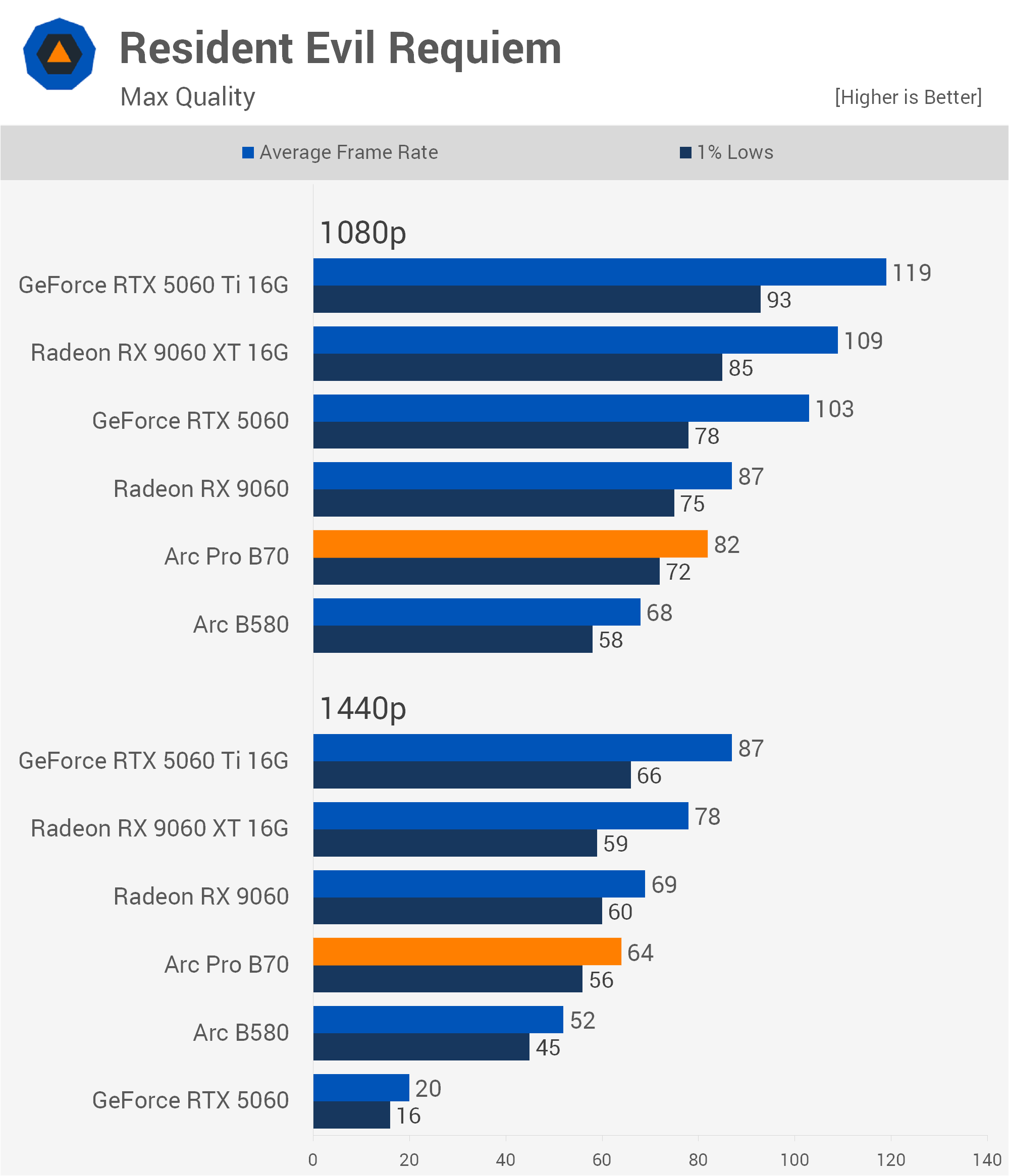
The more interesting story is the spectacular collapse of the baseline RTX 5060 at 1440p, where performance falls to a cinematic 20 fps due to severe VRAM limitations. While the Arc GPUs appear to suffer from some driver overhead at 1080p, their 12GB-plus memory configurations help maintain much more stable performance at higher resolutions.
Spider-Man 2
Next we have Spider-Man 2 running with the Very High settings, and here we witness a fork in the road for Intel's lineup. The B70 is a staggering 92% faster than the B580 at 1080p and 84% faster at 1440p. The lower-tier B580 completely falls off a cliff, managing just 52 FPS at 1080p.
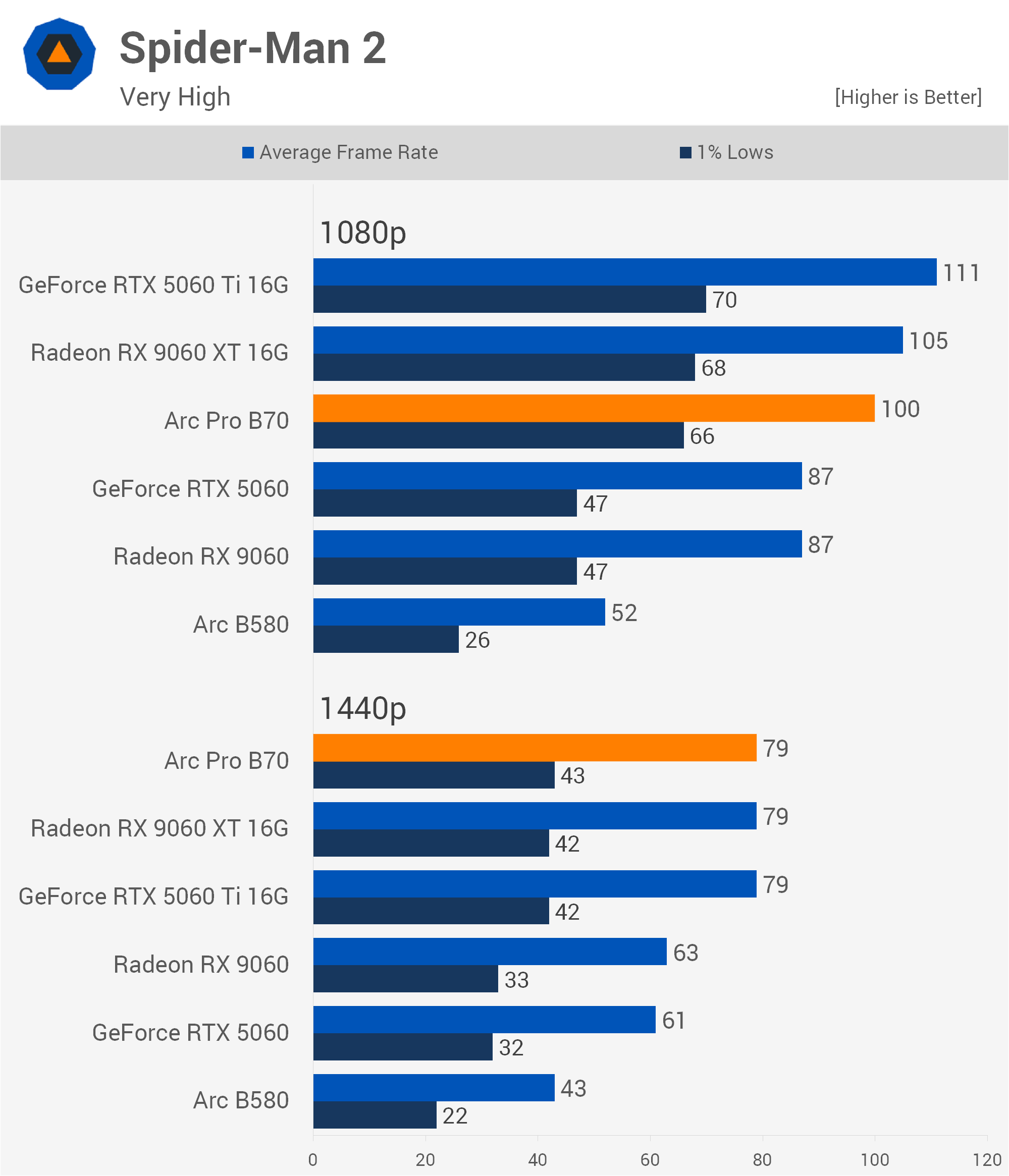
Initially, we thought the issue might be PCI Express bandwidth, given that the B70 uses a full PCIe 5.0 x16 interface. However, manually forcing the B70 down to PCIe 3.0 x8 only reduced performance by around 10%, still leaving it far ahead of the B580 despite operating with significantly less PCIe bandwidth.
The other possibility is VRAM, but the B580 has considerably more memory than the RX 9060 and RTX 5060, and those cards have no trouble here. The B70 also used only around 11 to 11.5GB of VRAM at 1440p in this test, so the B580 should be more than adequate.
So we're at a bit of a loss here. We don't know why the B70 performs so much better than the B580, or perhaps more accurately, why the B580 performs so poorly. It's almost as if the overhead issue we previously observed with the B580 silicon has been resolved with the B70.
Crimson Desert
With Crimson Desert tested using the Cinematic quality preset and ray tracing disabled, the B70 delivers a 35% performance advantage over the B580 at 1080p, with that margin growing to 41% at 1440p.
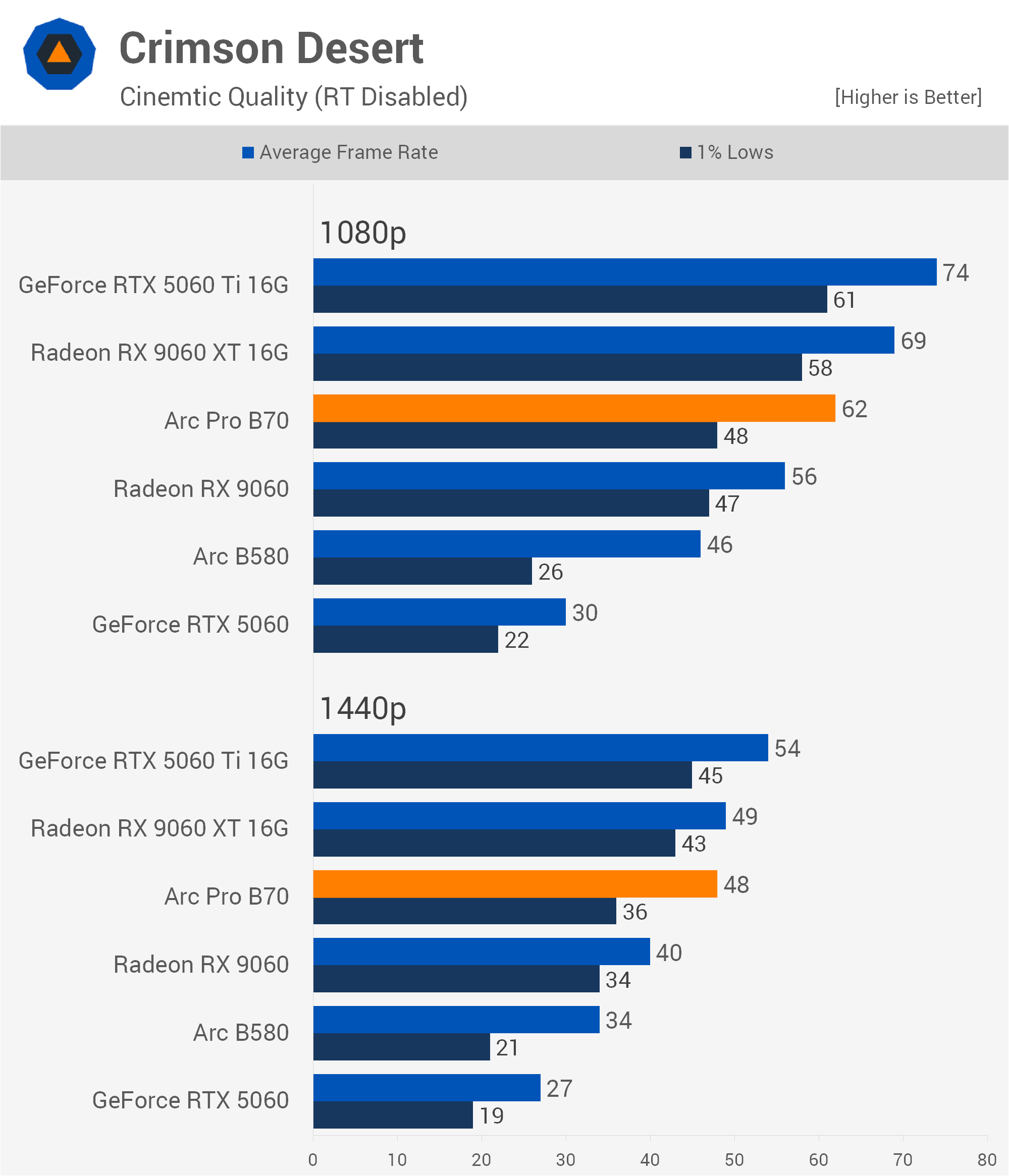
The most interesting result here is the baseline RTX 5060, which completely chokes on this demanding preset, likely running into a severe VRAM limitation and dropping to an unplayable 30 FPS at 1080p and 27 FPS at 1440p. The B70 faces no such issues, comfortably distancing itself from the lower tier while closing in on the RX 9060 XT.
Cyberpunk 2077: Phantom Liberty
In Cyberpunk 2077: Phantom Liberty using the Ultra quality preset, the B70 outperforms the B580 by 30% at 1080p and 32% at 1440p.
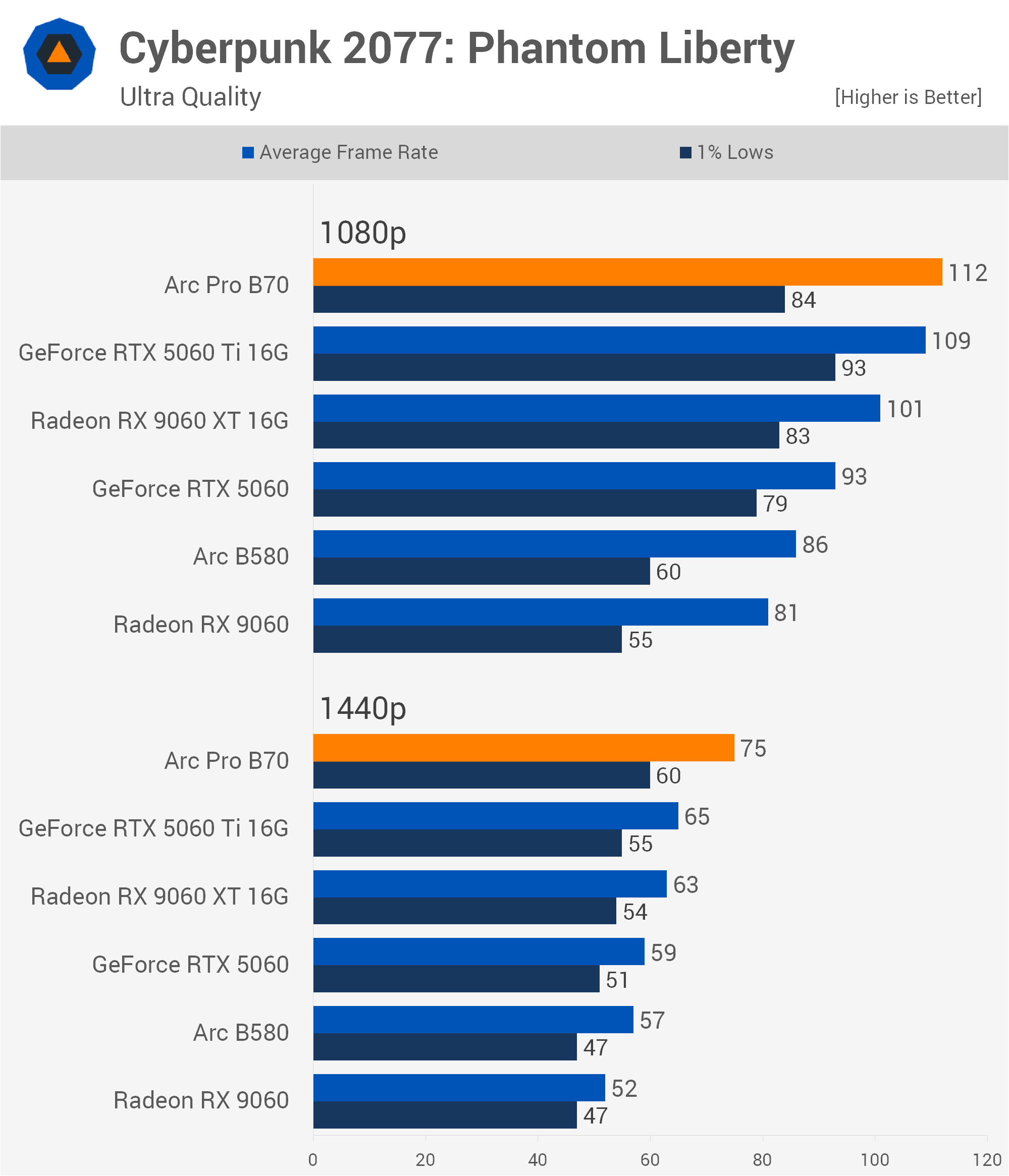
While Cyberpunk has historically favored Nvidia hardware, the B70 pulls ahead at 1440p, beating the RTX 5060 Ti by a 15% margin. Even the budget-oriented B580 performs well here, comfortably outperforming the standard RX 9060 at both resolutions.
Marvel Rivals
Turning to Marvel Rivals using the Medium quality preset, the B70 maintains a 40% lead over the B580 at 1080p and a 42% lead at 1440p.
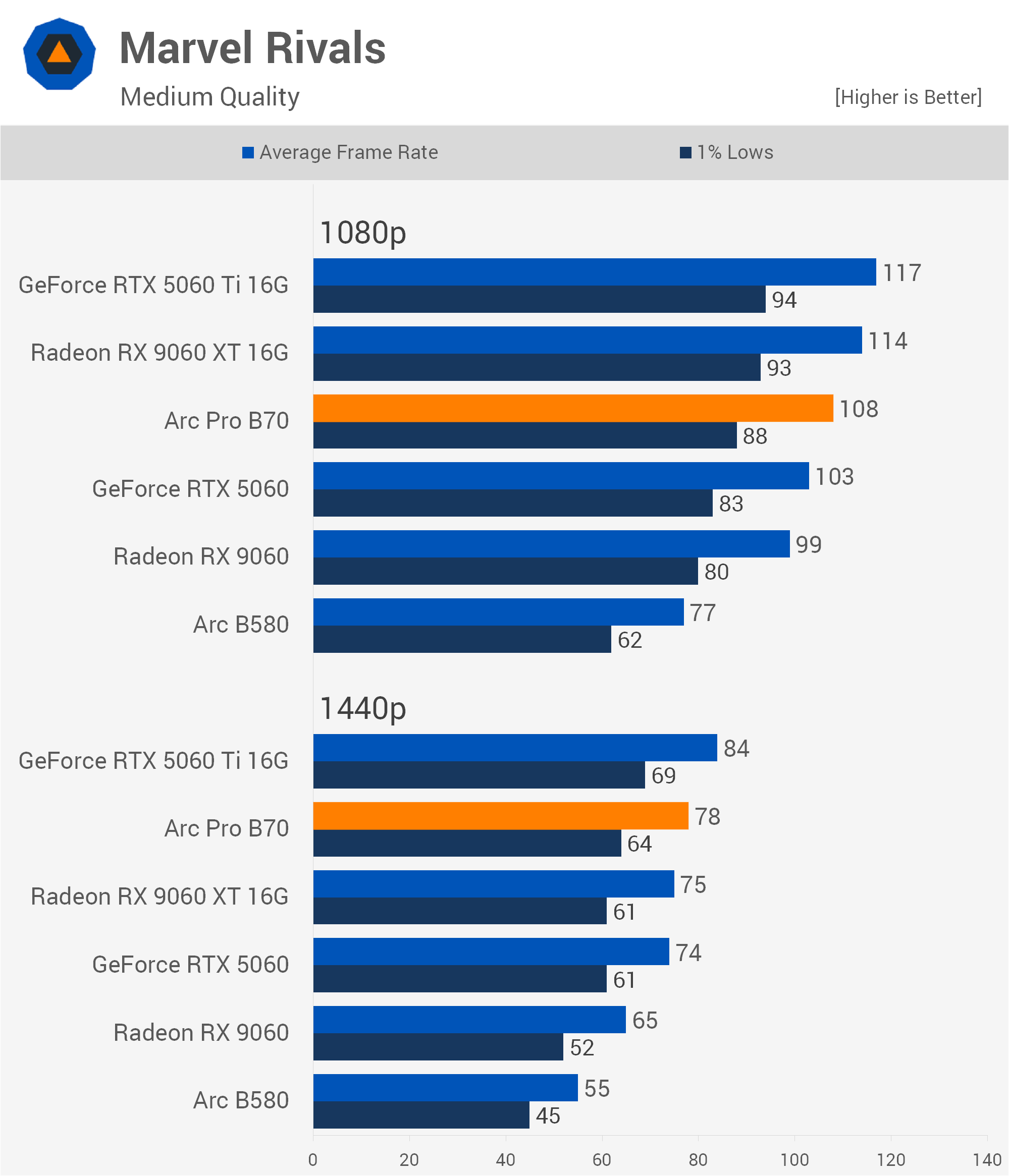
Still, it was slower than both the RX 9060 XT and RTX 5060 Ti at 1080p, and even at 1440p it trailed the 5060 Ti by a 7% margin.
Indiana Jones and the Great Circle
For Indiana Jones and the Great Circle running on the Supreme preset, the frame rates are impressive. The B70 is 39% faster than the B580 at 1080p and 33% faster at 1440p.
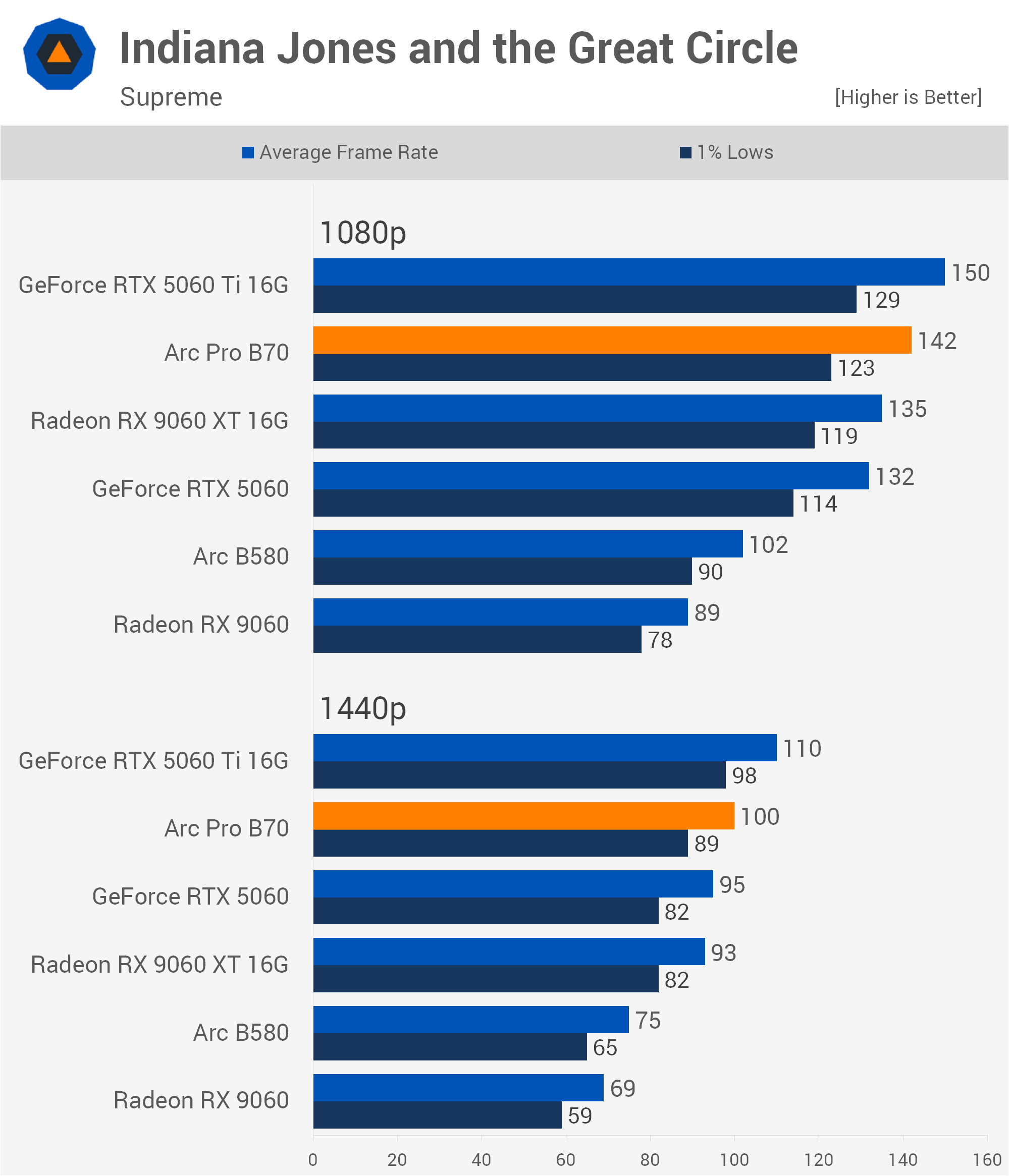
As a result, the B70 comfortably beats the RX 9060 XT across the board and sits directly behind the RTX 5060 Ti. Even the entry-level B580 outpaces the standard RX 9060 by roughly 15% at 1080p.
Borderlands 4
Next up is Borderlands 4 using the Very High settings, and here we see strong architecture scaling for Battlemage. The B70 is 39% faster than the B580 at 1080p and 38% faster at 1440p.
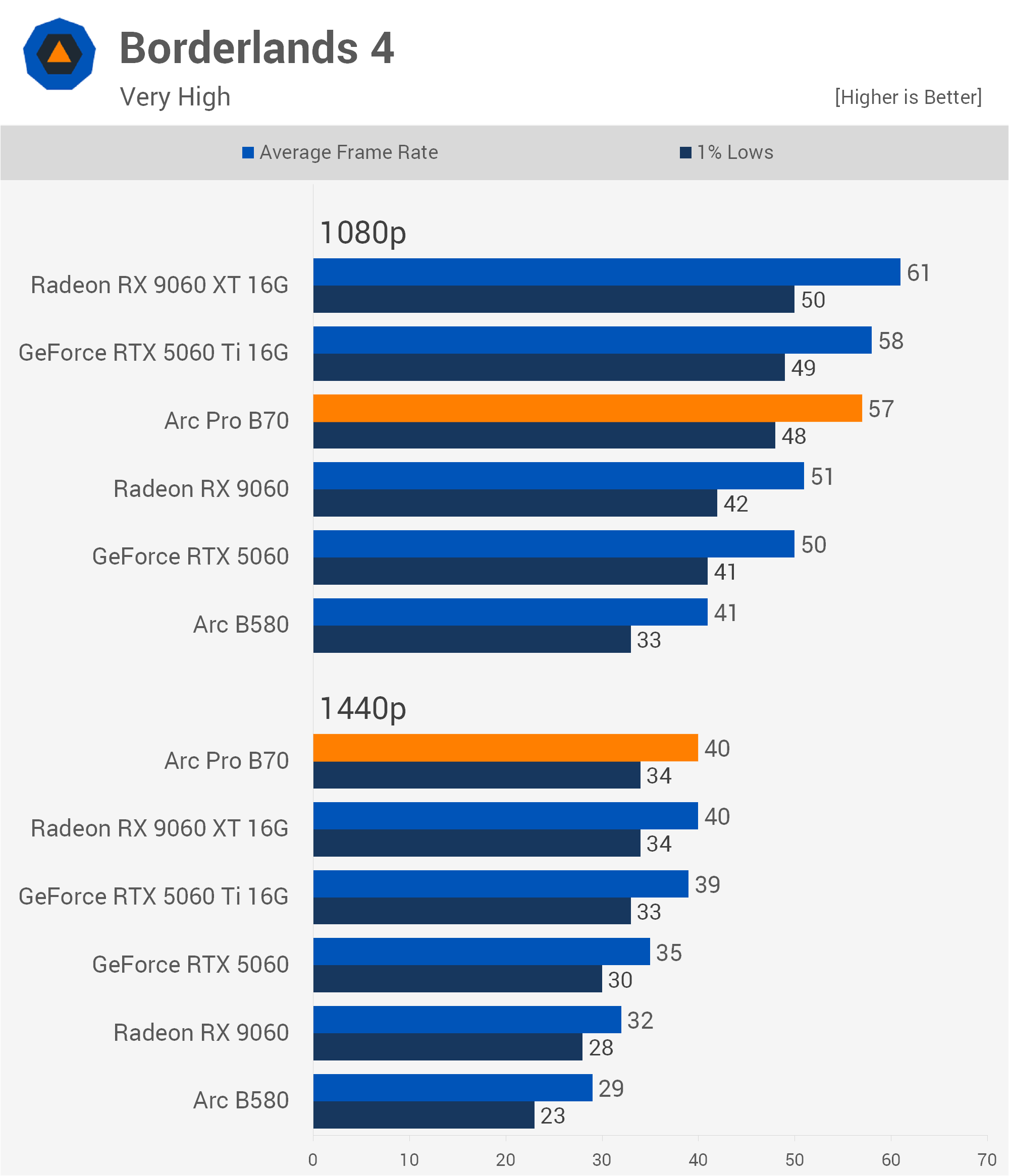
At 1440p, the B70 actually climbs to the top of the chart, tying the RX 9060 XT while beating the RTX 5060 Ti.
Cities: Skylines II
Looking at Cities: Skylines II using the Medium quality preset, Intel manages to walk away with a victory. The B70 was 43% faster than its smaller sibling at 1080p and 45% faster at 1440p.
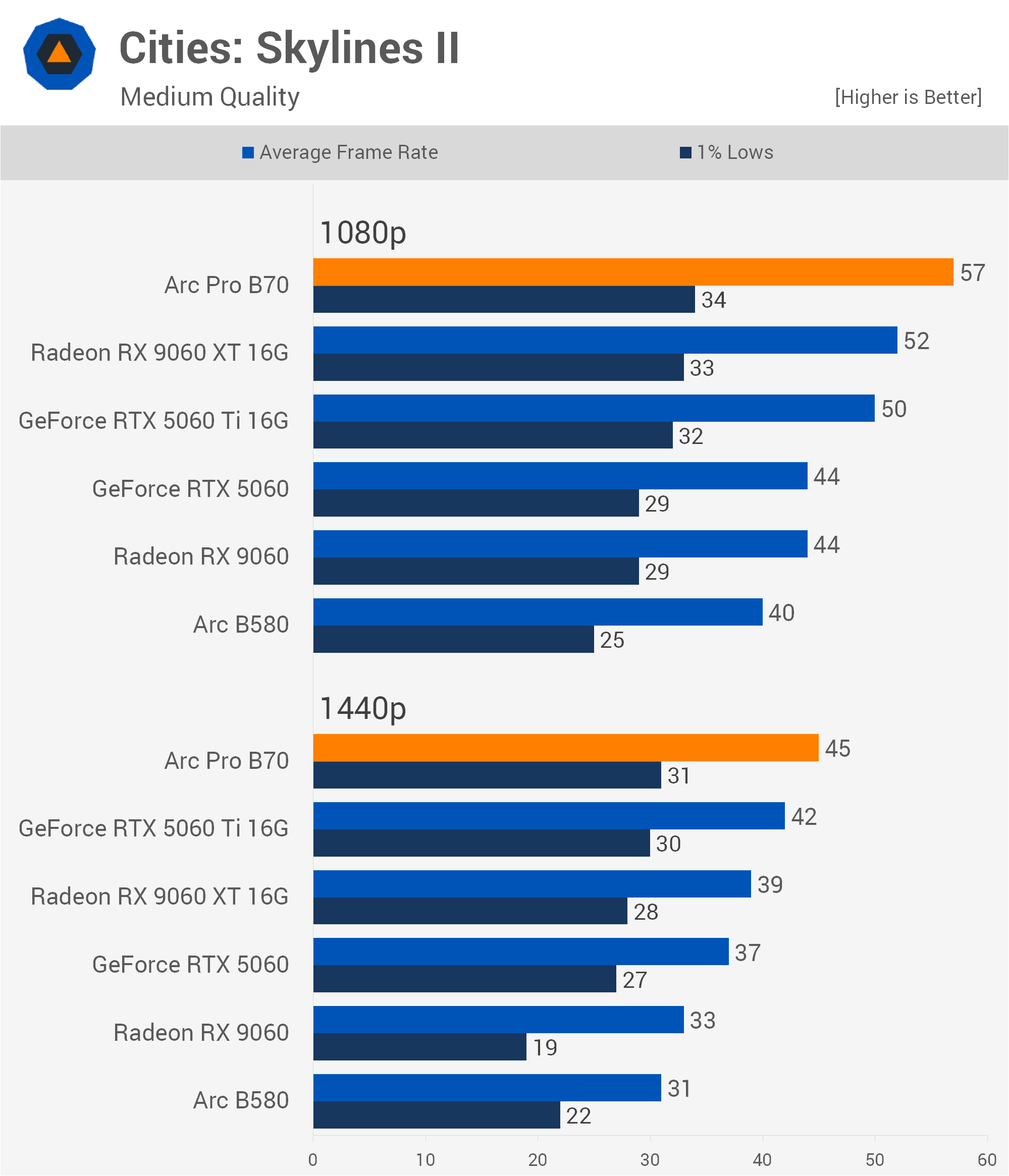
That made it 10% faster than the RX 9060 XT at 1080p and 14% faster than the RTX 5060 Ti. Interestingly, that margin shrank to 7% at 1440p.
Starfield
Taking a look at Starfield running the Ultra quality preset, the Arc B70 shows a healthy 36% performance advantage over the B580 at 1080p, easing to a 31% lead at 1440p.
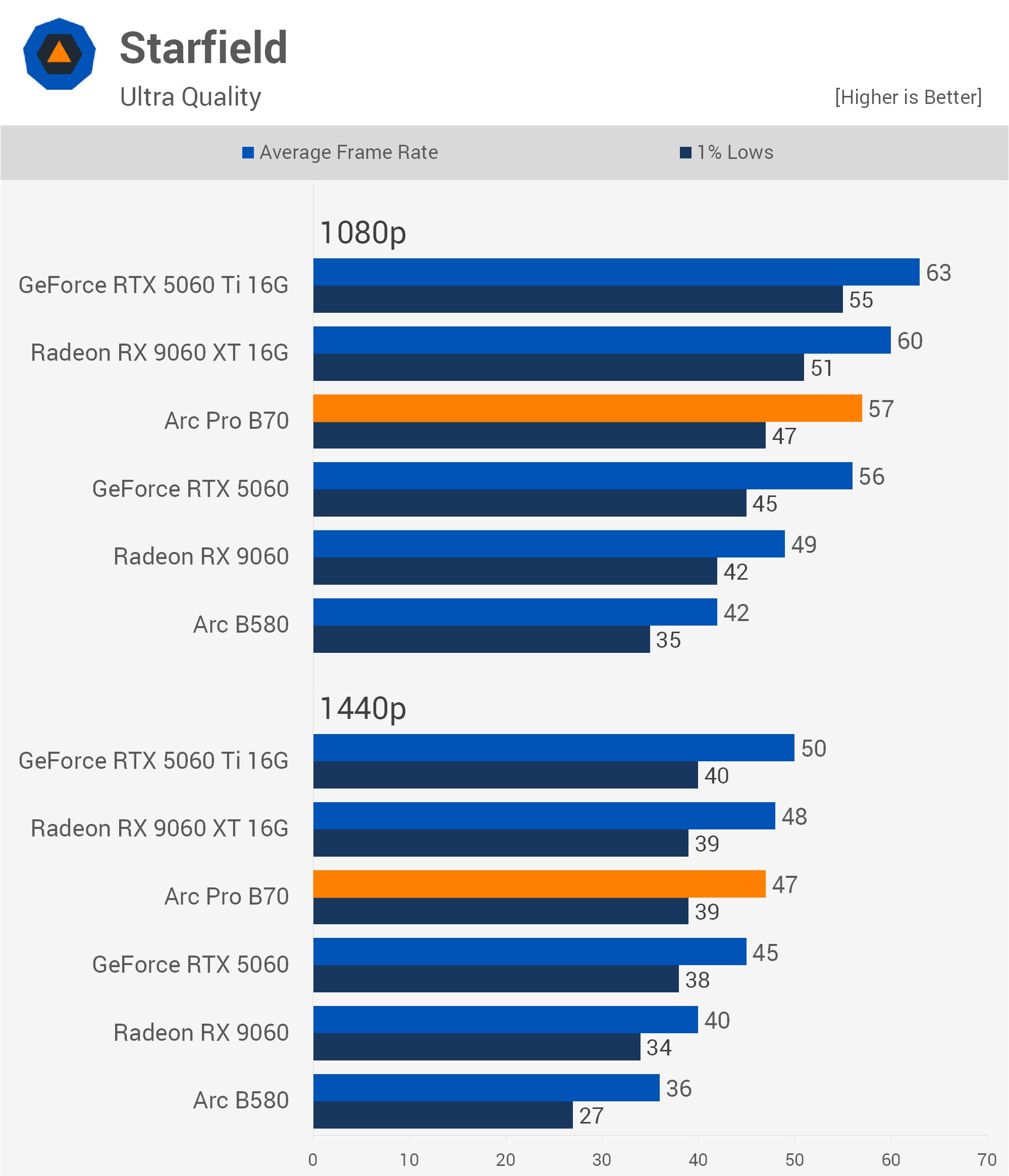
As we've seen several times now, the B70 scales better at higher resolutions. At 1080p, it sits between the standard RTX 5060 and the RX 9060 XT, but at 1440p it closes the gap to the frontrunners, trailing the RTX 5060 Ti by just 6%.
Warhammer 40,000: Space Marine 2
Moving on to Warhammer 40,000: Space Marine 2 using the Ultra quality preset, the B70 holds a 33% lead over the B580 at 1080p, which increases slightly to 34% at 1440p.
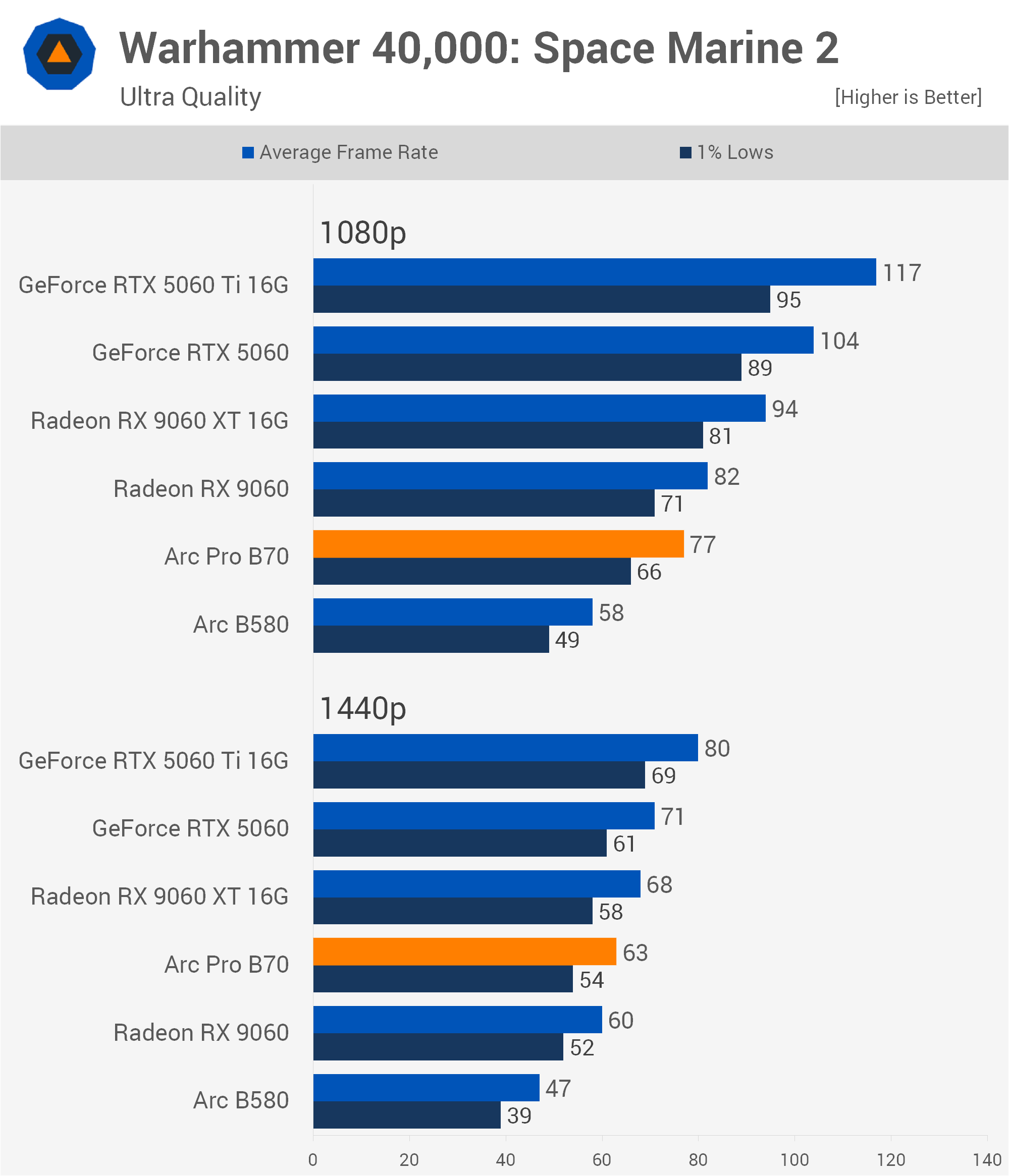
Still, the Arc GPUs simply aren't optimized well for this title. As a result, the B70 lands below the standard RX 9060 at 1080p, though it manages to reclaim some ground at 1440p and edge ahead by a few frames. Overall, it's a disappointing result.
Hogwarts Legacy
Finally, we have Hogwarts Legacy using the Ultra quality preset. Here, the B70 is 35% faster than the B580 at 1080p and 41% faster at 1440p.
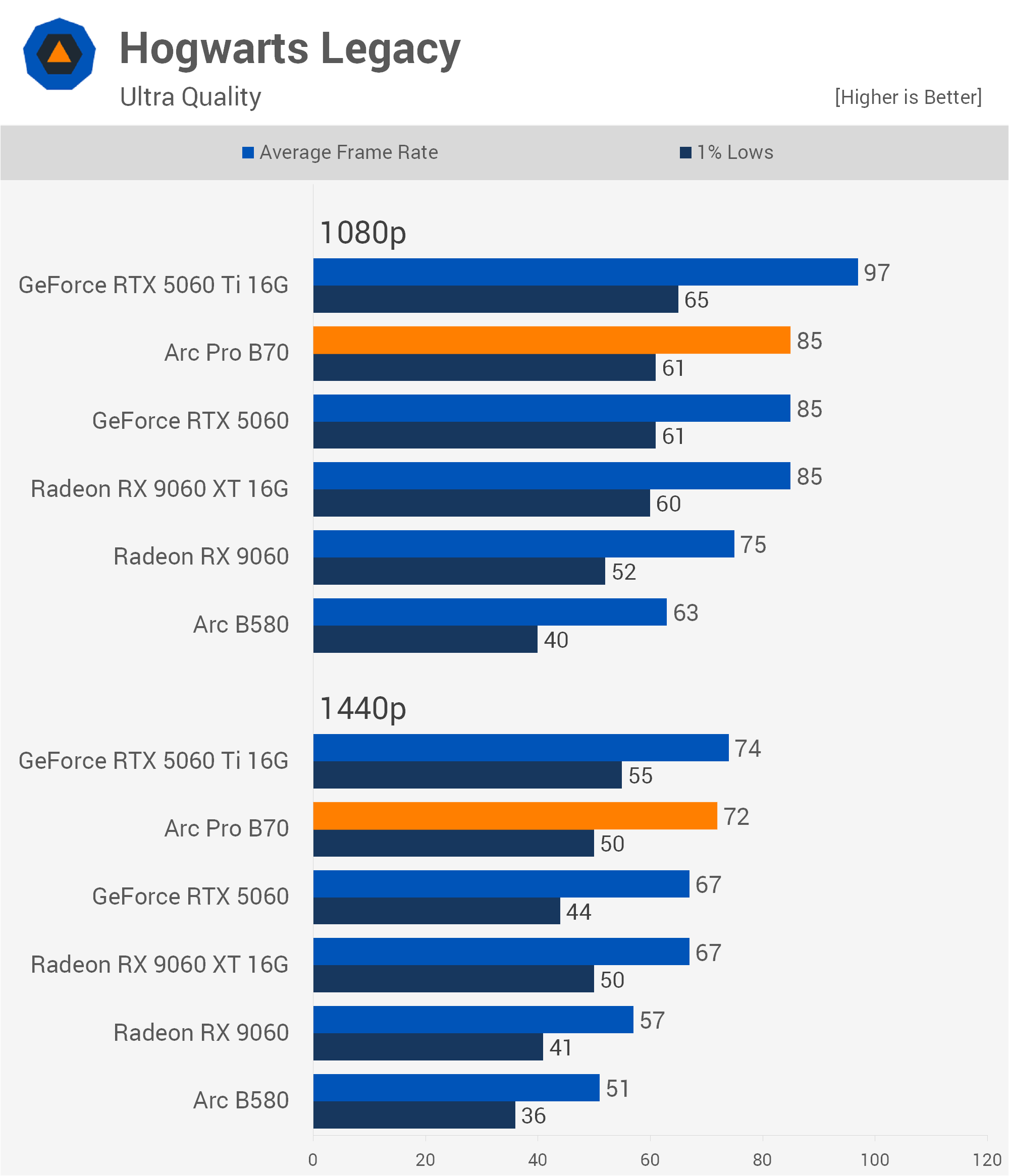
At 1080p, we see a three-way tie between the B70, RTX 5060, and RX 9060 XT, all delivering 85 FPS. However, as the resolution increases to 1440p, the B70 begins to pull away, ending up just two frames behind the RTX 5060 Ti.
12 Game Average
Looking at the 12-game average data, we get a good idea of what Intel could have offered with a hypothetical B770. Starting with Intel's own lineup, the Arc Pro B70 delivers a highly consistent performance uplift over its smaller sibling, coming in 38% faster than the B580 at 1080p and maintaining a 39% advantage at 1440p.
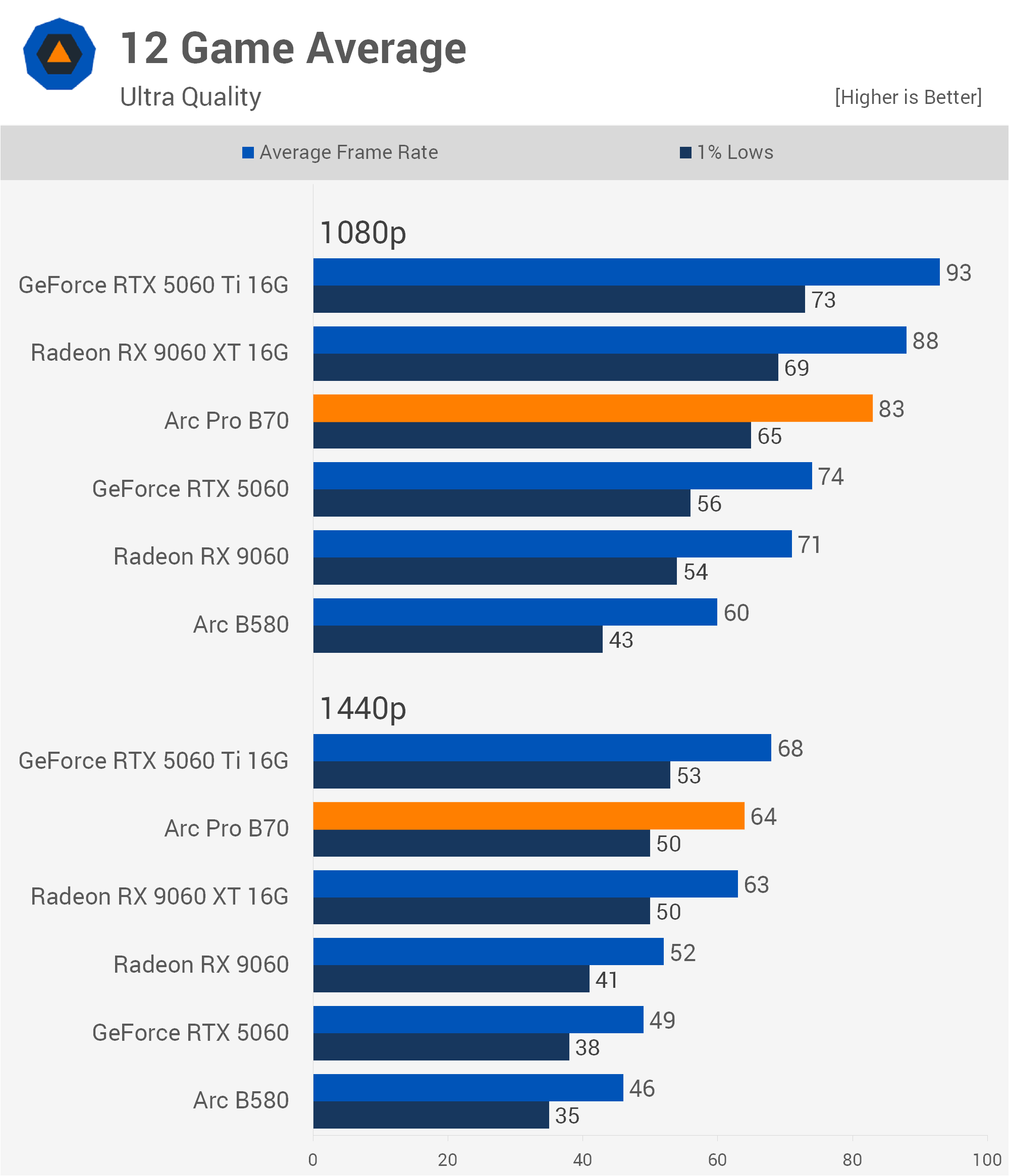
However, when compared to AMD and Nvidia offerings, the B70 is, at best, a mid-range product.
While it comfortably outpaces the standard RTX 5060 and RX 9060 by double-digit margins, it only manages to roughly match the higher-end versions of those GPUs. Even that comparison is somewhat generous, as the B70 was 11% slower than the RTX 5060 Ti at 1080p and still 6% slower at 1440p.
Power Consumption
When it comes to power consumption, the B70 isn't particularly impressive. This is a relatively large GPU, comparable in size to products such as the RTX 5070 Ti and RX 9070 XT, while also relying on an older TSMC process node.
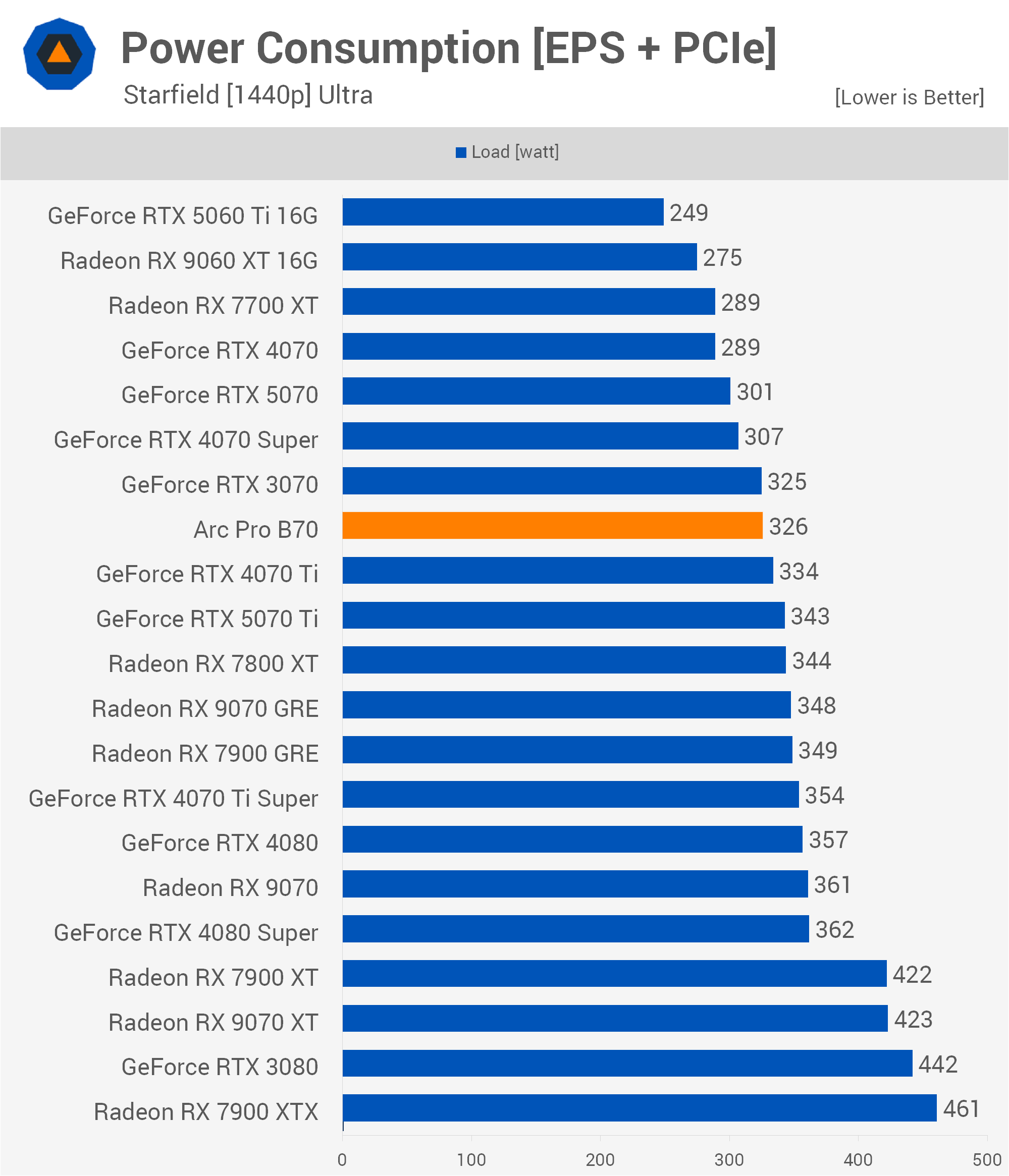
For power measurements, we're combining EPS and PCIe power consumption, as some GPU architectures place a heavier load on the CPU than others. As you can see in Space Marine 2, the B70 consumes a similar amount of power to the RTX 5070 Ti, making it considerably more power-hungry than the GeForce and Radeon products it roughly matches in performance.
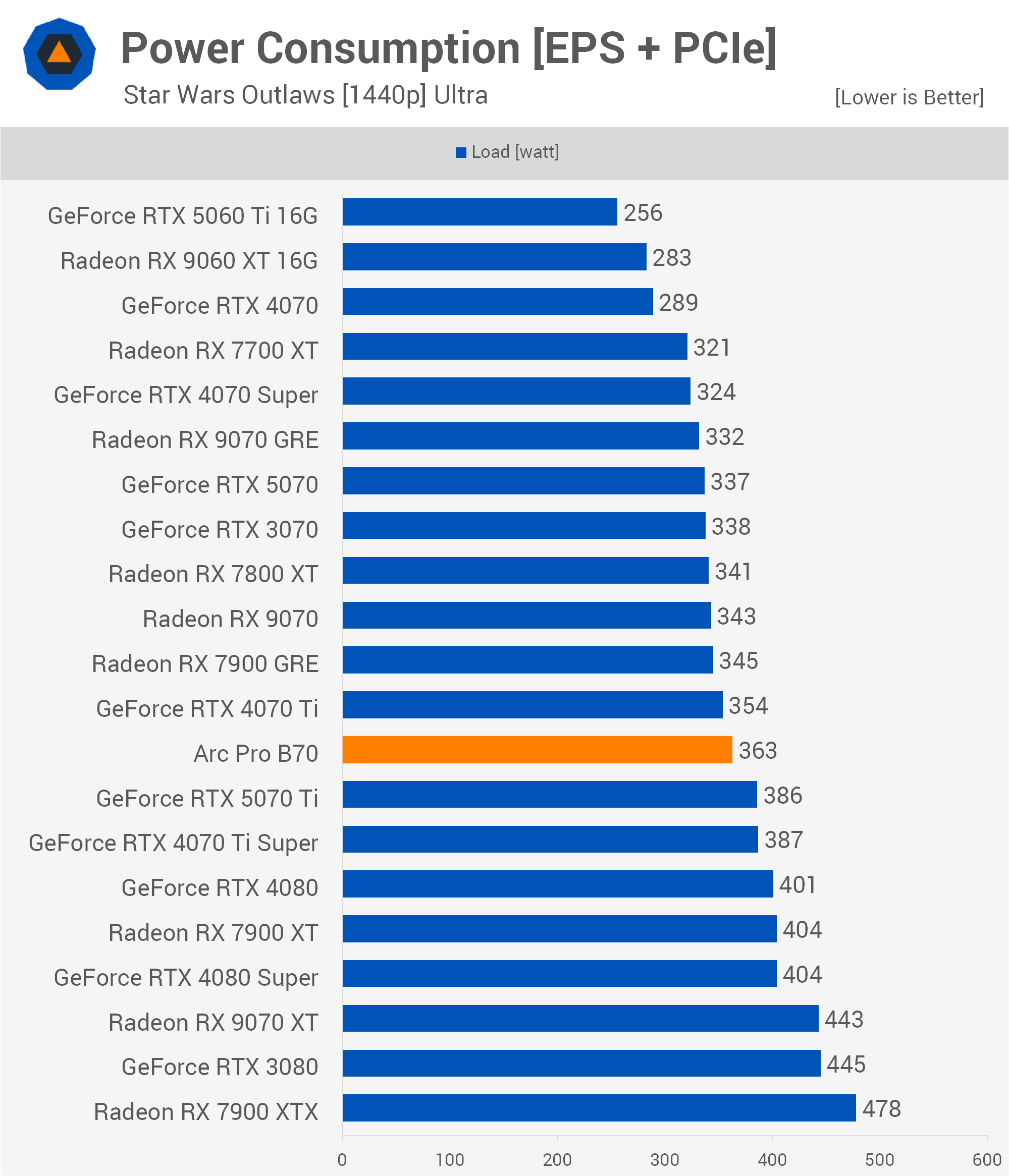
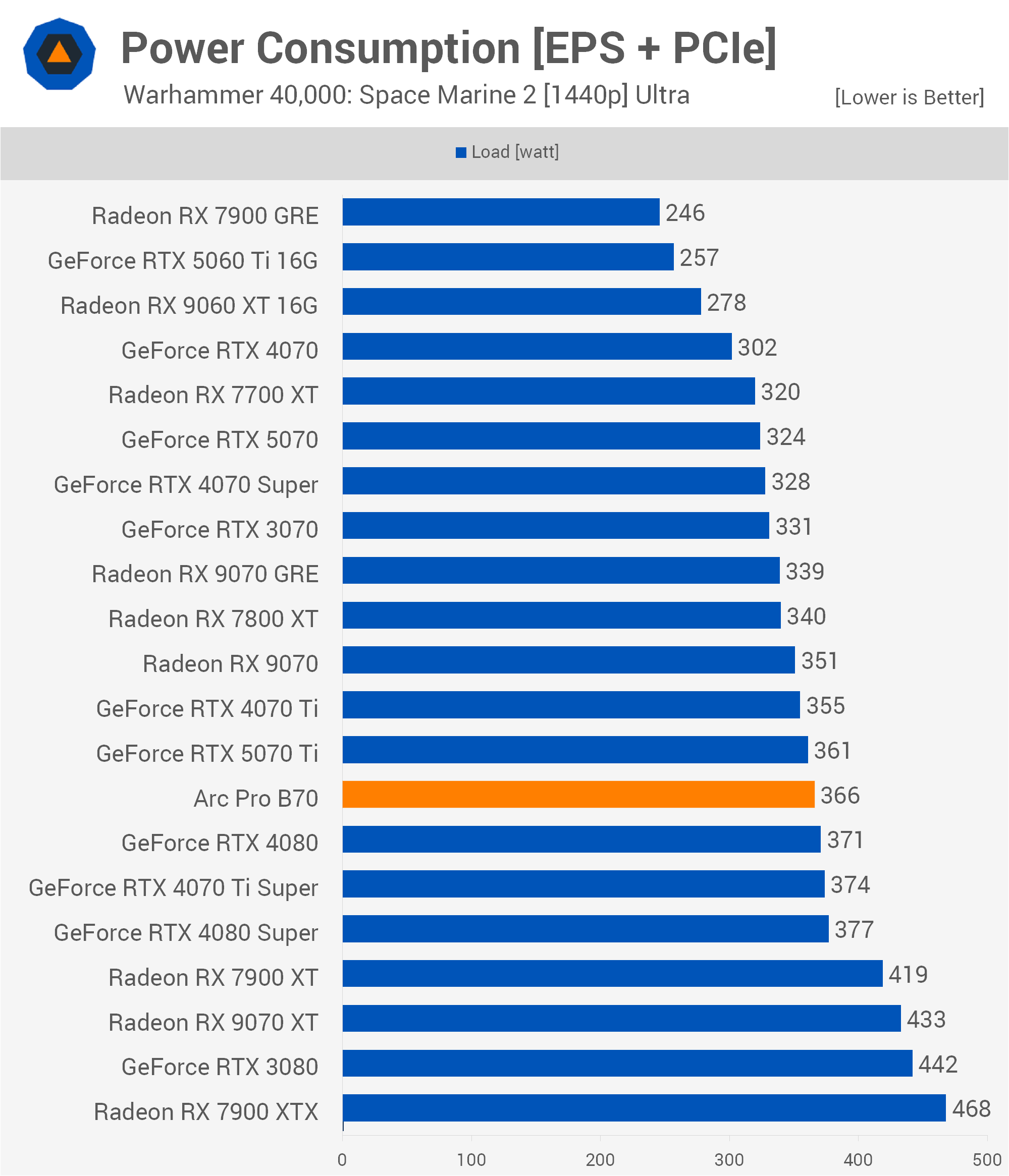
We're seeing the same trend across the other games tested as well. There is some variation depending on the workload, but overall the B70 consumes noticeably more power than both the RTX 5060 Ti and RX 9060 XT.
The Arc B770 That Never Was
Had Intel released the Arc B770, it would have been significantly faster than the Arc B580, which is exactly what we'd expect. Still, it's nice to confirm that the Battlemage architecture scales well. The problem is that, compared to current-generation AMD and Nvidia GPUs, the B580 is relatively slow, trailing both the RTX 5060 and RX 9060.
As a result, the Arc B70, or a hypothetical B770, is only able to roughly match the RX 9060 XT, while ending up 6% slower than the RTX 5060 Ti across the dozen games tested. The 16GB versions of those GPUs are supposed to cost $350 for the RX 9060 XT and $430 for the RTX 5060 Ti.
Given that positioning, Intel realistically couldn't have assigned a theoretical B770 an MSRP much higher than $300, which is a tough sell when the B580 launched with a $250 MSRP. Of course, MSRP means very little these days.
As things currently stand, the RX 9060 XT 16GB sells for closer to $440, while the RTX 5060 Ti 16GB is around $570. In the current market, Intel could probably try to charge around $350 for a B770-class product to convince buyers not to simply purchase the Radeon alternative, and that's assuming the B770 shipped with the same 16GB of VRAM.
That's a problem because the B580 is currently selling for around $300. A $350 B770-class product would be less than 20% more expensive while offering roughly 40% more performance and 33% more memory.
In short, this is likely why Intel never released the B770. Even before the memory price hikes, it would have struggled to be competitive. Now that DRAM prices have skyrocketed, Intel would likely need to price it similarly to the RX 9060 XT just to make the economics work, and I don't see a single gamer paying over $400 for a B70-class product with 16GB of VRAM.
Obviously, Intel is also eager to cash in on the AI boom. Regardless of whether it wanted to or not, the company was pushed in that direction. Pairing the B70 with 32GB of VRAM is arguably the only viable way to monetize that silicon, so that's the route Intel chose. As much as gamers would have loved to see Intel undercut both AMD and Nvidia with a B770-class product, it was never a very realistic outcome.