Having already tested the Core Ultra 5 250K Plus, a CPU that delivers some of the best value productivity performance we've ever seen, it's now time to see what its bigger sibling has to offer. This is our first look at the Core Ultra 7 270K Plus, the 8 P-core model priced at just $300.
Both chips launched this month, but given how impressed we were with the initial testing – and factoring in Intel's more aggressive pricing strategy – we felt each model warranted its own dedicated review. Judging by the response to the 250K Plus coverage, that seems to be the right call.

The 270K Plus does come at a 50% premium, which is significant given you're only getting a 33% increase in cores and a 20% bump in L3 cache. Still, it's effectively a tweaked version of the 285K, a part that costs over $600. So while it may not match the standout value of the 250K Plus, it still looks like a potential bargain, especially for those chasing high-end productivity performance.
Before diving into the blue bar graphs, let's go over the specs. The 270K Plus packs 8 P-cores clocked at up to 5.5GHz, along with 16 E-cores that can reach up to 4.7GHz. There's 36MB of L3 cache, and Intel has retained the same Max Turbo TDP rating as the 285K at 250W.
| Core Ultra Model | 285K | 270K Plus | 265K | 250K Plus | 245K | 225 |
|---|---|---|---|---|---|---|
| Release date | Oct 2024 | Mar 2026 | Oct 2024 | Mar 2026 | Oct 2024 | Jan 2025 |
| Release price | $600 | $300 | $395 | $200 | $310 | $240 |
| P-core (performance) | ||||||
| Cores (threads) | 8 (8) | 6 (6) | 6 (6) | |||
| Frequency | 3.7 GHz | 3.9 GHz | 4.2 GHz | 3.3 GHz | ||
| Turbo | 5.6 GHz | 5.5 GHz | 5.3 GHz | 5.2 GHz | 4.9 GHz | |
| L2 cache | 24 MB | 18 MB | 18 MB | |||
| E-core (efficiency) | ||||||
| Cores (threads) | 16 (16) | 12 (12) | 8 (8) | 4 (4) | ||
| Frequency | 3.2 GHz | 3.3 GHz | 3.6 GHz | 2.7 GHz | ||
| Turbo | 4.6 GHz | 4.6 GHz | 4.6 GHz | 4.4 GHz | ||
| L2 cache | 16 MB | 12 MB | 8 MB | 4 MB | ||
| L3 cache | 36 MB | 30 MB | 24 MB | 20 MB | ||
| Power | ||||||
| Base | 125 W | 65 W | ||||
| Max Turbo | 250 W | 159 W | 159 W | 121 W | ||
As was the case with the 250K Plus, the key tweaks to the 270K Plus involve die-to-die and ring clock frequencies. Intel has increased the die-to-die frequency to 3GHz, a 900MHz or 43% uplift over the 285K. The ring clock has also been raised by 200MHz to 3.9GHz, and these tweaks should help boost performance quite substantially.
In addition, official support for DDR5 memory has increased from an "up to" rating of DDR5-6400 on the original models to DDR5-7200 for these updated Plus versions. Intel is also expanding its CUDIMM support by adding CQDIMM, or 4R CUDIMM, to the 200S Plus series.

Another important update for the 200S Plus processors is Intel's Platform Performance Package, which you can think of as an all-in-one platform software layer. This is essential for proper scheduling, core parking, idle power behavior, and overall performance. Much like AMD's Ryzen chipset driver, we made sure to install it for all of our testing.
Speaking of testing, for all Core Ultra series processors we've used DDR5-8200 CUDIMM memory, though we will also include memory scaling data using slower, more affordable configurations. There's a lot of data to get through, so let's get started.
Test System Specs
| CPU Motherboard Memory |
AMD Ryzen 9000 AMD Ryzen 7000 |
Gigabyte X670E Aorus Master [BIOS F41] G.Skill Trident Z5 RGB 32GB DDR5-6000 CL30-38-38-96 |
| AMD Ryzen 5000 | MSI MPG X570S Carbon MAX WiFi [BIOS 7D52v1D1] G.Skill Ripjaws V Series 32GB DDR4-3600 CL14-15-15-35 |
|
| Intel Core Ultra 200S [Intel Default Profile] |
MSI Z890 Tomahawk WiFi II [BIOS 7E32v1B12] G.Skill Trident Z5 CK 32GB DDR5-8200 CL40-52-52-131 CUDIMM |
|
| Intel Core 14th-gen [Intel Default Profile] |
MSI MPG Z790 Carbon WiFi [BIOS 7D89v1H] G.Skill Trident Z5 RGB 32GB DDR5-7200 CL34-45-45-115 |
|
| Graphics Card | Asus ROG Astral RTX 5090 32GB OC Edition | |
| Power Supply | Kolink Regulator Gold ATX 3.0 1200W | |
| Storage | TeamGroup T-Force GE PRO M.2 PCIe Gen5 NVMe SSD 4TB | |
| GPU Driver | GeForce Game Ready 595.79 WHQL | |
Benchmarks
All-core Cinebench Workload
Before we jump into the bar graphs, here's a quick look at how the 270K Plus behaves under an all-core workload using Cinebench. We observed an average P-core frequency of 5.1GHz and an average E-core frequency of 4.6GHz. The ring was clocked at 4GHz, the die-to-die frequency at 3GHz, and the uncore at 3.2GHz. With a 360mm AIO installed, peak operating temperature reached 86°C.

Cinebench 2026 Multi
Starting with the Cinebench multi-thread results, we can see just how much of a beast the 270K Plus is for $300. It outperformed the 14900K by 10% and the 265K by 23%. It was also 36% faster than the 250K Plus, while AMD's Ryzen 7 9700X trailed by 106% and the 9800X3D by 77%. When it comes to heavily threaded productivity, AMD is nowhere right now in this price segment.

Cinebench 2026 Single
The 270K Plus was also very impressive in the single-thread test, beating the 250K Plus by 4% to become the fastest CPU tested.

Blender
The 270K Plus is incredibly fast in the Blender render test, producing 285 samples per minute, making it 121% faster than the 9700X.

7-Zip File Manager
When it comes to compression performance, the 270K Plus is again very fast, edging out the 14900K. It was 18% faster than the 265K and 22% faster than the 250K Plus. Compared to the 9700X, the Intel CPU was an impressive 62% faster.

It did slip behind the 14900K in decompression, though only by a 7% margin. Despite that, it was still 27% faster than the 265K and 37% faster than the 250K Plus. Not only that, but it smoked the 9700X by a whopping 63% margin.

Photoshop
As seen in previous testing, the Zen 5 architecture tends to perform better in Photoshop, which is a lightly threaded workload. As a result, the 270K Plus was 15% slower than the 9700X, coming in just behind the 14900K and 7800X3D.

Premiere
Premiere is a much heavier workload, and although the 270K Plus didn't crush the 9700X, it was 6% faster, giving it a small performance advantage in this case.

Gaming Benchmarks
Rainbow Six Siege X
Time for the gaming benchmarks, starting with Rainbow Six Siege. The 270K Plus is very competitive with the 9700X here, coming in just 4% slower in both quality preset tests. That still made it 14-16% faster than the 250K Plus and over 20% faster than the 265K, so a great result overall.

Battlefield 6
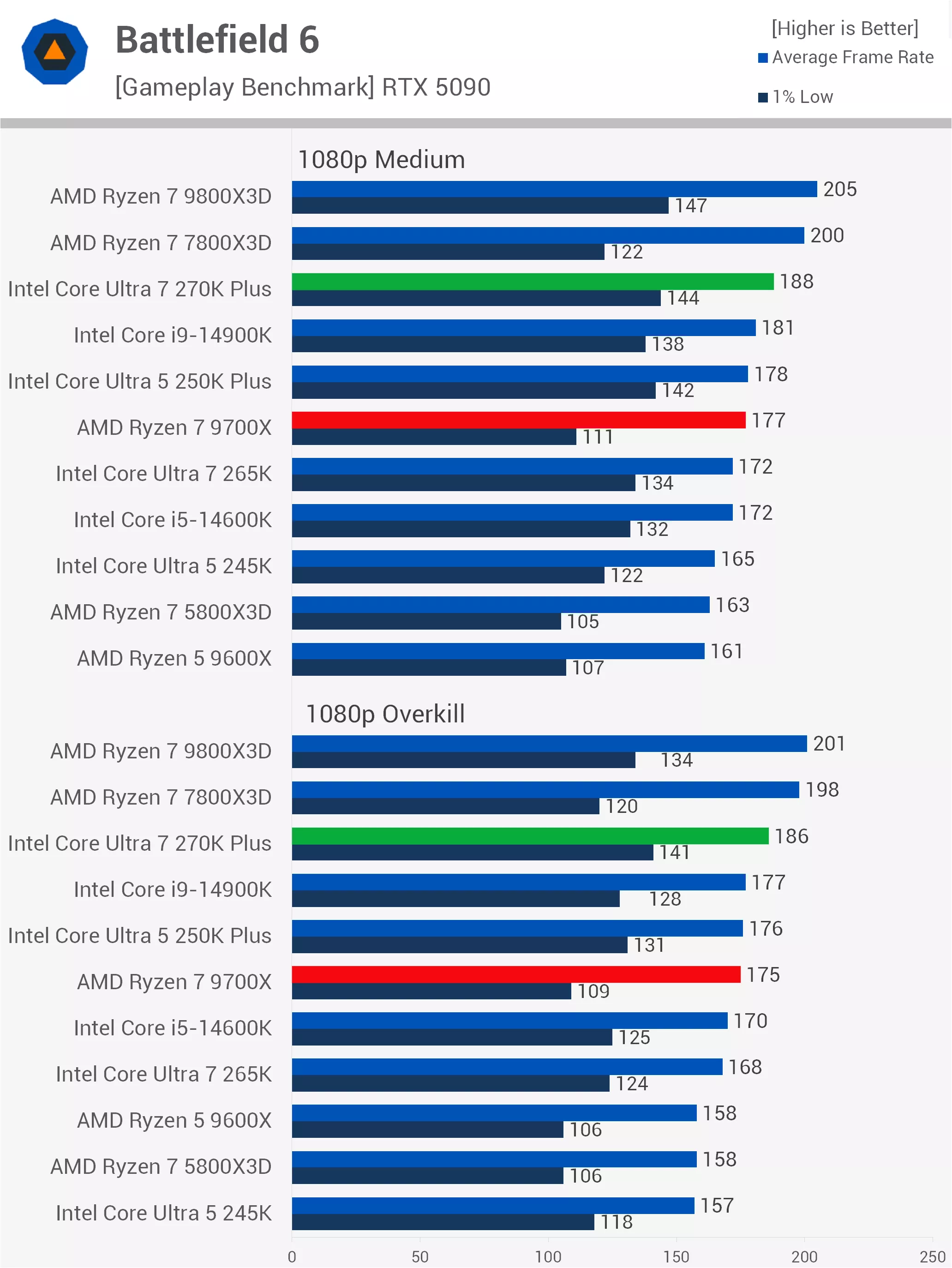
The Battlefield 6 results are much more impressive. Here, the 270K Plus easily beats the 9700X, particularly when comparing 1% lows. Using medium settings, it was 6% faster in average frame rate, but a massive 30% faster for 1% lows – a big improvement.
Arc Raiders
Performance in Arc Raiders is also very strong. The 270K Plus was 11% faster than the 9700X using medium settings, though just 2% faster with the Epic preset. Compared to the 265K, we're seeing up to a 22% performance uplift, which is huge.

Borderlands 4
Moving on to Borderlands 4, which is mostly GPU-limited – especially with modern CPUs like these. Given that limitation, it's no surprise to find the 270K Plus and 9700X running neck-and-neck.

Marvel Rivals
The 270K Plus also performed exceptionally well in Marvel Rivals, matching the 9800X3D using Ultra settings. Those settings are heavily GPU-limited, but it's still an impressive result, particularly as 1% lows were 11% higher than the 9700X. Using the medium preset, the 270K Plus was 6% faster on average and 17% faster for 1% lows.

Baldur's Gate 3
Performance in Baldur's Gate 3 is also strong, matching the average frame rate of the 9700X while delivering slightly better 1% lows. The 270K Plus was also 12% faster than the 265K in average frame rate and 22% faster for 1% lows.

Cyberpunk 2077: Phantom Liberty
The Cyberpunk 2077: Phantom Liberty results are a bit mixed. Using the medium preset, the 270K Plus roughly matched the average frame rate of the 9700X but delivered 12% stronger 1% lows. With the ray tracing Ultra preset – which typically hits GPU limits first – the 270K Plus was still up to 10% faster.

Counter-Strike 2
Counter-Strike 2 performance is really impressive. The 270K Plus was around 8% faster than the 9700X, but compared to the 265K, we're looking at a massive 21% performance increase, putting it within striking distance of the 7800X3D.

Space Marine 2
The 270K Plus was also very impressive in Space Marine 2, rendering 111 fps using medium settings. That made it a few frames faster than the 9700X, though it was 8% faster when comparing 1% lows. In short, we're looking at 14900K-like performance in this example, which is great for a 200 Series processor.

Mafia: The Old Country
Moving on to Mafia: The Old Country, we're again seeing very impressive gaming performance from the 270K Plus. It matched the 14900K, making it just 6% slower than the 9800X3D and 6% faster than the 9700X.

Assetto Corsa Competizione
The ACC results aren't quite as impressive as some of the games we've already looked at, coming in 11% slower than the 9700X. That said, for Intel this is still a solid step forward, as the 270K Plus was a massive 22% faster than the 265K.

Spider-Man 2
The Spider-Man 2 results are very strong. While not quite matching the 14900K, the 270K Plus still looks great for a Core Ultra processor, delivering 7% better performance than the 9700X with the medium preset and 17% better performance using the Ultimate Ray Tracing settings.

Horizon Zero Dawn Remastered
The Horizon Zero Dawn Remastered data is more competitive. Here, the 270K Plus and 9700X are essentially neck and neck, though we do see slightly better performance from the Intel processor when using the Very High preset.

The Last of Us Part II Remastered
Finally, we have The Last of Us Part II Remastered, and this is another example where the 270K Plus easily outclasses the 9700X. It delivered 15% better average frame rate performance, along with a massive 34% improvement in 1% lows, resulting in a similar experience to the 9800X3D and 14900K.

14 Game Average
Here's how the Core Ultra 7 270K Plus stacked up across the 14 games tested. Using medium settings, it was 3% faster than the 9700X, while 1% lows were 11% stronger – a trend that carried over to the Ultra quality data. In both cases, we're looking at 14900K-like performance.
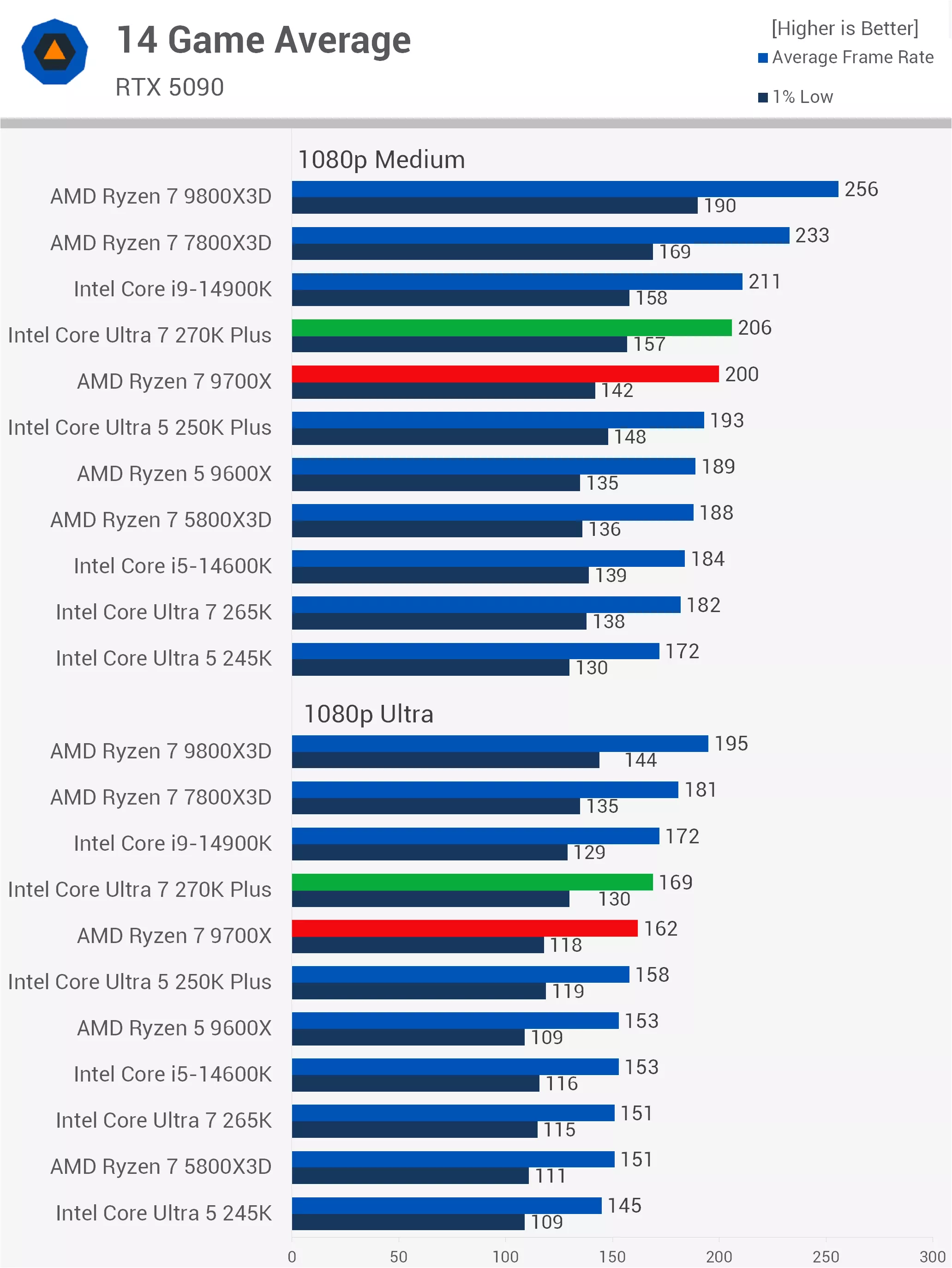
That's not especially impressive given how old that part is now, but the 270K Plus is far more power efficient and now much cheaper, which helps balance things out.
Compared to the 265K, we're seeing a 13% performance increase on average with medium settings and 12% with Ultra settings.
Power Consumption
In terms of power consumption, the 270K Plus doesn't exactly sip power under full load, but it's certainly manageable and a clear improvement over previous Intel generations. For example, it was 10% faster than the 14900K in this test while consuming 20% less power. It did consume 16% more power than the 265K, but it was also 23% faster, so efficiency is slightly improved overall.


Power efficiency in Cyberpunk 2077 wasn't great. Here, the 270K Plus consumed 42% more power than the 9700X for up to 12% better performance.

It's a similar story in Space Marine 2, where the 270K Plus consumed 35% more power for up to 10% better performance.

The worst case appears in Spider-Man 2, where the Intel CPU consumed 58% more power than the 9700X for 17% better performance.
DDR5 Scaling
Finally, here's a look at performance scaling across several DDR5 memory speeds, including DDR5-6000, 7200, and 8200, starting with Horizon Zero Dawn Remastered.
In this case, we're seeing just a 3% drop in performance when moving from 8200 down to 6000, and this applies to both quality presets. The 270K Plus doesn't appear to be particularly memory sensitive here.


We're seeing a slightly larger 5% hit in Marvel Rivals, though 1% lows are less affected than the average frame rate, making this largely a non-issue.

Finally, Rainbow Six Siege shows a minimal performance decline – just a 1% drop when going from 8200 down to 6000.
Strong Productivity Value, Awkward Platform Timing
For those looking to buy a CPU right now, primarily for productivity workloads, the Core Ultra 7 270K Plus is a great option at $300. In core-heavy tasks, we found it to be up to 121% faster than the 9700X and 106% faster in Cinebench multi-thread, so needless to say it's a lot faster than a Ryzen 7 processor.
The 9700X is currently priced at $300, making this a poor matchup for AMD. To achieve a similar level of performance on the AM5 platform, you would realistically need the 9950X, which costs around $520 – an over 70% premium compared to the 270K Plus.

For gaming, the situation is more favorable for AMD, but even so, the 270K Plus is generally the better choice than the 9700X, offering stronger frame-time performance, and power consumption isn't a major concern here either.
Of course, if you already have a high-end processor like the Core i9-14900K, the 270K Plus won't be particularly compelling. It's a little slower for gaming and only slightly faster for core-heavy productivity, though it is notably better in terms of power consumption. Still, after nearly three years, this isn't the kind of progress Intel users would have hoped for, especially given it's not even on a compatible socket.
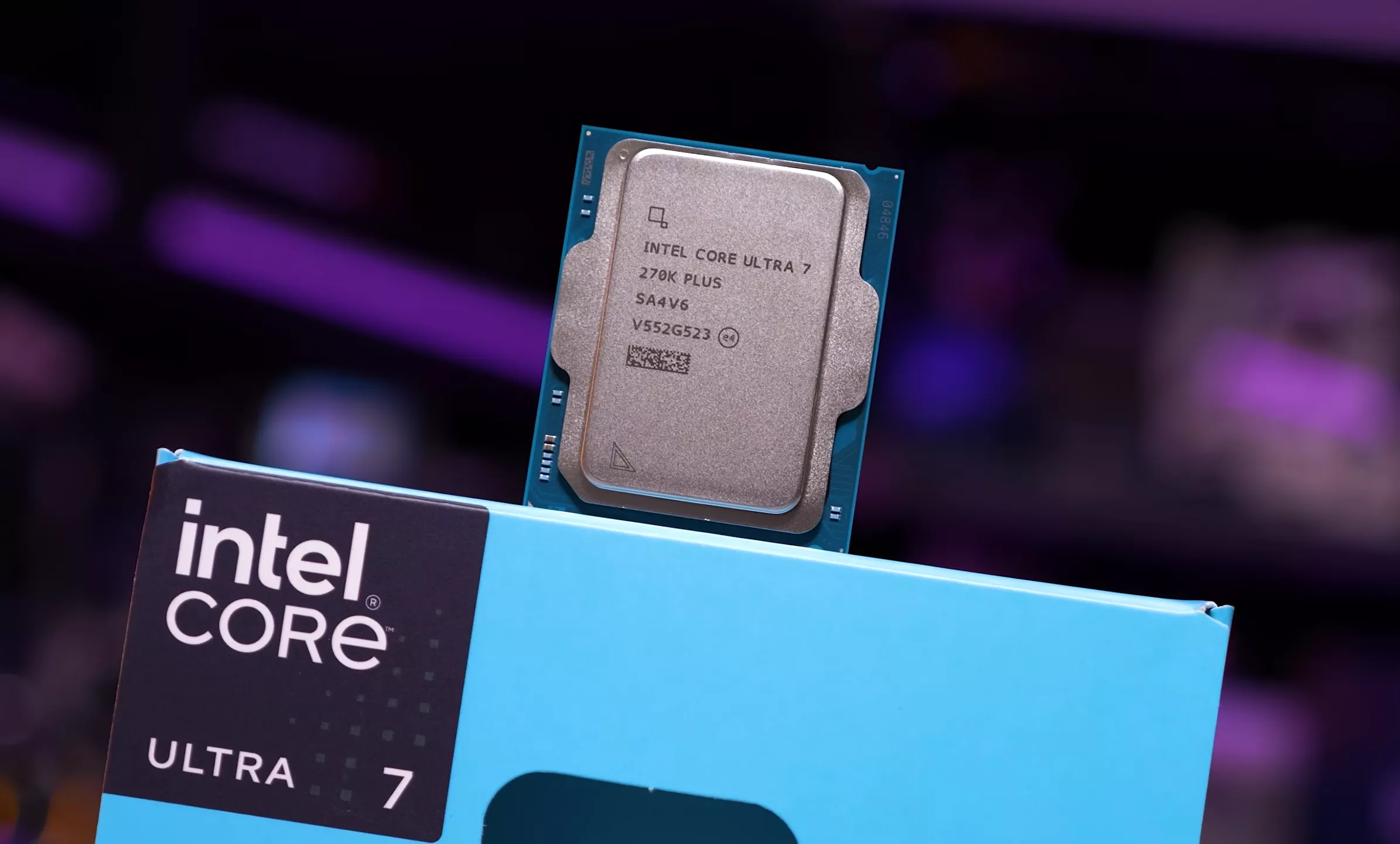
Speaking of socket compatibility, this is really the only major downside of the 270K Plus. Releasing it on a dead platform that Intel will soon replace is a bit of a buzzkill. The other issue, of course, is DDR5 memory pricing, though that isn't specific to the 270K Plus nor Intel's fault – it's simply a cost you'll face if you don't already own DDR5 memory.
For productivity, though, the 270K Plus is hard to ignore at $300. For gaming, while it is clearly better than the 9700X – and between those two we would choose Intel every time – if we were building a new PC or upgrading an entire platform specifically for gaming, we would spend a bit more on the 7800X3D. It can be found for around $380, and not only is it faster for gaming, but it also consumes less than half the power. In our view, paying $80 more is worth it, not just for those advantages but also for the stronger platform support, as AM5 is expected to support at least Zen 6.

Still, the 270K Plus is a strong overall offering. As we noted in our 250K Plus review, it's frustrating that it took Intel 18 months to get the formula right. The company has done a much better job configuring these CPUs and pricing them appropriately to reflect their position in the market, which clearly isn't one of dominance.