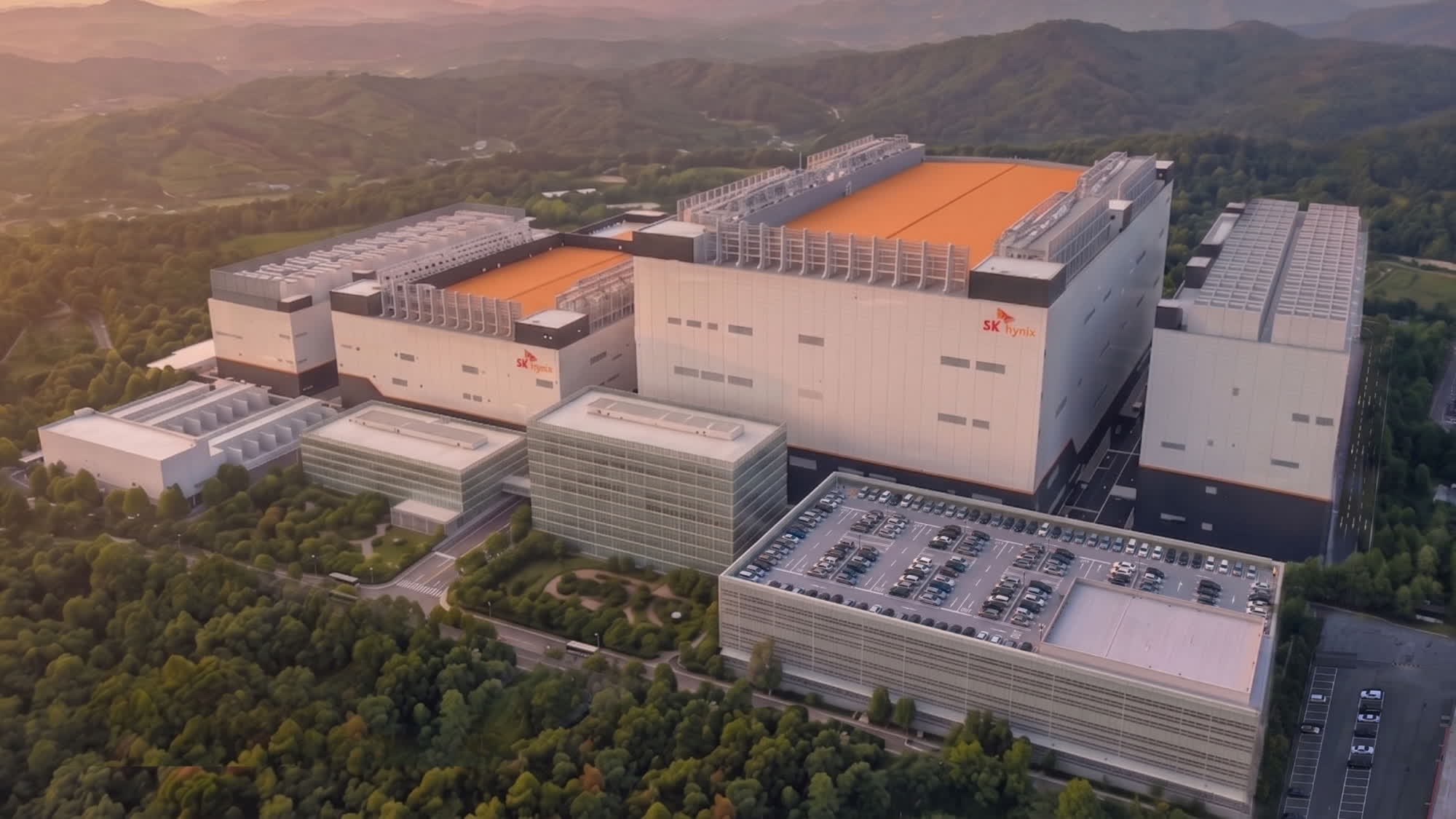
The big picture: Foundry corporations have repeatedly stated that the chip supply chain crisis is not going to improve anytime soon. Adding more manufacturing plants could help partially ease the industry's pain, which is exactly what SK Hynix plans to do over the next few years. Let's just hope the AI bubble doesn't burst in the meantime.
SK Hynix just announced a massive new investment to strengthen its manufacturing capacity for both DRAM and NAND flash products. The South Korean corporation, one of the world's three largest memory manufacturers alongside Samsung and Micron, is going to spend 54 trillion won ($38 billion) to build the new "Y2" and "M17" chip fabs in Yongin and Cheongju, respectively.
The new plants are part of a larger investment strategy totaling 700 trillion won. Yongin Y2 is the second of four new fabs planned for the Yongin Semiconductor Cluster. The plant will increase SK Hynix's DRAM production capacity, with construction expected to begin in July 2027.
The first cleanroom in Y2 is expected to be ready by June 2029 and will house the equipment required to produce high-bandwidth memory solutions and "next-generation" DRAM chips. Meanwhile, construction of the Cheongju M17 plant is expected to begin in February 2027. The facility is scheduled to open its first cleanroom in December 2028, with production primarily focused on NAND Flash chips.
SK Hynix acknowledges that HBM memory is now one of the most sought-after chip formats in the world. Nvidia, AMD, and other vendors are struggling to secure enough capacity to keep developing and producing new GPUs and AI accelerators for data center hyperscalers. Analysts say that new data center plans are still on paper for the most part, while Big Tech companies continue to buy up every memory chip they can find.
SK Hynix also said that demand for NAND flash is surging rapidly. The focus is once again on hyperscalers and enterprise SSDs, which are being deployed to further expand the capacity and capabilities of AI services. NAND chips are used as cache storage in AI inference workloads, with agentic AI and physical AI applications such as robots expected to drive demand even higher.
Commenting on the newly announced construction plans, an unnamed SK Hynix official said that the company aims to become "a key partner in AI infrastructure, contributing to the stability of the global AI semiconductor supply chain."

Memory manufacturers have long been criticized for their alleged unwillingness to build new manufacturing capacity, with SK Hynix predicting that the supply chain crisis will likely peak between 2027 and 2030. The new Y2 and M17 plants will certainly increase the company's production capacity, although they should come online just as the market finally begins to settle down.