
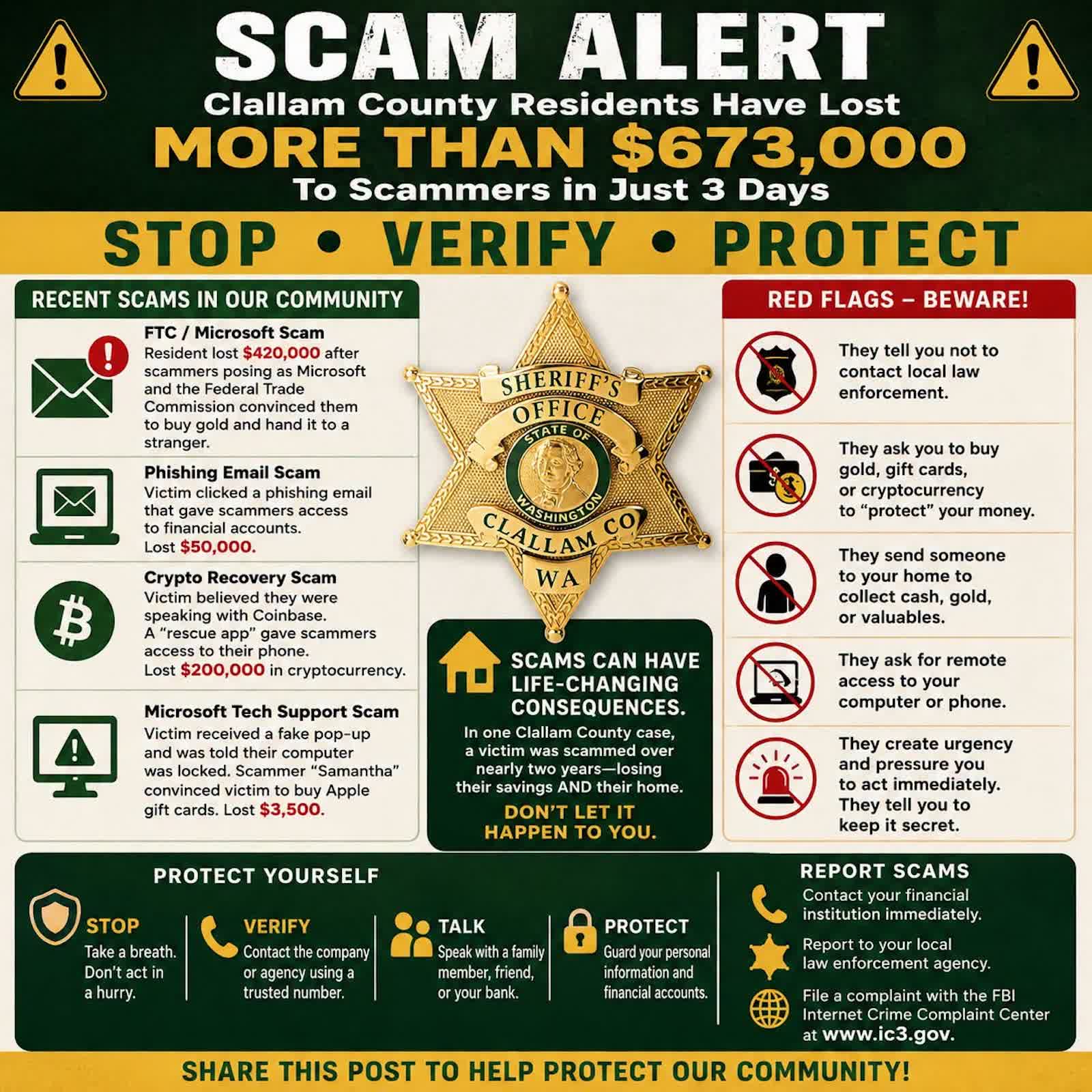
What just happened? A recent run of scams in Washington state shows how quickly people can lose money when fraudsters pose as trusted tech or government figures and exploit fear. Over three days, four residents in Clallam County lost more than $673,000, according to the county sheriff's office. The cases involved a mix of tactics: fake tech support, a bogus app, a malicious email, and even an in-person pickup of gold. All were meant to push victims to act before they could check what was going on.
Several of the scams started with familiar setups. One person lost $3,500 after buying Apple gift cards for someone posing as Microsoft technical support. Another lost $50,000 after clicking on a malicious email that allowed scammers to access financial accounts.
A third case centered on a fake app. A 64-year-old was convinced to download what they believed was a legitimate Coinbase application. Instead, it opened the door for scammers to pressure the victim into moving $200,000. The case shows how easy it is for fake crypto platforms to blend in, especially when people already expect to manage money through apps and digital wallets.
The largest loss in the group involved a shift from digital fraud to a physical handoff. An 84-year-old resident gave roughly $420,000 in gold to a man who showed up in their driveway.
That case began with scammers posing as federal authorities. The victim was told they were under investigation by the Federal Trade Commission for alleged child pornography and money laundering. The scammers told the victim to avoid contacting local law enforcement and claimed that banks in the area were also under investigation. They warned that the victim's accounts could be seized and told them to move their money into gold to protect it.
After buying the gold, the victim handed it over when someone arrived at their driveway. The fraud only came to light later, after the victim contacted their bank.
Law enforcement says the tactics are deliberate and calculated. "These criminals are professional manipulators who prey on fear, trust and urgency," Undersheriff Lorraine Shore said.
What stands out across the cases is how the scams move between channels. A malicious email leads to account access. A fake app looks like a real financial platform. In some cases, an in-person visit seals the story the scammers have built. In the most extreme case, the scheme ends with a person physically collecting assets. By the time victims realize something is wrong, the money or valuables are gone.
The scams also rely heavily on isolation. Victims are told not to contact police or their banks, cutting off the easiest ways to verify what is happening. "These criminals are professional con artists," the sheriff's office said in its Facebook post. "They create fear, urgency, and trust to convince victims to act before they have time to think."
Officials stress that legitimate companies and government agencies do not operate this way. They do not ask for payment in gift cards, cryptocurrency or gold. They do not send someone to your home to collect valuables. And they do not discourage people from contacting law enforcement.
The Clallam County cases show that even as scammers change their methods, the playbook is familiar: win trust, create a crisis and pressure people to move money quickly.