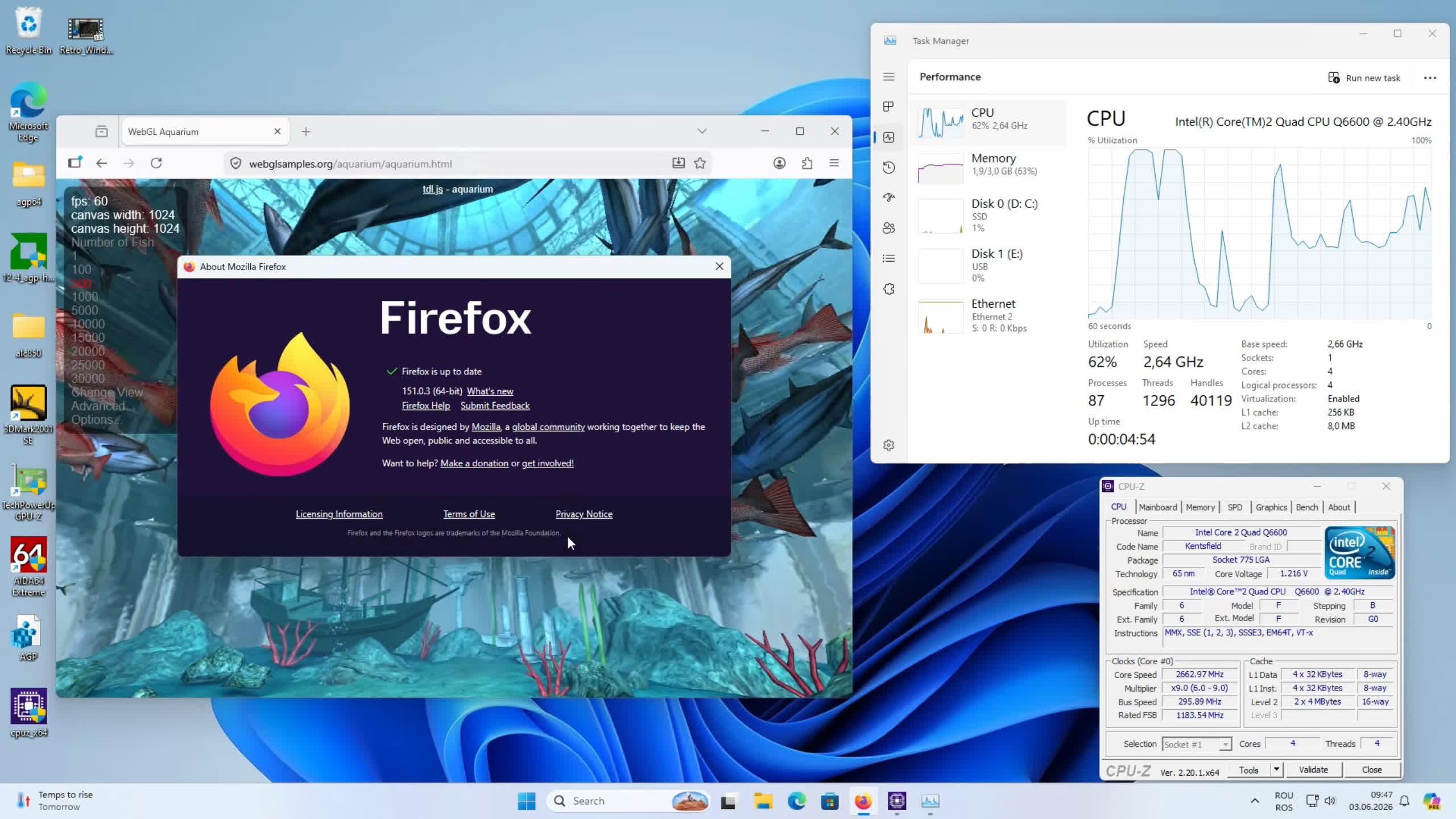
Retro Windows: Ancient hardware can be surprisingly resilient against modern software environments. Microsoft has heavily invested in Windows' backward compatibility, and even the troublesome Windows 11 generation appears to follow that same principle, despite its completely reworked system requirements.
Can Windows 11 run on a 2003 motherboard, an AGP GPU (for those not old enough, that's the slot that predates PCI Express) with no official drivers, and a slightly newer CPU rocking four 65nm cores? A retro-hardware enthusiast named Omores recently proved that it can, even as Microsoft would much rather customers upgrade to the latest genAI machine to get the "best" out of its agent AI-ready operating system.
Omores said he was able to install and run Windows 11 on an Asrock ConRoe865PE motherboard, built around the Intel i865PE chipset that dates back to 2003. The board uses DDR1 memory modules but can also support "legendary" Core 2 Quad CPUs, including the Core 2 Quad Q6600. Released in 2007, the Q6600 packs four "physical" cores running at a 2.4 GHz clock rate.
As it turned out, the motherboard and other basic components weren't the real obstacle in this retro Windows 11 build. The trouble was the GPU: the ConRoe865PE only offers five "classic" PCI slots and a single AGP 8X slot, and Microsoft abandoned AGP support during the Windows 10 era, leaving no straightforward path to loading Windows 11 on AGP-based hardware.
Windows 11 on a DDR1 motherboard, with AGP support enabled
by u/O_MORES in windows
Getting there took a bit of "hacking." Omores tracked down the driver that provided early AGP support in initial Windows 10 builds, pulled it out (Intel's AGP440.sys), and edited the right "inf" file to trick Windows 11 into recognizing the AGP-compatible chipset. From there, he installed a "high-end" AGP GPU, a Radeon HD 4650, using AMD's last 64-bit Windows 7 drivers from 2012 to get the card properly running.
The payoff: Windows 11 recognized everything, ran in a "rock stable" state, and delivered a complete PC environment capable of loading the latest browsers and some "light" gaming from the AGP era. Firefox even leaned on hardware acceleration for H.264 decoding, though the motherboard's 3GB of DDR1 RAM put a hard ceiling on how many tabs could stay open at once.
Despite lacking any UEFI firmware or other modern platform standards, the old motherboard showed that many of Windows 11's backward-compatibility limits are really just "soft" blocks, ones that can be bypassed with enough patience and elbow grease.
Omores stuck with Windows 11 version 23H2 for the build, since 24H2 introduced a "hard" block against CPUs lacking the SSE4.2 instruction set. As far as retro tinkering goes, that's the wall: there's no known tweak, Registry edit, or bypass method that can make truly old PC hardware compatible with the latest editions of Windows 11.