The takeaway: For all the progress humanoid robots have made, most are still stuck performing isolated tasks in controlled environments. The problem is getting them to handle messy, multi-step work – moving through an office, making decisions, and adjusting as conditions change.
Flexion Robotics, a Swiss startup founded by former Nvidia researchers, is approaching the problem from a different angle. It teaches robots basic physical skills and uses a higher-level AI system to decide which skill to call up and when. The goal is not just to complete tasks but to adapt them to changing conditions.
That contrasts with how many humanoid robots are currently trained. In most demos, robots appear to carry out useful work – folding laundry or stocking shelves – but those actions are often guided behind the scenes through teleoperation. The robot is effectively being steered step by step. Take away that control, and performance tends to break down, especially in unfamiliar settings.
Flexion is betting on a different model. Its system relies heavily on simulation, in which robots practice individual actions such as opening doors, climbing stairs, or carrying objects. Those skills are then combined by a higher-level AI model that decides how to execute a broader instruction.
What makes the system unusual is how the top layer is trained. Flexion trains the model by feeding it videos of humans performing everyday tasks, rather than relying mainly on hand-written rules. The model learns the logic of what needs to happen and in what sequence, but not the physical mechanics. Those are handled separately by the robot's learned behaviors.
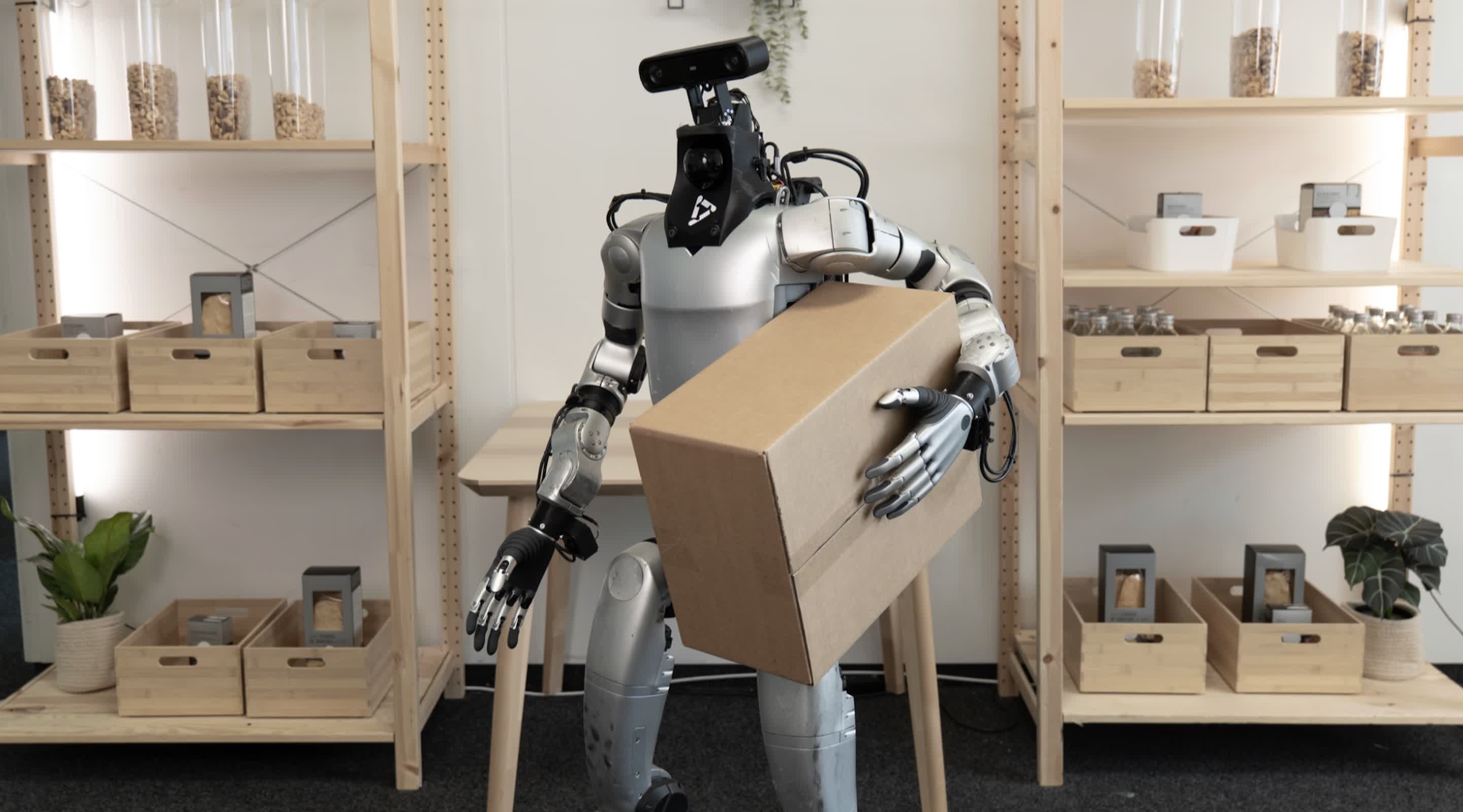
In one demonstration, a humanoid robot is given a single instruction: retrieve a delivered package, navigate stairs and an elevator, unpack the contents, and place the items into a drawer. The robot completes the sequence on its own, moving through each step without direct human input. It identifies when to switch between actions – walking, opening, carrying – based on the task context.
Reinforcement learning is the system's driver, allowing the software to improve through trial and error. According to cofounder and CEO Nikita Rudin, the method is used throughout the stack, from high-level planning down to motor control. He describes it as the software's "secret ingredient," enabling the robot to refine both its decision-making and physical execution over time.
The focus is increasingly on AI rather than hardware. While humanoid robots tend to draw attention for their appearance, analysts like George Chowdhury say the real progress lies in how they are controlled. "The humanoid itself isn't the interesting, revolutionary thing, rather it's the AI models that back them," ABI Research's Chowdhury tells Wired.
ABI Research estimates that robot foundation models could represent a $150 billion opportunity by 2036, suggesting that software platforms – not just physical machines – will drive much of the value in robotics.
Flexion appears to be positioning itself with that in mind. Rudin says the company is working with multiple robotics manufacturers and has designed its system to operate across different humanoid platforms. In a field where hardware designs vary widely, that flexibility could prove important.
The path forward is not straightforward. Chowdhury points out that success will depend on close coordination with hardware makers and the ability to stand out in an increasingly competitive market. More fundamentally, he argues that without systems capable of programming robots to handle complex, multi-step work, the broader humanoid market may struggle to gain traction.
"There isn't really a market here," he says.