
Given the incredible explosion of interest in AI infrastructure and the chips that power them, it's no surprise that virtually every semiconductor company has been talking about how their offerings are an important part of the overall AI computing story.
In truth, however, the level of contribution and realistic opportunities that these companies have vary a great deal. One of the most recent names to enter the fray is Qualcomm, best known for powering a huge percentage of modern smartphones, but also an increasingly important force in the automotive, PC and wearable markets among others.
The company had previously announced a few accelerators that were targeted at the AI data center market but at their recent Investor Day in NYC (which they sponsored me and several other analysts to attend), the company laid out a surprisingly comprehensive view of their plans and goals for AI infrastructure...
In short, the company is planning to not only expand its line of AI accelerators, but is also working on a new CPU targeted at AI workloads, a range of connectivity solutions leveraging IP from the company's recent AlphaWave purchase, and even a custom ASIC design business that they plan to offer to hyperscalers and other large AI model providers.
Plus, the company has a new architecture of their own design called HBC (High Bandwidth Computing) that provides near-memory access for AI workloads without the costs associated with HBM. All of this is being done through the company's newly unveiled DragonFly brand.
Qualcomm's announcements are interesting on several fronts. First, the company has been working on broadening its range of target markets for several years now. This move into the data center helps complete their vision of providing semiconductor solutions across most all the major tech related markets and highlights the diversity of the company's offerings.
After several decades of being seen primarily as a more specialized connectivity and mobile device provider, this is a big step.
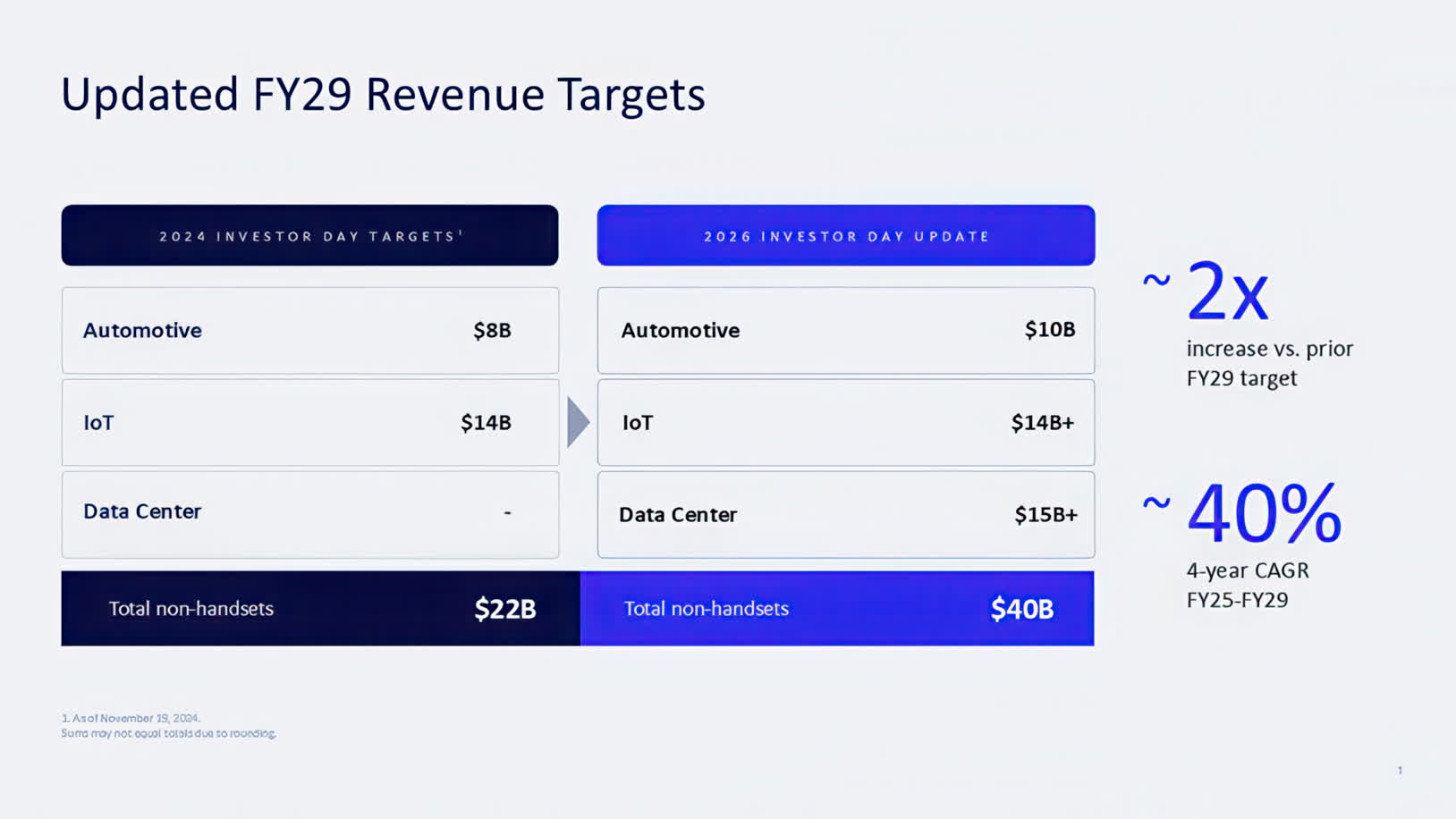
Qualcomm fiscal 2029 targets for the QCT business
The company is also taking big steps in terms of its business model. The move into creating custom chip designs, in particular, is a very different approach to the more traditional "create your own product" practices it's followed in the past. It also puts Qualcomm in direct competition with companies like Broadcom and Marvell (as well as their connectivity competitor MediaTek).
The recently acquired AlphaWave has had a custom ASIC division for several years now, but by incorporating Qualcomm's IP along with the unique technologies that AlphaWave brings to the table, they suddenly present an intriguing alternative to the likes of Broadcom and Marvell. And while they couldn't name specific partners, Qualcomm did say that they have two major hyperscalers as customers of these custom silicon efforts, each of which is expected to deliver over a $1 billion in revenue in the company's fiscal year 2027, which starts in just three months.
Technologically, the company is also expanding its portfolio of capabilities as part of this announcement. While it's always been seen as a leader in connectivity technologies, most of its efforts have been around wireless, such as cellular and WiFi. The new high-speed wired options leveraging AlphaWave's SerDes expertise enable the company to get into the heart of today's most powerful AI-focused computing racks.

In addition, the company's new HBC architecture that's part of their A250 and A300 AI accelerators and an option for their upcoming C1000 CPU design provides a unique way to do high-speed AI inferencing workloads that can leverage lower-cost DRAM instead of very pricey HBM memory.
By using a variety of interesting new packaging and design advancements, this new home-grown technology should allow Qualcomm to offer some intriguing new options not only for datacenter applications, but potentially automotive, computing and even future handsets as well. How the company executes on this approach remains to be seen, but it certainly represents a bold new way of tackling the problem and early interest from the major hyperscalers and automotive customers suggests they could be on to something.
In addition to hardware, the company also made two software-related announcements. First, they detailed the acquisition of Modular, an AI software platform company that's creating a suite of open-source tools that allow AI applications to be run across a heterogeneous group of different AI accelerators.
In other words, software originally written in Cuda for Nvidia GPUs can be quickly enabled to run on Qualcomm NPUs, AMD GPUs or other architectures. This is a hugely interesting opportunity that could help enable a much more diverse set of AI accelerator silicon options.
In addition, the company announced a deal with Hugging Face that helps bring some of the silicon agnostic benefits of the Modular software to AI models and applications being created through the library of AI models and applications available via Hugging Face. Even more importantly, the Modular software leaders claimed that they could even offer better performance on certain types of silicon when switching to their platform versus running native on a given silicon providers software (such as AMD's ROCm and Google's XLA).
Qualcomm CEO Cristiano Amon has made it clear over the last few years that he has had a big, broad vision for the company and with these latest developments in AI infrastructure, he's put in the last few pieces needed to help bring that vision to life. Of course, as with any move like this, the real question will be how he and the rest of the company can execute on that vision.
Delivering the capabilities they've promised in the timelines they've discussed is a non-trivial matter, even for a company with the proven track record that Qualcomm has earned over the last few decades. At the same time, the company needs to clarify exactly how its new datacenter solutions can be delivered both to companies looking to employ entire Qualcomm Dragonfly rack solutions as well as those who may want to integrate only certain elements of Qualcomm's new offerings into their existing environments. Over time, this is something the company will undoubtedly tackle, but there's still some work to be done.
At a higher level, it makes a great deal of sense for Qualcomm to diversify its offerings across the many industries they are now targeting. At a time when core technologies can help enable new experiences across a wide range of consumer and commercial devices, Qualcomm's growing portfolio of these core capabilities should be leverageable advantage from which the company can benefit.
In an age of agentic AI that's going to run across hybrid AI architectures that span from device to enterprise to cloud and beyond, having technologies that can work across these boundaries is going to be critical.
Bob O'Donnell is the founder and chief analyst of TECHnalysis Research, LLC a technology consulting firm that provides strategic consulting and market research services to the technology industry and professional financial community. You can follow him on X @bobodtech