Why it matters: Think Nvidia products are expensive in the United States? In China, one system is being sold for the equivalent of $1.1 million. But that's for the DGX B300 platform, which not only costs around $400,000 in the US but is also banned in the country. It's those increasingly tight export restrictions that are pushing up prices for AI hardware on China's black market.
The US has restricted the export of Nvidia's most powerful AI chips to China since 2022 over fears that they could be used for military purposes.
However, as is always the case when trying to keep something out of the hands of people who desperately want it, the ban has created a thriving underground trade.
According to the Financial Times, citing interviews with multiple Chinese chip traders, the price of Nvidia's flagship DGX B300 server has climbed to more than 8 million yuan, or about $1.1 million. It had previously been selling for around 4 million yuan, which was still an inflated $589,000.
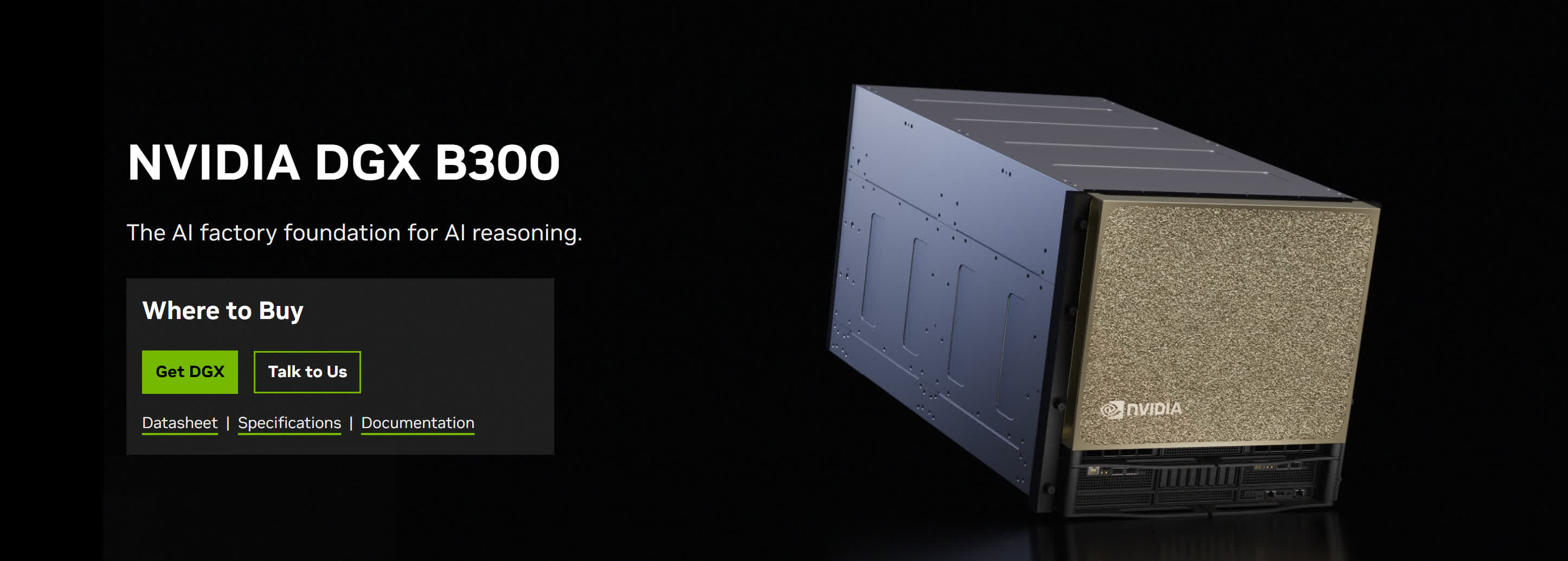
There's a reason the DGX B300 carries a high price even in the US. The system contains eight Blackwell GPUs, making it exactly the sort of hardware Washington doesn't want Chinese companies using.
It's not just data center systems enjoying these obscene markups. The RTX 6000 Pro workstation card has reportedly risen from around 50,000 yuan ($7,363) at the start of the year to as much as 130,000 yuan, or roughly $18,000. That card's 96GB of memory makes it especially attractive to AI startups.
In addition to the usual demand for Nvidia's hardware in China, the surge has been influenced by the US crackdown on the routes used to get it into the country.
Reuters reported in April that DGX B300 servers were already approaching $1 million in China as gray-market supply tightened. Nvidia said at the time that the B300 was restricted from sale in the country and warned that diverted systems would receive no service or support.
Washington has also been trying to close offshore loopholes. Commerce Department guidance clarified that licenses are still required when advanced computing items are sold to entities headquartered in restricted countries, or whose parent companies are based there, even if the buyer itself is elsewhere.
The irony is that China has also been pushing local firms away from Nvidia and toward domestic alternatives from the likes of Huawei, Alibaba, and MetaX. Beijing has urged companies to avoid Nvidia's H20, while the US later struck a deal requiring Nvidia and AMD to give Washington a cut of certain AI chip sales to China.