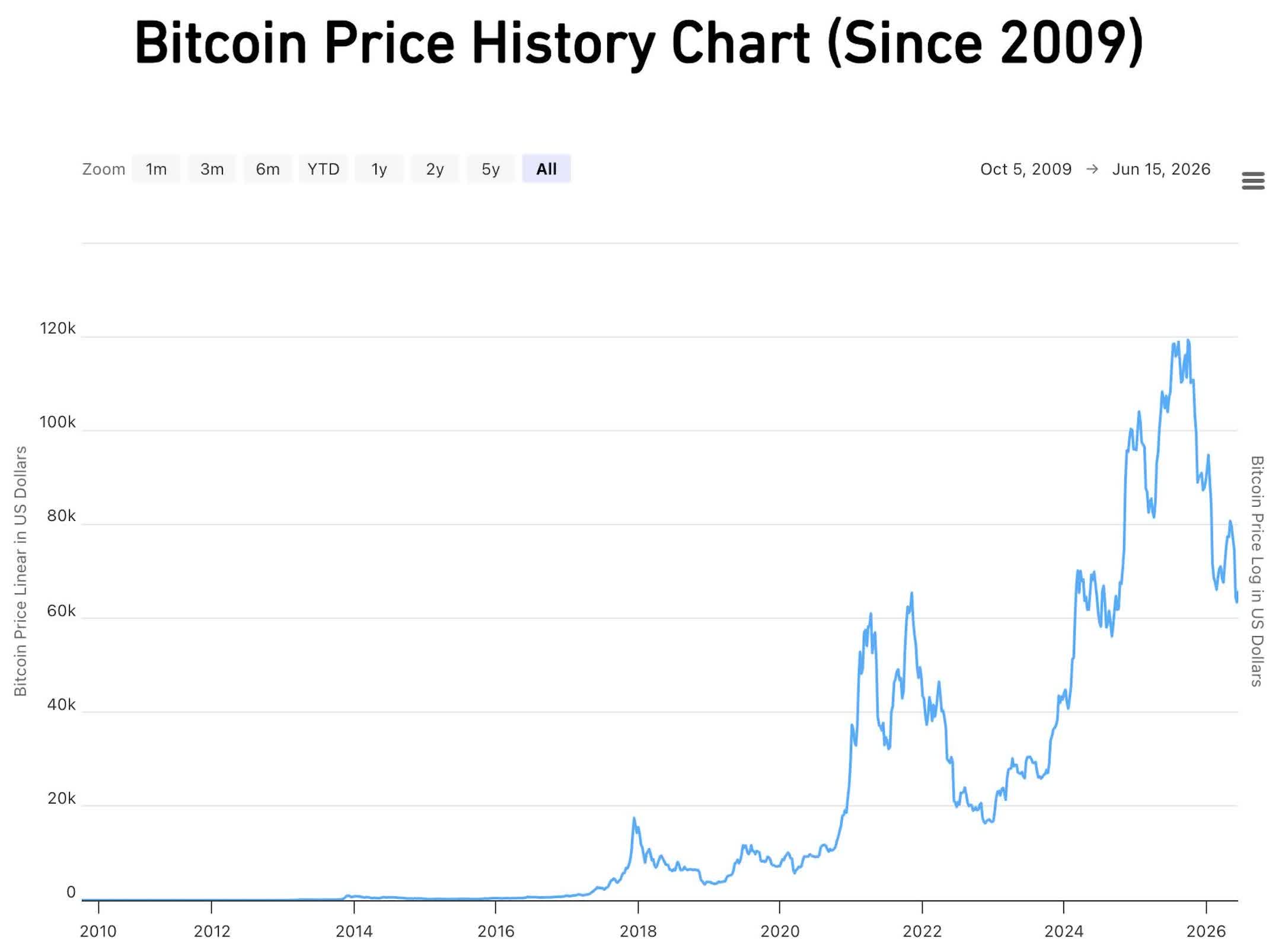
Bottom line: After climbing above $123,000 in July 2025, bitcoin has fallen to around $66,475, giving back nearly half its value. The decline hasn't occurred in a vacuum. The Nasdaq Composite has also slipped, and gold has retreated from its highs as well. Taken together, the moves suggest investors are reassessing risk rather than reacting to something unique to crypto. Daniel Sotiroff, associate director of ETF and Passive Strategies Research at Morningstar, doesn't see the decline as a sign of a structural shift. "I think a lot of this is crypto being crypto," he told CNBC.
It's another reminder that volatility is inherent to this asset. Some investors are taking profits after bitcoin's recent run-up. Others are concerned that interest rates may remain high, which tends to weigh on speculative investments. At the same time, capital is flowing into other high-growth themes, with artificial intelligence emerging as a major competitor for investor attention and dollars.
That rotation speaks to a broader issue: bitcoin's role in a modern portfolio remains unsettled. Backers often describe it as a portfolio diversifier, arguing that it behaves differently from stocks, bonds, and other traditional assets. "I've heard it referred to as a diversifier. That seems to be the strongest argument," Sotiroff says.
The idea has some intuitive appeal. Supporters argue that bitcoin behaves differently from traditional assets, which in theory should help cushion a portfolio when other holdings come under pressure. But the data has not always supported that claim. Bitcoin has often moved in tandem with other risk assets rather than offsetting their losses.
Arguments that bitcoin can reliably store value or hedge against inflation remain more controversial. Sotiroff points out that its price volatility makes those roles difficult to defend, especially when more established options, such as Treasury Inflation-Protected Securities, are readily available.
The recent downturn is prompting some investors to reassess their assumptions. "You just really can't make a call on what direction it's going to go," Sotiroff says.
Credit: Bitbo
That uncertainty is why many financial advisors continue to view bitcoin as a limited allocation rather than a core holding. Andrew Herzog, a certified financial planner with The Watchman Group, suggests that limiting exposure to between 1% and 5% of a portfolio strikes a balance between risk and potential upside.
That range aligns with what many other planners recommend, even as access to bitcoin has expanded through spot ETFs launched in 2024. Easier access has not reduced volatility. If anything, it has reinforced the need for discipline in how the asset is used.
"We're talking about low single digit percentage points," Sotiroff says. "If you went beyond that, you start to see increases in volatility in your portfolio."
For some investors, those swings are part of the appeal. The expectation of long-term gains can outweigh short-term losses, but that mindset tends to distinguish investors with a clear strategy from those chasing momentum.
"What a selloff actually does is reveal which investors had a plan and which were riding momentum," says Matt Chancey, a CFP at Tax Alpha Companies. "If you owned bitcoin because it was going up, the case is broken, but the case was never sound."
Skeptics, however, continue to question whether bitcoin belongs in an investment portfolio at all. Unlike stocks, bonds, or real estate, it does not generate income or cash flow, making it difficult to value using traditional investment metrics.
"You cannot invest in Bitcoin, you can only speculate," says Robert Johnson, a finance professor at Creighton University.
Even those more open to crypto acknowledge that limitation. "The best analogy I've heard is that it's more like a collectible, because it's basically worth what other people are going to pay for it," Sotiroff says.
For now, bitcoin remains caught between competing narratives. Some investors treat it as a long-term holding, while others see it as a speculative trade, with sentiment driving much of its price movement. As investors weigh opportunities across emerging technologies, including AI, bitcoin's role may continue to evolve, but its volatility is unlikely to fade anytime soon.