What just happened? Nvidia has used Computex 2026 to announce DLSS 4.5 Ray Reconstruction, an updated version of its AI denoising technology built around a second-generation transformer model. The feature is coming in August and will be available to all GeForce RTX GPUs through the Nvidia app.
Ray Reconstruction is designed to replace the hand-tuned denoisers traditionally used in ray-traced and path-traced games.
Instead of relying on separate, developer-adjusted filters to clean up noisy lighting, reflections, and shadows, Nvidia's model combines denoising and Super Resolution into one neural network that analyzes temporal and spatial data from the game engine to reconstruct the final image.
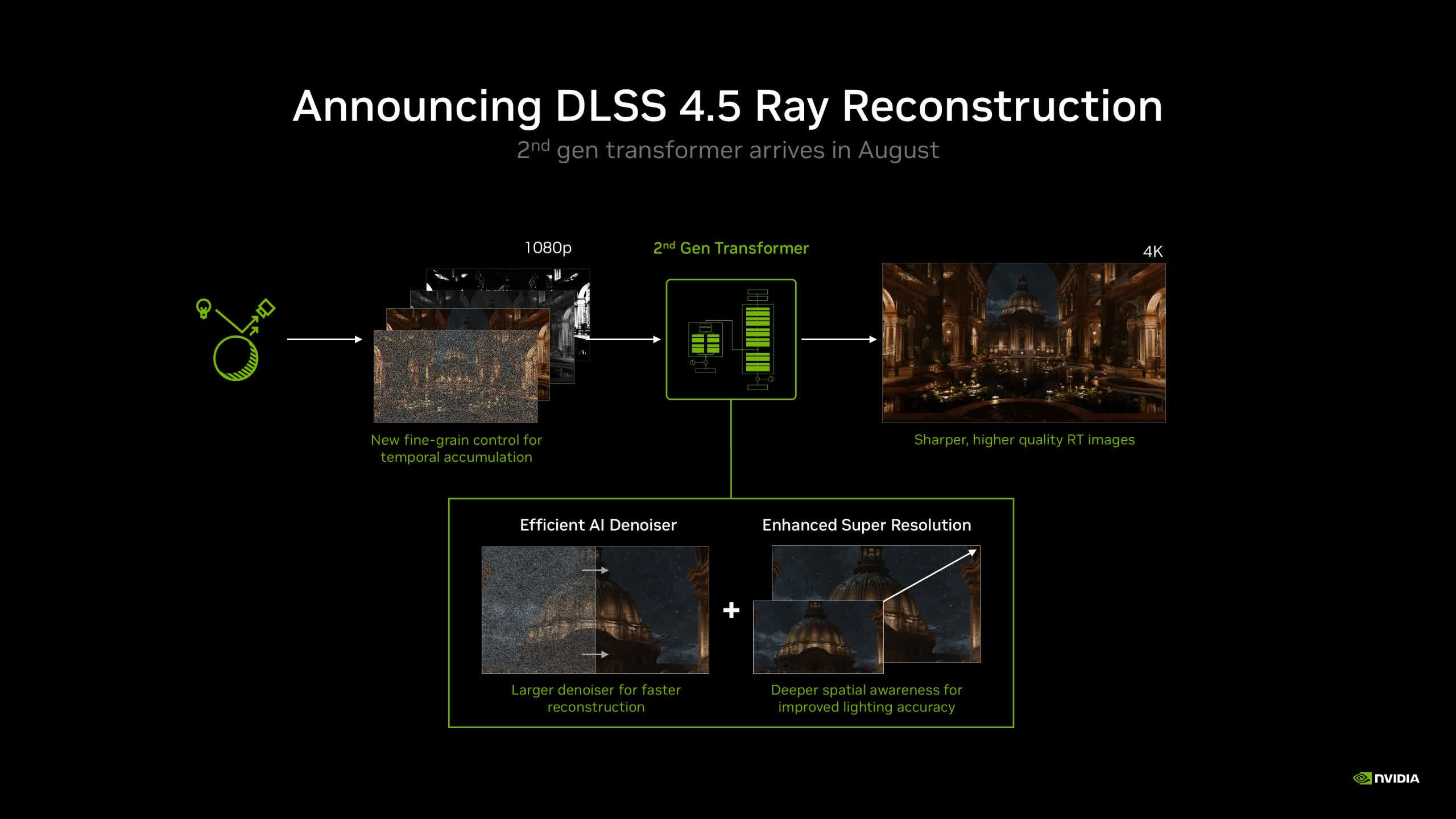
The company says the new model delivers 35% more compute capability and processes 20% more parameters while maintaining similar performance to the previous version.
It's also been trained on a larger dataset, which Nvidia says helps it choose the right engine data more accurately and produce lighting closer to ground truth. Developers also get finer control over temporal accumulation.
Nvidia is promising better lighting accuracy, improved temporal stability, and clearer motion in ray-traced and path-traced content. The company showed examples including cleaner snow particles in Indiana Jones and the Great Circle, reduced residual laser artifacts in Pragmata, and sharper CRT static in Alan Wake 2.
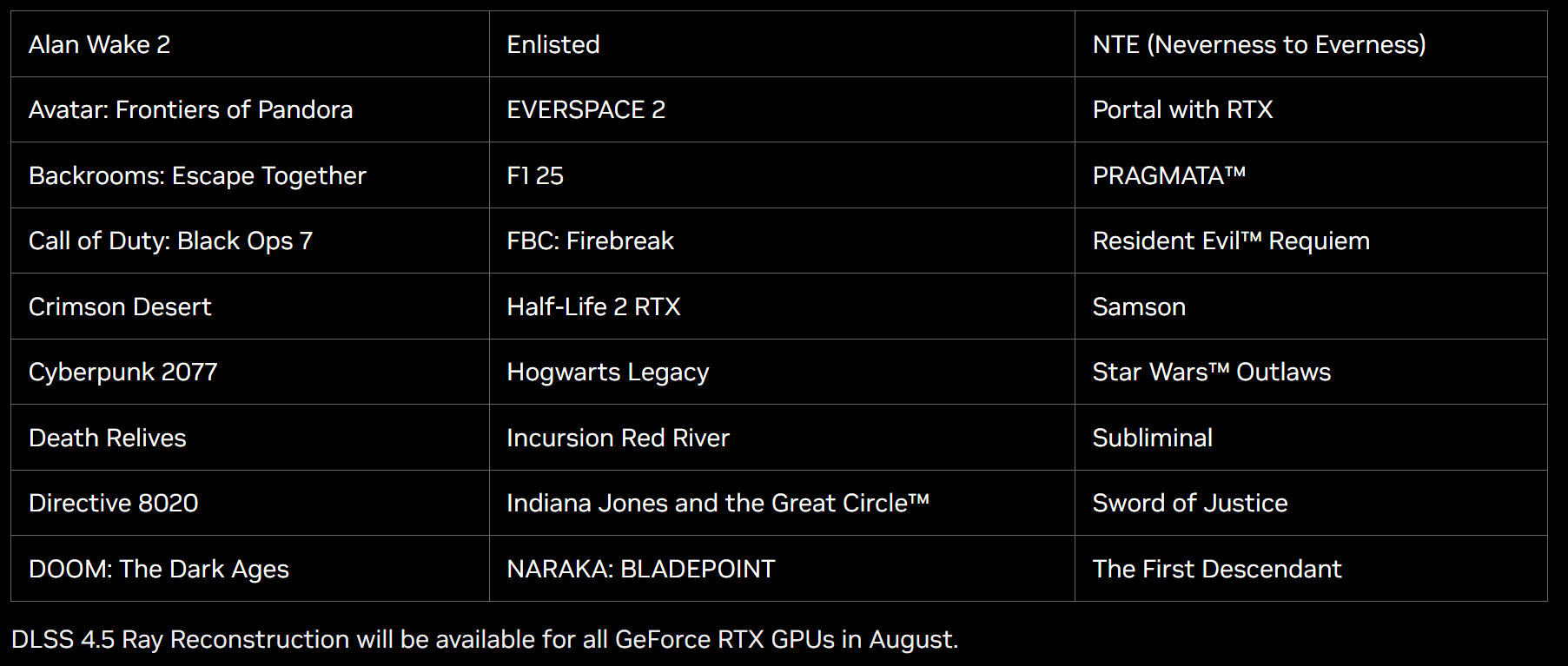
DLSS 4.5 Ray Reconstruction will work in 27 games at launch (below), including Cyberpunk 2077, Alan Wake 2, Hogwarts Legacy, Star Wars Outlaws, Doom: The Dark Ages, Indiana Jones and the Great Circle, and Portal with RTX.
Nvidia also confirmed that Blender Cycles is adding DLSS 4.5 Ray Reconstruction as a denoiser in Blender 5.3 this fall, aimed at giving artists a more interactive near-final viewport preview.
The announcement comes as Nvidia says there are now more than 1,000 RTX games and apps.
There was no talk at Computex about the controversial next-generation DLSS 5. Few reveals have proven as disliked as the when Team Green showed off the latest version of its technology at GTC 2026. Nvidia said it's designed to sit on top of existing assets, taking a 2D frame plus motion vectors and inferring more photorealistic lighting and materials in real time. But most people think it just makes games look like AI-generated slop.
As we recently argued in our Was Ray Tracing a Scam? feature, RT has often been more about marketing than real-world usefulness. DLSS 4.5 Ray Reconstruction looks like another meaningful step toward making ray tracing more convincing, but there's still the question of whether it makes a game look better enough to justify the performance hit.