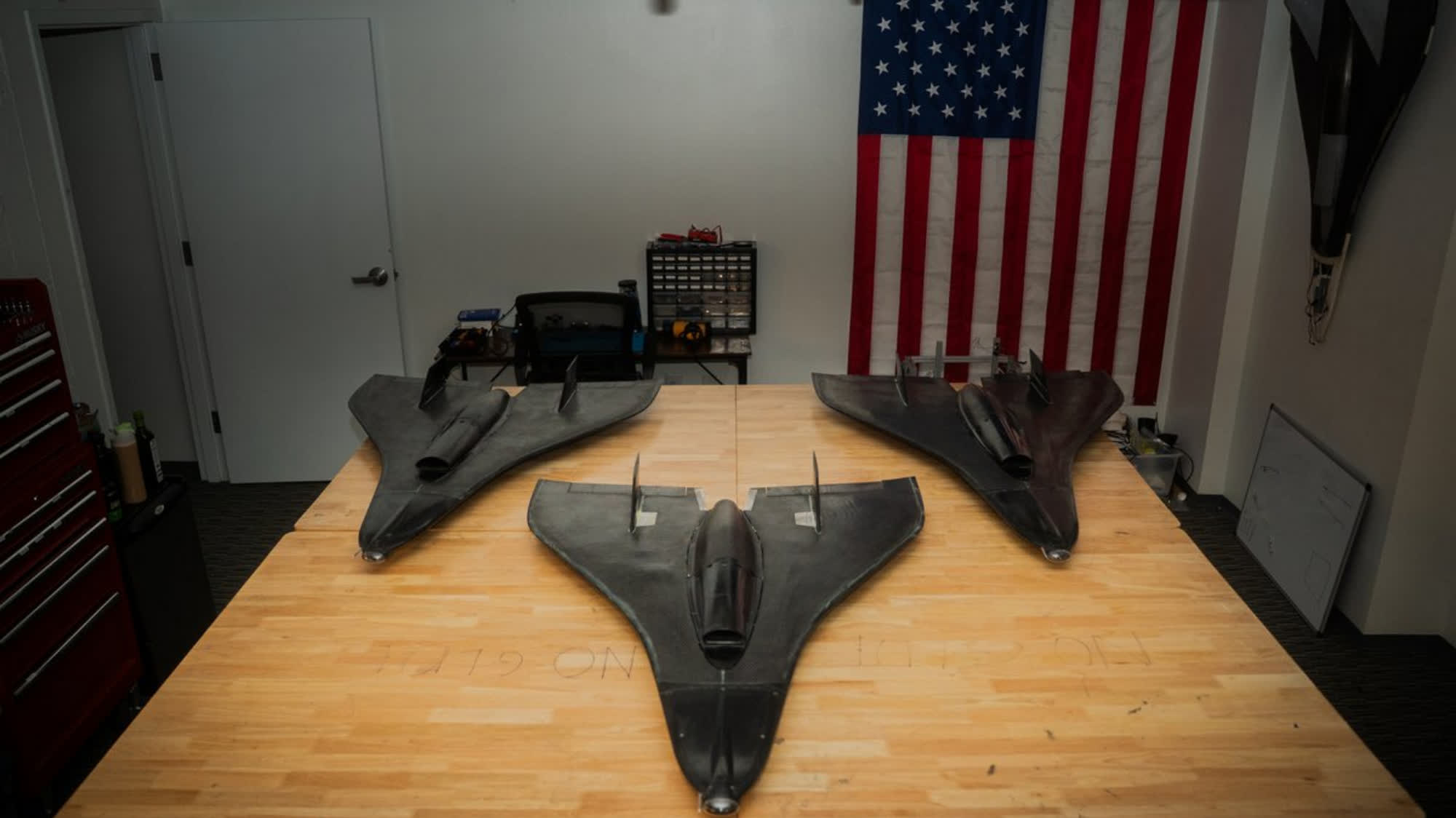
In brief: An aerospace engineering student at Georgia Tech claims to have broken the world record for the fastest jet-powered remote-controlled aircraft. Tomas Salvo, the creator of the "Reaper" drone, says it reached 491 mph while carrying a 2.6-pound payload, smashing the previous 465 mph record set in 2017 by a model aircraft called "Inferno," designed by German pilot Niels Herbrich.
Salvo said that the Reaper project was conceived, designed, and assembled in his college dorm room, and that he has been working on it since last February. He claims to have built three working prototypes, each capable of sustaining the claimed 491 mph (790 km/h) speed for four minutes on a full tank. He added that he hopes to win the $800,000 Boom Prize with the Reaper.
– Tomas Salvo (@tomas_salvo22) October 30, 2026
According to Salvo, the Reaper prototypes feature custom-molded carbon-fiber shells, laser-cut internal components, and 250 N turbojet engines with custom air intakes and 3D-printed titanium nozzles. The drones can be launched from rails or a truck and can climb to 6,600 ft (2,000 m) in under 20 seconds. He added that they can cover 31 miles (50 km) at full speed.
Salvo, who first announced the Reaper project in July, says it has proven to be "a reliable and repeatable system," delivering very similar results in every test. He expects further testing and optimization to push its top speed beyond 500 mph (800 km/h). He also revealed that the entire project cost around $13,000 – a considerable sum for a college student working on a hobby project.
The Boom Prize offers $750,000 in cash and $50,000 worth of Boom Supersonic stock to the first amateur team or individual to fly a remote-controlled aircraft faster than Mach 1 (the speed of sound) for at least five seconds and land it safely. The feat must be repeated twice using the same aircraft in a single day for an entry to qualify for the prize.
The competition, announced earlier this year by Boom CEO Blake Scholl, is restricted to amateur hobbyists who are not funded through corporate sponsorships or venture capital. Projects associated with aerospace companies or led by professional aerospace engineers are also ineligible. Only US citizens, lawful permanent residents, and individuals granted legal asylum are eligible for the award.
To qualify, an aircraft must have a fixed-wing design and use air-breathing propulsion, such as a turbojet, turbofan, or ramjet engine. Rockets, onboard oxidizers, and expendable vehicles are prohibited. Entries will be evaluated by a panel of judges that includes former Boeing CEO Phil Condit, SpaceX co-founder Tom Mueller, and astrophysicist Scott Manley. The competition will remain open through 2030.