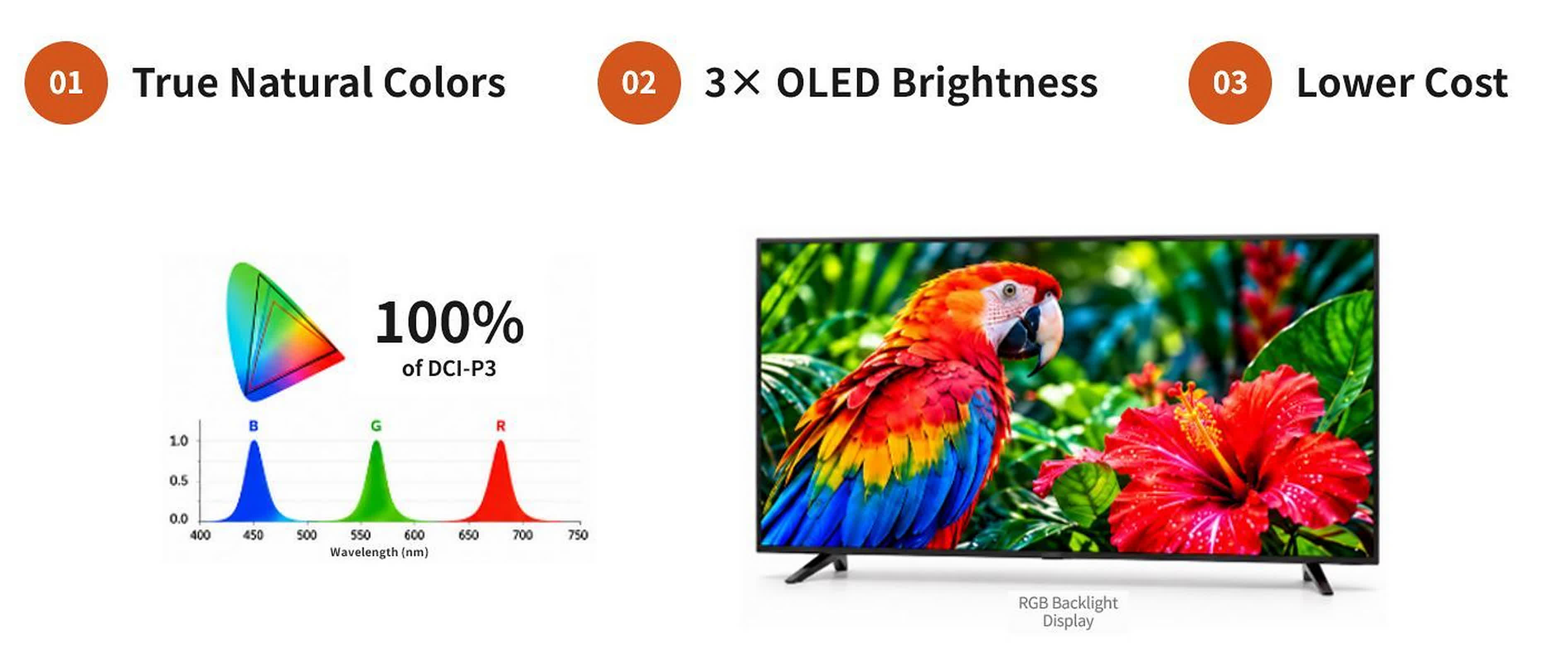
First look: A television's backlight usually starts as white light that a color filter then splits into red, green, and blue. Seoul Semiconductor wants to drop that step by placing individual red, green, and blue chips behind a standard LCD panel, spaced only tens of micrometers apart. The company says the approach, called WICOP Pixel, covers 100% of the DCI-P3 color gamut used in digital cinema, reaches peak brightness of up to 3,000 nits, and has now entered mass production.
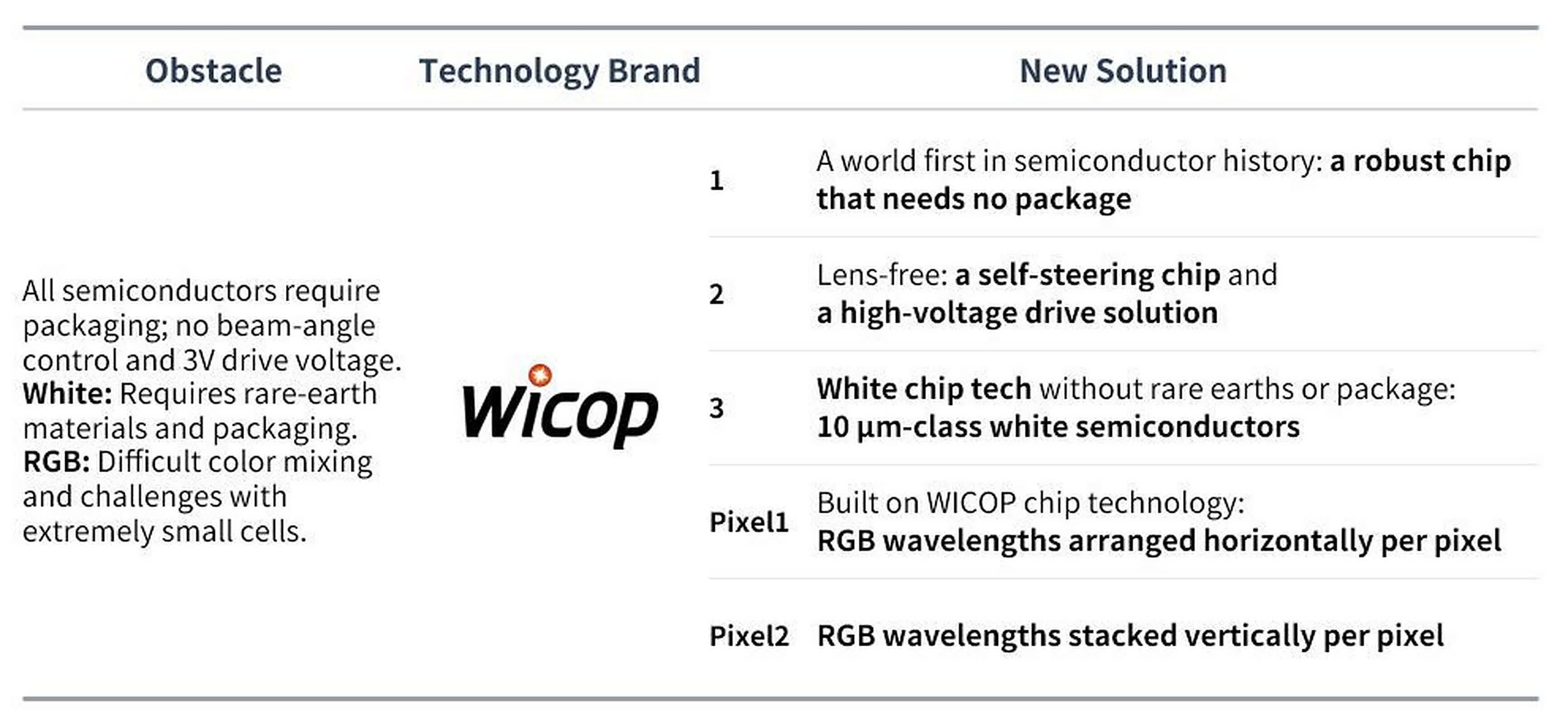
The design comes from Seoul Viosys, a Seoul Semiconductor subsidiary. Its WICOP technology removes the conventional package, the housing that normally surrounds an LED die. The chip structure is robust enough to be handled like an ordinary electronic component. The technique was first applied to blue opto-semiconductors and has since been extended to green, red, and ultraviolet wavelengths.
WICOP Pixel combines several of those wavelengths in a single pixel unit. Each color is controlled independently and mixed precisely. The company says this reproduces tens of thousands of natural colors efficiently and vividly.
The performance claims are aimed squarely at OLED, which has long been the reference for premium picture quality. Seoul Semiconductor says peak brightness of up to 3,000 nits is more than three times what OLED delivers, and that the design lasts more than twice as long. Brightness matters most in rooms with a lot of ambient light, and the company points to living rooms and public spaces as the settings where the gap shows. It says the result is sharp images even in bright indoor and outdoor environments.
DCI-P3 is a color gamut developed for digital cinema. Hitting 100% means a display can reproduce the entire range. The company says that coverage gives richer, more vivid color than OLED. The release also lists BT.2020, the ITU's standard for ultra-high-definition video, among its reference standards, though it gives no coverage figure for it.
None of these numbers come from independent testing. They are the manufacturer's own specifications, and real-world results will depend on how TV makers tune panels, local dimming, and image processing around the new light source.
Because the light source sits behind an ordinary LCD, the design keeps TV makers on familiar panel supply chains. Seoul Semiconductor argues this raises product value and profitability for manufacturers and reduces their dependence on expensive LCD panels. It also frames the technology as a draw for home-theater sets.
The company is also researching the removal of the color filter, which accounts for about 20% of LCD panel material costs. That follows from the design itself: if the backlight already produces pure red, green, and blue, a filter that carves colors out of white light becomes less necessary. The company describes this as research, not a shipping feature.
Seoul Semiconductor says it has begun expanding supply to global TV manufacturers. Its display-related revenue in the third quarter rose nearly 20% year over year. Rather than commit to significant new capital spending, it plans to convert existing white-backlight capacity to WICOP Pixel production.
A patent licensing program is also part of the plan. The company expects royalties to boost revenue and profit while keeping customer supply stable. It says it will channel that income into research and development in biotechnology, 3D printing, AR, and AI data communications.
Market research firm Omdia says the shift to RGB backlights is accelerating. It expects global RGB TV shipments, led by large-screen premium models, to reach about 7 million units by 2030, representing more than 10% of global TV market revenue. The white-backlight market is about $3 billion today. Seoul Semiconductor says the market is expected to more than double as it shifts to RGB with the adoption of advanced packaging technology.
Industry watchers will want to see which TV brands adopt the chips, how the sets compare with OLED in independent tests, and whether color-filter removal makes it from the lab into commercial products. The licensing strategy also warrants attention, since it positions the company as both a component supplier and a patent holder in a segment that Omdia expects to grow quickly.