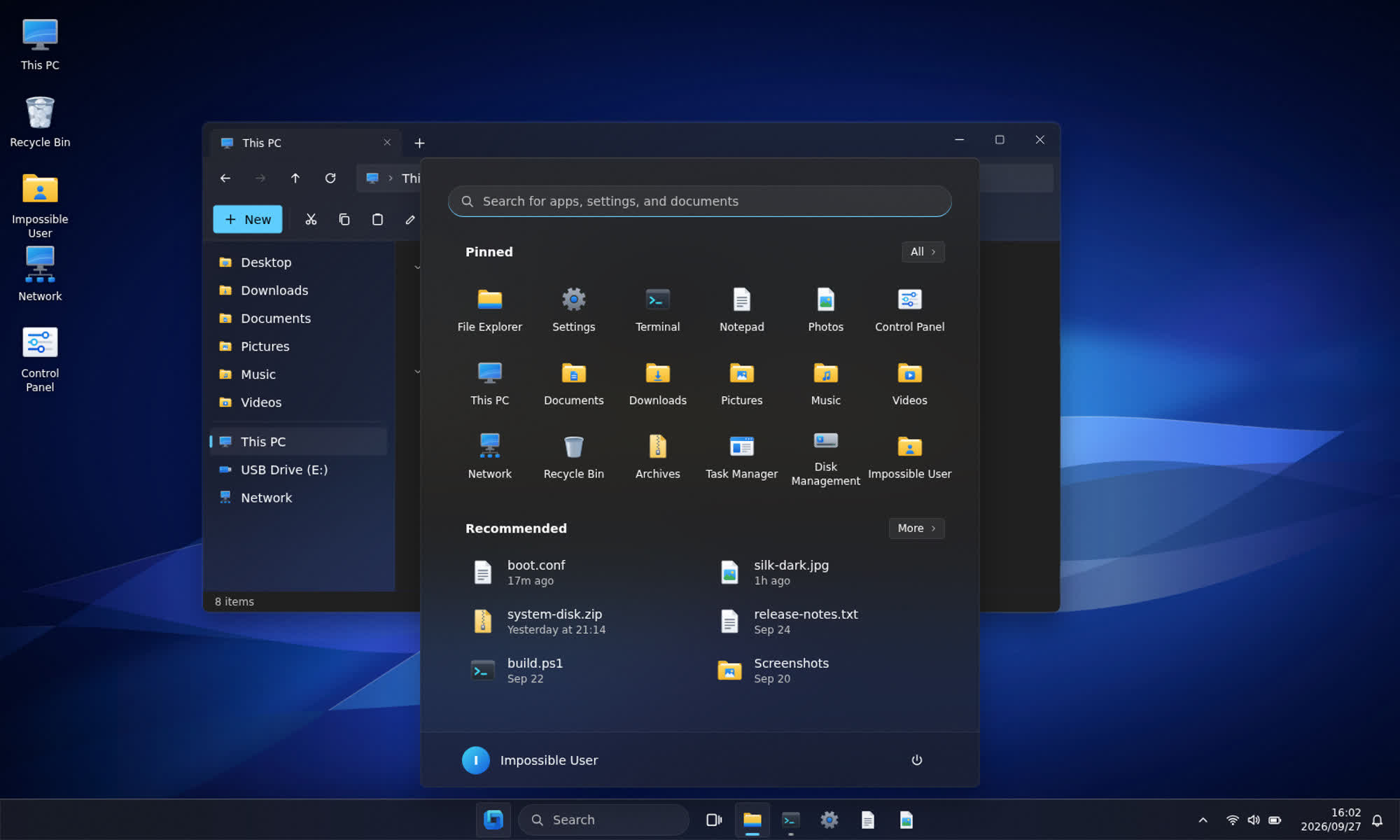
Vibe-OS: Building a new operating system from the ground up using modern software principles is no easy feat, but that's not stopping a South African company from attempting just that with its ambitious "Impossible OS" project. The first public release is expected within two years.
Writing a new, custom operating system from scratch is difficult enough for an experienced team, but Derick Payne is attempting to do it all by himself. The South African developer and entrepreneur recently unveiled Impossible OS, a modern PC (x86-64) operating system inspired by Windows 11 and built using "100%" open-source code.
According to its official manifesto, the new OS aims to provide native compatibility with software written for the Win32 API, along with support for Linux binaries. Payne says the OS is not just another Linux distro, as it includes its own fundamental components, such as a ring-0 kernel, UEFI bootloader, desktop GUI, and more.
Win32 compatibility is achieved through the kernel's native API, while Linux ELF binaries will be supported through a built-in compatibility layer. Impossible OS will feature an original codebase written in C and x86-64 assembly. Mature open-source libraries will be adapted at times when rewriting them from scratch would be impractical.
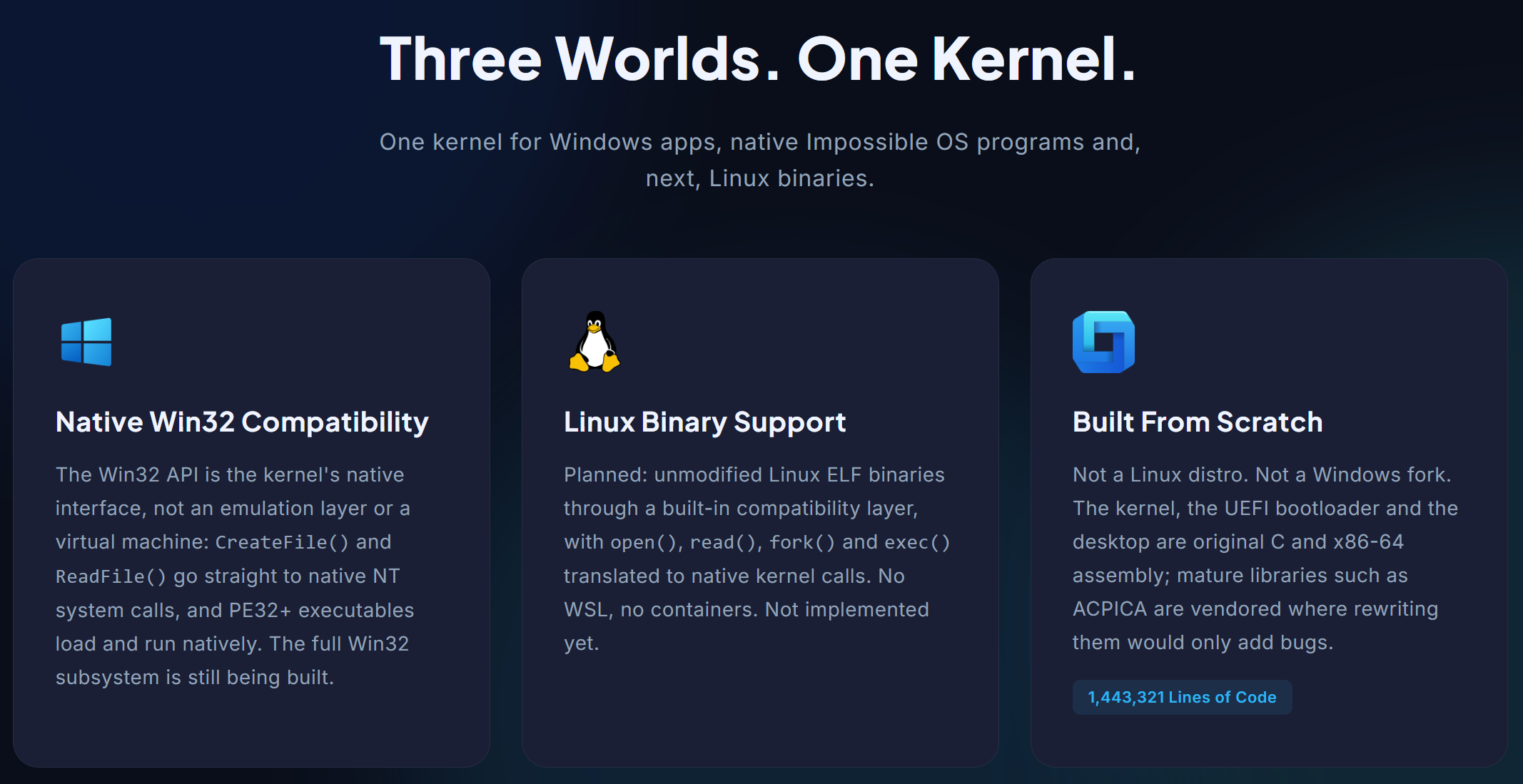
Impossible OS currently contains 1,443,321 lines of code, but it is unlikely to be ready for prime time on a live hardware configuration anytime soon. Payne says the first public alpha release is scheduled for August 8, 2028, although the system already appears capable of booting on physical hardware and displaying a desktop environment.
Payne acknowledges that a solo developer is unlikely to outperform an entire corporate engineering team anytime soon, but he decided to take on the challenge anyway. Making good software takes time, while "impossible" software takes just a little longer.
He also warns that the project will be finished "sometime between next month and the end of time."
Jokes aside, low-level programming and operating system development remain enormous challenges, even for multibillion-dollar corporations such as Microsoft and Apple. The much smaller ReactOS team has been working on a Windows-compatible operating system for almost 30 years, yet it is still tackling fundamental OS functionality, including disk partitioning and standardized hardware support.
Impossible OS doesn't show the usual signs of a vibe-coded software repo, but Payne's portfolio does not include a massive showcase of never-before seen software achievements either. His company, Rizonesoft, previously worked on DVD and CD-related utilities, a Windows Notepad clone, and a custom productivity suite named Rizonesoft Office.