
AI Gold Rush: SK Hynix's latest quarterly results confirm a familiar trend across the semiconductor supply chain. AI data center projects are putting enormous pressure on manufacturers' ability to meet demand, and end customers are likely to face unprecedented shortages for years to come.
SK Hynix recently published its financial results for the third quarter of 2026. Beyond the rosy numbers fueled by surging demand for memory chips, the South Korean semiconductor manufacturer also outlined where it expects the market to go over the next few years. Big spoiler: demand for AI-related products isn't going anywhere anytime soon, which means the ongoing DRAM shortage could persist for years.
SK Hynix said that the third quarter of its financial year ended with 104.6155 trillion won ($78 billion) in revenue, 83.3338 trillion won ($63 billion) in operating profit, and 39.7756 trillion won ($30 billion) in net profit. Revenue and operating profit rose by 32% and 38%, respectively, compared with the previous quarter.
These unprecedented results were largely driven by a massive increase in sales of server DDR5 memory chips, while shipments of newer HBM4 chips have only just begun. NAND sales for SSDs are also expanding, while higher-margin data center products continue to grow across the board. For the first time in its history, SK Hynix surpassed 100 trillion won in quarterly revenue in Q3 2026.
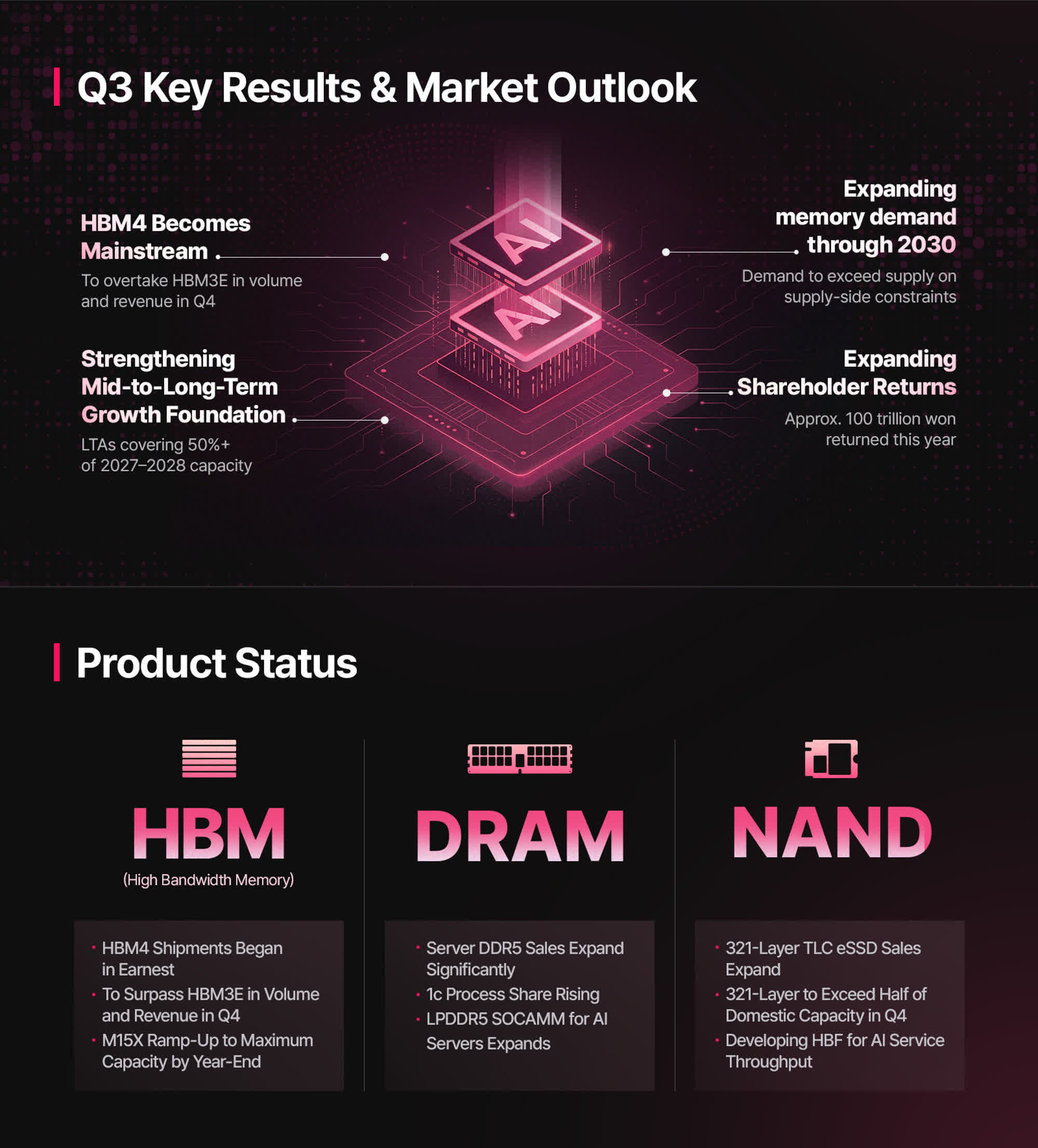
The Korean manufacturer, one of the memory industry's "Big Three," described the ongoing memory crisis as a "virtuous" cycle for its business. SK Hynix expects the growing adoption of generative AI, chatbots, and other technologies based on large language models to drive further investment in infrastructure and additional memory products.
"The company likewise expects the memory market to sustain its growth, led in the short term by enterprise and personal AI and, over the mid-to-long term, by physical AI such as autonomous driving and robotics," SK Hynix added.
Despite the backlash against data center projects in the US and elsewhere in the world, SK Hynix said new infrastructure projects are putting further pressure on manufacturers' ability to meet demand for memory chips. Supply is failing to keep pace with the market's rapid growth, and SK Hynix now expects demand to exceed supply "through 2030."
The Korean giant is planning to "accelerate" the expansion of its manufacturing capacity. SK Hynix is building new chip plants in its homeland and the US, although it will likely take years for these new facilities to come online. In the meantime, customers will just have to "enjoy" their DDR5 shortage for a few more years, the company suggests.