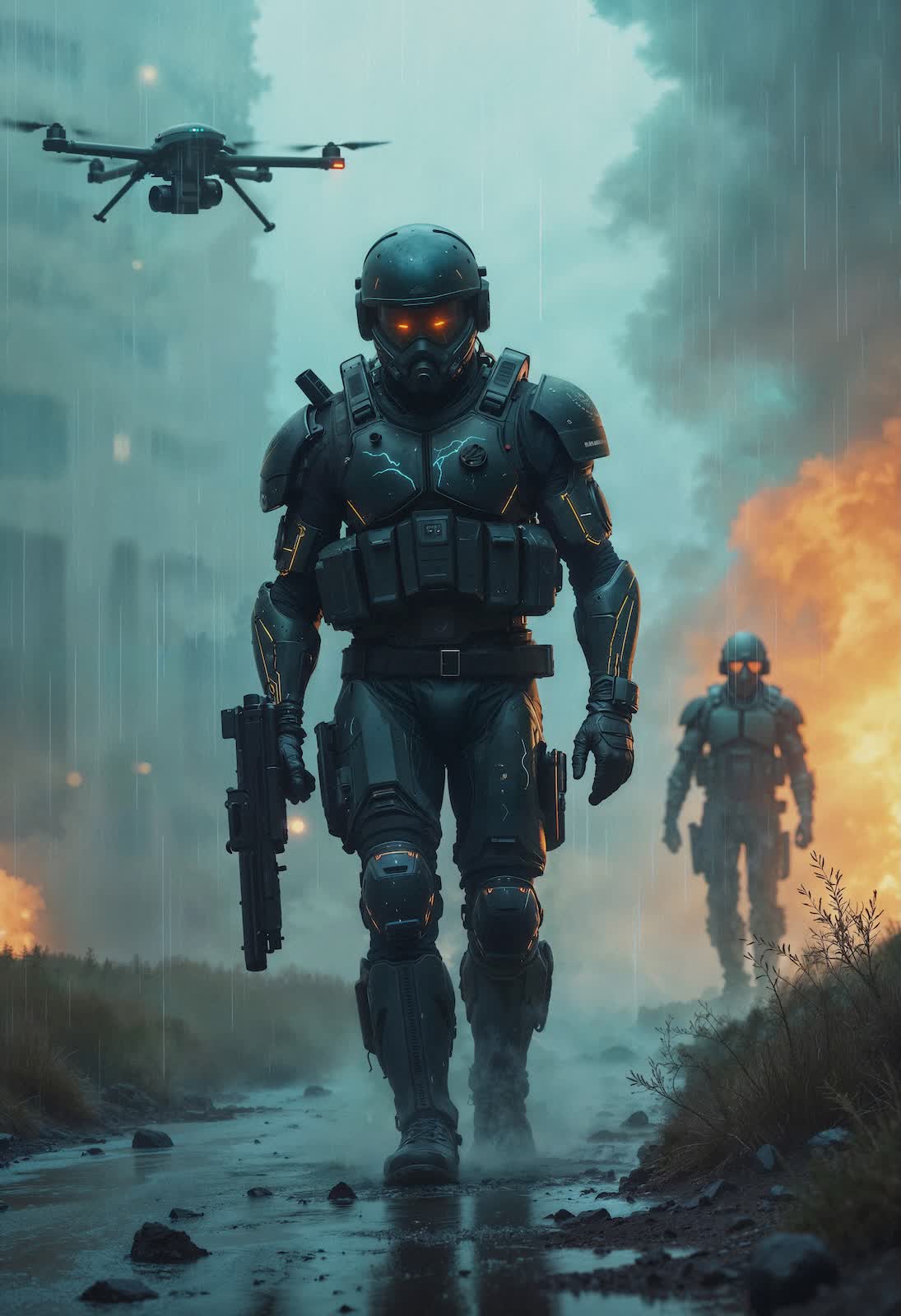
Looking ahead: AI could begin directing networks of battlefield sensors and weapons by 2030, according to retired US Gen. David Petraeus, who expects military use of the technology to expand from analyzing data to making decisions with little or no human input. The former CIA director's forecast centers on AI staff officers and autonomous command systems that could coordinate multiple machines. Rather than operating drones independently, militaries would connect them through a command network able to gather information and direct operations.
"Just four years from now, we will have autonomous systems, and I think we will have the beginning of autonomous systems of autonomous systems; we will have AI agents, so you'll have agentic AI staff officers," Petraeus told investor Finn Murphy on the Forecast2050 podcast.
Petraeus outlined how such a network could operate during a CNBC interview in May. Autonomous sensors would collect battlefield data and relay it to a central command system, which would then direct weapons with little or no human involvement.
That would give AI a broader role than controlling a single drone or sorting information for a human commander. The software would help run operations across groups of machines. Petraeus has previously said autonomous systems could soon work together in platoon- or battalion-sized units, sharing information and coordinating without human intervention.
He described the prospective AI staff officers as "generic artificial intelligence staff officers who will never sleep, never eat, never take a break."
Petraeus also cited recursive learning, in which an AI model uses its own data and processes to improve itself. He expects that capability to contribute to the changes ahead, although the account provided no details about how military systems would implement or test it.
Petraeus expects Ukraine to see increasing use of autonomous unmanned systems by the end of 2026. For drones, one immediate consequence would be a reduced need for pilots, allowing more aircraft to operate without a corresponding increase in personnel.
The US military's stated approach still leaves decisions about using weapons to human operators. Admiral Brad Cooper, the head of US Central Command, has confirmed that AI is being used to sift through large amounts of data, but has not detailed the applications.
Human operatives will "always make final decisions on what to shoot and what not to shoot, and when to shoot," Cooper said.
Petraeus said adopting autonomous warfare would also require changes within military institutions. He argued that the UK could be positioned to lead because it has a smaller force, a more centralized defense ministry and a budget with greater emphasis on unmanned systems, despite its smaller economy.
The US, he said, still lacks some of the institutional changes needed for the transition. His forecast leaves militaries facing two tasks: building systems that can coordinate battlefield operations and deciding how much authority to give them.