The takeaway: Private conversations with AI chatbots are increasingly being used in court cases, creating a new source of evidence for police, prosecutors, and civil litigants. These records can expose a user's intentions, private thoughts, and sensitive disclosures, yet they generally receive none of the legal confidentiality protections afforded to conversations with lawyers, doctors, or therapists.
ChatGPT and similar tools are often used for personal questions, legal worries, health concerns, and emotional support. Those conversations can feel private, but they may be accessible through a phone search, a subpoena, discovery in a lawsuit, or a report by the AI company itself.
A review by The Washington Post found chatbot conversations cited in 12 public court cases over the past two years. The number is likely higher because much of the evidence collected during investigations and lawsuits never becomes public.
One case involved a teenager identified in court records as R.K.C., who sued Meta, Snap, TikTok, and YouTube in 2023. He alleged that their platforms contributed to social media addiction and mental health problems.
Defense lawyers obtained his ChatGPT history during the case. In one October 2024 conversation, R.K.C. asked the chatbot to explain a statement from his father about a possible settlement.
"My dad Said that I'm will get a settlement worth of 1million dollar," he wrote. "He said that If that doesn't make me happy what does. What does he mean."
R.K.C.'s lawyers settled with Snap, TikTok, and YouTube by late July. They also dropped the case against Meta, saying they were concerned about putting the teenager through a long trial. The companies denied his claims. Mike Morgan, a partner at Morgan & Morgan, said the ChatGPT messages did not affect the outcome of the case.
Morgan said young people may share more with a chatbot than they would with family members, friends, or therapists. "A fifteen-year-old may type things into a chatbot that he may not say to a therapist, a parent, or a friend, and he does it without realizing that it could end up in a defense expert's report," he said in a statement.
Chatbot records have also become part of criminal cases.
In Palm Beach County, Florida, OpenAI contacted the FBI after a ChatGPT user repeatedly described plans to harm an ex-girlfriend, according to a police affidavit. The FBI passed the information to local police, who identified the woman and found that the user, Darren Zhou, had sent her anonymous messages after their relationship ended.
Police said the ChatGPT conversations supported the credibility of the threats. Zhou was arrested in May and charged with stalking and making electronic threats. He pleaded guilty this month and was sentenced to eight years of probation.
OpenAI has said it uses software to detect conversations that may involve dangerous behavior. Those conversations can be reviewed by staff. If reviewers determine there is "an imminent and credible risk of harm to others," the company may contact law enforcement.
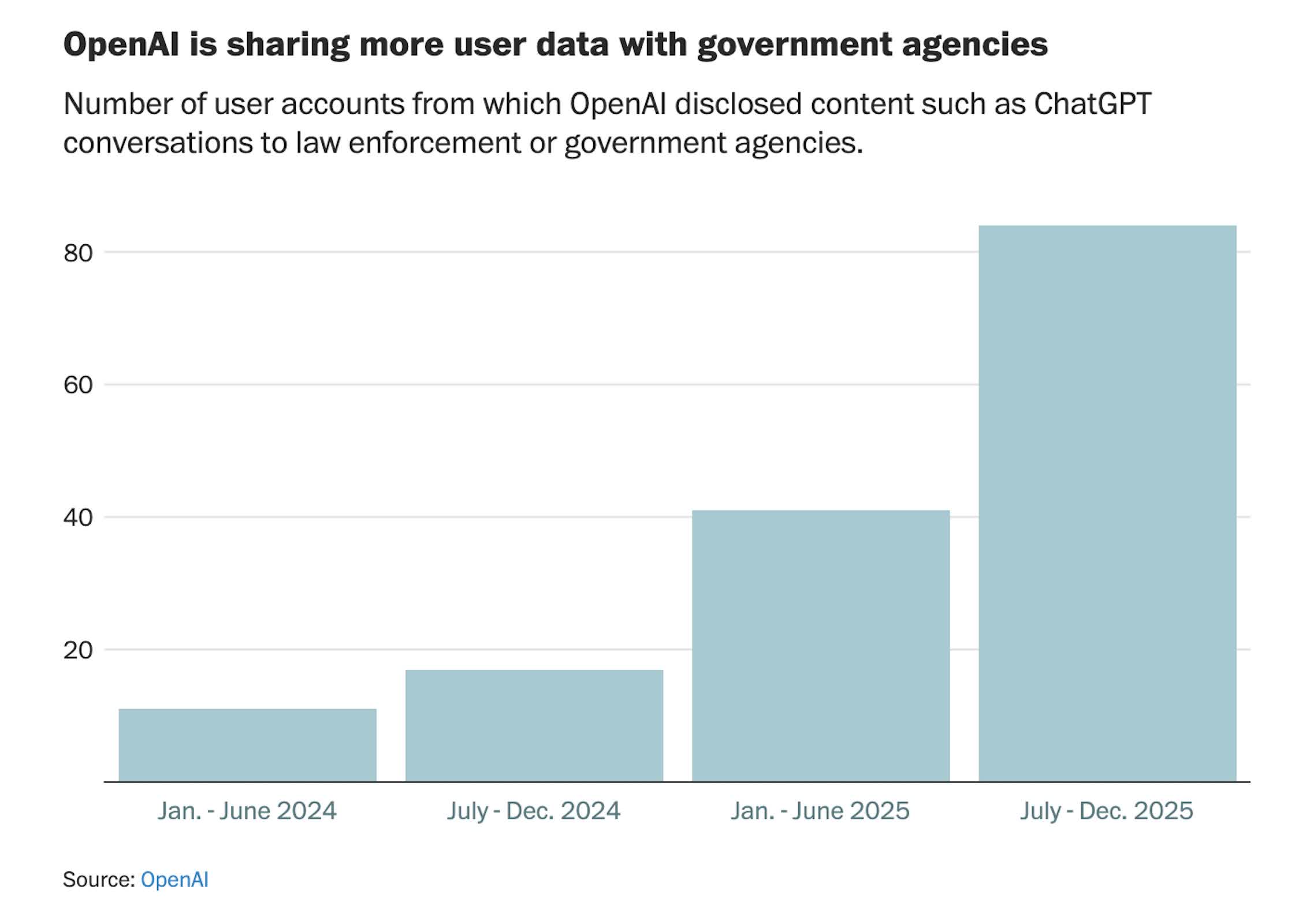
The company has not said how often it makes such reports. Its transparency data, however, shows a sharp increase in government and law-enforcement requests for user information. OpenAI disclosed data from more than 80 accounts during the second half of 2025, more than four times the total from the same period a year earlier.
In many cases, police do not need to obtain records from an AI company. They find the conversations on a person's phone.
Michael Price, litigation director of the Fourth Amendment Center at the National Association of Criminal Defense Lawyers, said people often agree to let officers search their phones. In most situations, people have the right to refuse a search unless police have a warrant.
"The short answer is that most people consent," Price told The Washington Post. "They shouldn't, but they do."
That happened in the case of Ryan Schaefer, a Missouri State University student accused of damaging 17 cars in a campus parking lot. According to police records, Schaefer agreed to let officers search his phone. They found ChatGPT messages he sent shortly after the alleged vandalism.
"How f----d am i bro," Schaefer wrote. "What if i smahsed the s--- oitta mutlipls cars."
He later wrote: "Is there any way they could know it was me."
Schaefer later pleaded guilty to felony property damage and was sentenced in July to five years of probation.
AI chats can also be pulled into civil lawsuits through the discovery process. In a Michigan employment case, a tire salesman's former employer alleged that he had taken customers after joining a rival company. The salesman had asked ChatGPT whether deleted Yahoo emails could still be retrieved, including through a court subpoena.
The employer argued that the messages showed he had tried to hide evidence. A judge later ordered him to pay an undetermined amount in attorneys' fees and allowed the lawsuit to continue.
Chatbot exchanges do not have the legal protections that apply to conversations with lawyers, doctors, or therapists. OpenAI CEO Sam Altman has said AI conversations should have stronger privacy protections because people increasingly use chatbots for sensitive matters. Courts have not recognized that type of privilege.
A federal judge in New York made that clear in a case involving financial executive Bradley Heppner. Heppner argued that prosecutors should not be allowed to review his conversations with Anthropic's Claude about potential fraud defenses. The judge ruled that the chats were not protected because Claude is not a lawyer and Heppner's attorneys had not told him to consult the chatbot.
Heppner was convicted in May of securities fraud, wire fraud, and other charges.
The issue may grow as AI tools take on more tasks for users and gain access to more personal data. Andrew Ferguson, a law professor at George Washington University who studies digital surveillance, said chatbot records may be only the beginning.
"Your entire world is going to now be available for police," Ferguson said.